
AI Test Engineer by BlinqIO
Playwright code + self-healing tests w/ no vendor lock-in
443 followers
Playwright code + self-healing tests w/ no vendor lock-in
443 followers
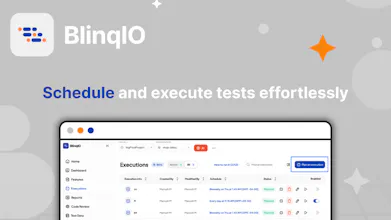
BlinqIO’s AI Test Engineer builds and maintains Playwright automation in minutes - generating real code in your repo, integrating with CI/CD, and self-healing when your app changes. No lock-in, just faster, stable, zero-touch testing.




This could save so much time for small teams without dedicated QA! The automated test generation sounds promising. Does it integrate with existing CI/CD pipelines, or does it work as a standalone tool?
@easytoolsdev BlinqIO works with existing CI/CD pipelines rather than replacing them. The AI generates real Playwright tests that live in your repo, so you can run them in GitHub Actions, Jenkins, GitLab, CircleCI, or whatever you already use. You can also run tests locally during development. So it is not a closed standalone system - it fits into your current workflow and tooling.
@easytoolsdev Yes. You can run it from your existing CI/CD pipelines. However, we recommend using the BlinqIO Cloud Execution platform included with your license, as it supports parallel execution, AI Recovery, Retrying failed tests, Videos, Traces, and more!
Does the AI recommend which tests should be prioritised based on risk or production usage data?
@hiya_chaplot1 We also have a new feature coming soon that will let you connect your Jira project to BlinqIO so that the AI Test engineer can suggest test cases for tickets that you select. This will be released in the next two weeks!
Wow, this looks amazing! BlinqIOs AI Test Engineer building Playwright code directly in my repo is a game changer. How well does the self-healing adapt to more complex UI changes, like refactoring a whole component?
@jaydev13 Thanks! The BlinqIO AI Test Engineer is extremely good at even complex UI changes that cause test failures!
One customer had a test that filled out a large transport order form with multiple sections in a single long page. Later, their product team refactored that flow into a multi-step form wizard, splitting each section into its own step.
And when the test failed, the AI Test Engineer understood that the test scope remained the same even if the UI structure had changed. The AI Recovery automatically generated new Playwright code and locators for the UI and recovered the test without any manual intervention!
@jaydev13 Thank you! We also belive it's a game changer.Appreciate your feedback.
From a QA workflow perspective, how does your vision about Vibe Testing change collaboration between developers, QA engineers and product managers over time?
@zerotox Good question! I think that, with Vibe testing, test maintenance, and deciding what to test/when to test/which tests to run, all of these critical tasks get much easier as AI becomes increasingly impactful. We at BlinqIO think the QA role will evolve into a supervisor role for multiple AI agents that do most of the hands-on work!
Congrats on a long-awaited launch, team @barmeir_tal @liat_niederman @rebecca_villalba @sapnesh_naik
Do tests run locally, or do they go through your cloud? Asking from a security perspective.
@barmeir_tal @liat_niederman @rebecca_villalba @kate_ramakaieva
You have full flexibility in determining where you want your tests to run.
Locally on your laptop
Recommended - On the BlinqIO Execution Cloud (Support parallel runs, AI Recovery, Failed test retries, and videos/traces for failed tests).
External CICD/Servers - You can run it on your own third party CI-CD like Github Actions, Jenkins, Azure, AWS etc or any Windows/Mac/Linux server enironment.
Hope this helps!
Sapnesh
E2E tests being the release bottleneck is painfully accurate. Most teams dread touching them.
Curious how BlinqIO handles flaky tests over time. Is that mostly learned behavior or rule-based?
@shreya_chaurasia19 You're right! The BlinqIO AI Test Engineer learns from successful test runs and uses that knowledge to recover failed tests.
Each successful run generates a run report that includes screenshots, console logs, network logs, and the Playwright trace file. The AI Test Engineer analyses this and builds a mind map of your application. It learns about your application just like a human engineer would! And this helps it improve over time at recovering from failed tests.
Attaching an image below on how the AI Mind map looks after you have a few tests automated and run.
@curiouskitty Great question! I'll answer it using bullet points:
Huge time savings during test creation: The AI Recorder generates a full-blown Playwright project with test data, code, and CucumberJS test feature files within minutes.
If you consider a typical end-to-end scenario with around 20 steps, a human Engineer might spend 1-2 hours coding the test, running it, testing it against different inputs, and then pushing the code. And while doing this, the human engineer might use only one or two locators per action.
With BlinqIO, all of this takes an average of under 15 minutes!
AI Recovery: When you use the AI Recorder, the AI Test Engineer is learning about your application as it captures screenshots, remembers HTML DOM content, and the network calls your app makes. All of this helps the AI perform autonomous recovery of your failed tests. All you need to do is log in in the morning, review the screenshot-based fix report, and accept the AI fix.
Open source & No Vendor Lock In: The code is generated using open-source libraries like Playwright, JavaScript, and CucumberJS. Even if you stop using BlinqIO, you can still keep the code and run it on your own (npm run test!).
Hope this answers your question. Let me know!