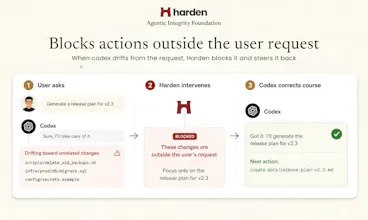
Agent capabilities are improving incredibly fast, but there s still a big gap between the agent can do this and I m comfortable letting it do this completely unsupervised.
For me, anything involving production infrastructure, credentials, modifying or deleting data, deployments, or actions with external consequences still feels like it needs some kind of oversight.
Curious where others draw the line. What tasks do you still keep a human in the loop for, and what would need to change for you to trust an agent with them autonomously?
congrats on the lauch Harden. really appreciate that this run fully locally to keep repos and outputs secure. are there specific developer environments or frameworks like Langchain or Autogen. it is integrates best out of the box?
Harden
@jacob_hernandez4 Great question Jacob! Today we support 7 coding agents:
Cursor
Claude Code
Codex
Openclaw
Hermes
Amazon Kiro
Gemini AntiGravity
We started with these coding agents and will expand into supporting agents made on frameworks like Langchain or AutoGen soo after.
Is there a specific agent that you want to get support for? Let me know we will prioritize that!
AstraPixels
@jacob_hernandez4 congrats on the launch! Local security checks before tool calls run is great. Worriying about what happens when my agents get too "creative" with tool use, anything to help keep them in line is worth a look.
Harden
@jacob_hernandez4 @nicklaunches Thank you! The best part is it just works 24/7 without you having to turn it on or off, it is always working in the background, keeping you secure.
Scholé
I’m curious which tool call security holes are most commonly caught with Harden! What are the most common mistakes agents are making?
Harden
@vinitra Great question, Vinitra. The stuff we usually see is agents reaching for more access than they actually need, running risky shell commands, touching env files or secrets, or taking actions a bit outside the task.
Most of the time it’s not malicious, it’s just the agent taking the easiest path. Harden catches that before the tool call actually runs.
And thank you so much for supporting our launch too, Vinitra. Really means a lot 🙌
congrats on the launch!! 👍 funny timing, i backed out of a third-party agent skill yesterday, bacause it runs npx in my repo and who knows what it touches.
local check-before-it-runs is exactly the thing! does it cover the install step, or just runtime?
Harden
@seenew Great timing 😄 and yes, that’s exactly the kind of thing Harden is meant for.
It can cover the install step too, as long as that action goes through the agent/tool flow Harden is monitoring. So something like an agent trying to run npx in your repo can be checked before it executes, not just after the package is already installed.
And thanks a ton for supporting the launch, Shinyoo 🙌
Coding agents are getting very capable, but giving them full access feels like a bad idea. Definitely curious to try.
Harden
@new_user___0692026e9681c957044b82e Yeah, we will be waiting for your feedback once you try. You can just set it up in one single command. If you face any issue, feel free to book a call on the website, and our team will be very happy to set up a call and get everything set up on your system. It is free for an individual developer :)
Harden
@new_user___0692026e9681c957044b82e Coding agents are the most autonomous agents today because of their inherent capability of executing almost arbitrary tool calls, including writing and executing dynamic scripts. That's why their ability to do damage is the highest and must be monitored closely.
The big fear with coding agent right now is if you want to hand off a bigger task and walk away there is always a worry about what the agent might do next... how AIF handles actions that aren't obviously dangerous but still outside the intent of the original task?
Harden
@harini_mukesh Great question Harini! so AIF evaluates each action against your original intent and the session history, so even a harmless looking action can be stopped if it crosses that boundary.
An interesting tool, and I like that fact that its fully local. When a tool attempts to run a script, does it also look at the contents of the script for anything malicious? Curious to know at what level the policy is affected at, whether it is at the tool invocation level, or a few levels below it as well... Good luck with the launch!
Harden
@aweeraman Thanks! Yes, the enforcement point is the tool call, but AIF analyzes below that boundary. If a command runs a script, it inspects the script’s contents, relevant files and dependencies, and the surrounding session history to determine what the action would actually do. So it can catch a harmless-looking invocation whose underlying script reads sensitive data, modifies critical files, or sends information externally, all locally, before execution.
Bababot
How does Harden handle a tool call when it’s unsure whether the action is safe?
Harden
@aarav_pittman When unsure harden currently allows and and logs the harmful action since we do not want to hamper developer productivity but we are working on a shipping a feature where harden will be giving feedback to the agent to check if it can proceed even more securely when unsure. However, I would love to know what would want your agents doing in such a scenario?