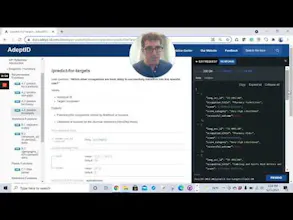
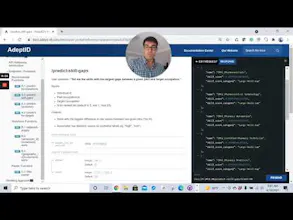
AdeptID’s API makes it easy for anyone building a Future of Work application to include ML in the way they discover talent without college degrees. We connect talent to jobs and training on the basis of transferable skills (rather than job titles).
Thanks for hunting @nikkielizdemere!
?makers I was reading a report on the labour market by ILO and can truly relate to your mission, to provide an opportunity to the hidden talent to realize their potential.
Have you collaborated with some skill and training institutes, which fall outside the traditional 'institutions'?
@nikkielizdemere@adityavsc We're fortunate to work with some great vocational training institutions (like Year Up https://www.yearup.org/) that offer apprenticeship programs for Opportunity Talent. They've taught us a lot about potential pathways into high-growth industries.
A lot of the employment outcomes data we use to train our models come from these partners.
Report
Hi Brian and Fernando, do you provide a platform for other job portal or career website to feed their job banks to your API so they can build connections between different jobs? or like in the demo, you also provide the list of standardized jobs title, standardized job description to link different jobs together? I'm a bit confused on how the platform work. I guess I'm not clear on that part from the video.
@oby_sumampouw good question. we've ingested a set of skills taxonomies that map (cumulatively) about 40,000 different skills to a consistent set of ~1,000 occupation ids. when a user provides a job title, we map it to the nearest occupation id, then infer where that title sits in a high-dimensional skills-space. we then look at the degree over skills overlap with other occupations, along with 100,000s of past records of real job transitions, to determine which ones are "near" or "far" and (crucially), what new skills would help an individual get from Job A to Job B. There's a modelling approach section of the docs center that gets into more detail https://docs.adept-id.com/develo... Does this help?
Report
Talk about timely!
Just yesterday morning, I read Debbie Lovich's Forbes' piece on how American corporate execs now find employees are seeking new levels of flexibility as they consider returning to the office. At the same time, the OECD, covering 32 countries and some 60% of global nominal GDP, is warning that automation-caused job loss is likely to hit hard, esp. among employees with lesser degrees.
For execs and workers alike, that sounds like a perfect storm!
The big question: how does the C-suite navigate these new pressures?
One way will be to focus on their staff's input more closely than ever before. An equally important way will be to upgrade those inputs – and enhance them. Of course, for staff with solid skills (and potentially solid suggestions), but less than stellar college degrees, getting to give such input used to be the "Impossible Dream."
Here comes AdeptID – right on cue!
Matching skills learned with skills required, and doing it precisely enough to score the likelihood of any specific worker transition, will come as good news for execs – and, crucially, for the 80 million or so Americans who lack college degrees, but who have the skills or else the aptitude demonstrated in past performance to acquire those skills.
Our "suits" and our training providers can generate a whole new talent pipeline strategy … and our workers get a personalized pathway. That takes the "impossible" out of the dream.
And today's launch makes the dream itself a reality. For the initial partners of AdeptID have found that the AdeptID's API does, indeed, work. Good news, indeed!
For smart execs and all-too-often unvalued staff, this could well be a win-win.
And if that's not a democratic solution, maybe even an example of America setting a positive pace for all of us, what is?
@hieronymus_felix you've captured our mission very nicely, Hieronymus! Lots of work ahead, but a very motivating problem to be working on
Report
Sorry, I'm not clear what it is that the product is trying to solve. Pretend that an employer writes a job post, the employer should know what skills are required for the job and the job post will/should list those key phrases. Applicants will/should list their list of skills as well and job site algorithm should be able to make good matches based on these. If for any reason the applicants "forgot" to list their relevant skills, this API will make a match based on other dimensions, but this will lead to the employer getting a list of recommended applicants whose profiles do not have the list of skills that the employer is looking for. How should the employer screen these recommended applicants then? Contact each one to verify that they indeed have the minimum skills required? Sorry, I can't quite figure out how this product helps the employer?
@edwin_adhiprakasha Thanks for the note...
We're sorry too... it seems like these materials didn't adequately communicate what we do.
If you were building an application for employers to identify/hire talent, you could use our API to flag sources of talent who have highly transferable skills to what you're looking for (e.g. the cashiers as a source of high-potential pharmacy techs). You could also highlight individual applicants on the degree of non-obvious "skills-fit" with what you're looking for.
Lots of employers, particularly ones in growing sectors like health care, renewable energy, and IT (whom we work with) struggle to find talent in the middle-skilled segment (which is why you hear lots of discussion of "skills gaps"). Part of this is because the existing ways of assessing talent are rather superficial (employers restrict hiring to limited set of past occupations) - which compounds difficulty of hiring AND is susceptible to harmful bias / systemic oppression. We use taxonomies to infer the underlying skills people have picked up in seemingly different roles to highlight non-obvious pools of talent. These inferences reduce friction / error on the part of job seekers because it doesn't force them into reverse engineering what they think an employer will want. Our models' ability to find talent in new places, in a friction-less way, helps employers expand potential hires and improve the representation of their talent pipeline.
Report
Given how quickly technology is changing the job landscape, it is crucial that folks can find fulfilling, meaningful employment regardless of previous titles and responsibilities. Finding something that is aligned to ones skills is difficult enough, and convincing a prospective employer can be even more difficult. As a career changer myself, I can attest that this is a monumental task. Having someone in your corner would lift a great burden from the shoulders of would-be job seekers who want nothing more than to do something they enjoy ( most of the time, work is work for a reason right?). As the resident non-expert in this space, I think your target demographic/fields are shrewd but this could easily expand into tech jobs such as software. Many folks in this field are self-taught and I can personally attest that some skills not only transfer over, but offer a divergence from the normal hegemony that exists today. Speaking of software, I played around with the API and it worked great! Nice job! I wish you guys the best of luck and look forward to whats coming next!
Report
Hunter
Changing jobs is incredibly hard, particularly for folks without college degrees, and I think this is connected to a lot of problems we struggle with...
AdeptID has built models that identify transferable skills people have picked up that would make them successful in new roles. They’ve already helped some big employers rethink the way they find and promote talent.
Now they’re releasing this API to make it easy for anyone building a Future of Work app to connect hidden talent to jobs and training.
They’re a driven team with big hearts and an inclusive mission and they’re eager for feedback from you! ♥️
Report
Solving the middle skilled mobility problem is important for the economy and our society but also for individual companies and training providers and middle skilled workers themselves. This is an amazing machine that helps those transitions and opens up mobility to millions of individuals.
@e_radford Thanks! This API product is meant to make that machine available to anyone building an app in the talent space! Hopefully we can meet some of these folks via PH!
Report
@fernandorv I really like your mission and your use of novel ML methods to a space that hasn't seen much sophisticated innovation. There's such a huge need for this product - and I see folks like Enel are already customers and enjoying the benefits.




Product Hunt
AdeptID
AdeptID
AdeptID
AdeptID
AdeptID