I love that it meets people where they already work, hope to see a Teams native version as many of my clients are on Microsoft. It’s thoughtful, practical, and has a ton of potential especially for quick onboarding to authenticated MCP, which can be managed at the team vs individual level, enabling less tech savvy, AI holdouts, can get value from the first question, if another team member has set up a connection that helps them, without requiring everyone on the workspace to create a new account. Really excited to see where the team takes it.





 ChatGPT by OpenAI
 Claude by Anthropic
@shantanuwali Thanks! Yes, it maintains both team-wide and person-specific memory. It's using recency, reasoning, and source to decide which information to prioritize.
Big Claude Tag fan, and see this being an incredibly accessible way to set up without relying on Anthropic and being model-agnostic and eventually can run on local models my company is using.
Does Tadata require me to tag it or will it be able to decide when to jump in?
@zach_gold Exactly. This way you can use open source models and have your company knowledge and how-to stored in a model-agnostic way.
Model providers are naturally incentivized to keep every task on their own models and encourage higher token usage, even when another model is a better fit for the task. At Tadata, our incentive is simply to get you the best result for the cost.
Right now you have to tag Tadata for it to jump in. Or DM it directly.
@tori_seidenstein Makes a ton of sense, especially the encouraging higher token usage! Curious if a future feature could be team can configure thinking to use more expensive models then cheaper ones on execution. Overall, super cool product!
@zach_gold Yes, 100%. We believe that in the future, we'll just need the expensive model to do the hard work of figuring out the task for the first time, and then can use something cheaper (or even deterministic code) for future runs.
@zach_gold you need to tag Tadata for it to join a conversation, that's an explicit decision based on other experiences to avoid spamming the workspace. when we feel confident that Tadata can join the conversation without creating noise we'll add that option
@itay_shemer1 Makes a ton of sense to start with!
Hi @tori_seidenstein How does Tadata, compare to Viktor for example? Also can I connect it to Shopify?
@a_c26 Both are AI employees that live in Slack but have a different feel that is the culmination of a bunch of different product decisions. Tadata is designed to be very concise for example, like an employee that gives you the bottom line up front.
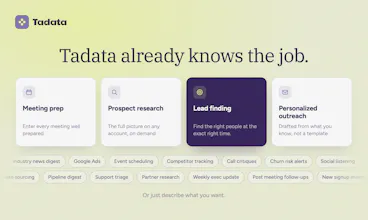
Tadata also excels out of the box in go-to-market tasks that require lots of web data.
It also doesn't introduce itself to your colleagues without permission, which is the biggest thing Viktor has been critiqued for.
And yes, you can connect it to Shopify!
@tori_seidenstein How does it compare price wise?
That's a really nice tool tbh.
The connectors part is awesome! I liked it depth, one of the most thought-through I've seen. good job folks!
Btw- can you share where does this different than Claude tags?
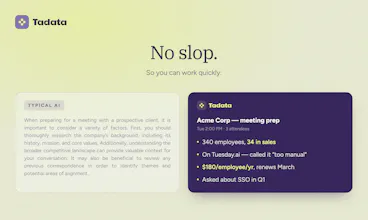
@amit_aviram Tadata's focus is the quality of the finished work, we actually want you to read what it writes. it asks when context is missing, adapts to how your team works, and creates usable deliverables instead of dropping generic AI slop into Slack. We also never train on customer data.
@itay_shemer1 sounds cool.
I saw that you guys have a slide labeled "No Slop". Really interesting because I find that AI agents typically are too verbose. On Tadata, can we control how verbose it is?
@matteo8p By default, all Tadata responses will be concise. If you ask for something that requires detail to convey the value (e.g. a research report or a big list of leads) that will be given to you in an artifact format -- a markdown file or CSV for example.
We're looking at how to control writing style and verbosity though for cases where the task is writing. For example, how does Tadata craft a follow-up email for Sam that matches Sam's style, and a follow-up email for Devin that matches Devin's style?
So, good question!
With the short and crisp answers, and ability to give instructions in Slack, feels more seamless than other Slack bots!
@jisha_kambo1 Thank you!
@busmark_w_nika Tadata doesn't train on your data, and neither do our model providers. Each organization’s data is isolated, work runs in temporary containers, and credentials are deleted when you revoke a connection. Data is encrypted in transit and at rest, and we’ve passed Google’s CASA Tier 2 assessment.
You can read more at https://tadata.com/security