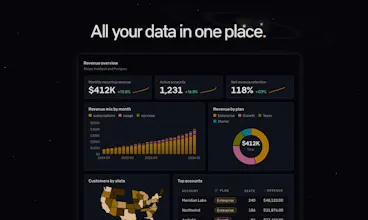
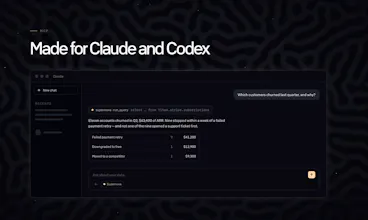
Supernova connects your startupβs live data to Claude and Codex, so anyone can ask questions, investigate performance, and run complex analysis in the AI tools they already use. Connect Stripe, HubSpot, PostgreSQL, and 30+ other apps, then analyze revenue, pipeline, customers, usage, and operations without waiting on engineers or moving everything into a traditional BI stack.
This is the 2nd launch from Supernova. View more

Supernova
Launching today
Supernova connects your startupβs live data to Claude and Codex, so anyone can ask questions, investigate performance, and run complex analysis in the AI tools they already use. Connect Stripe, HubSpot, PostgreSQL, and 30+ other apps, then analyze revenue, pipeline, customers, usage, and operations without waiting on engineers or moving everything into a traditional BI stack.



Payment Required
Launch Team / Built With


Supernova
Hi again everyone!
Luke and Kate from Supernova here.
Great to be back on Product Hunt. We got awesome feedback our last launch so I'm pretty psyched to show off what we've been cooking since then.
Claude and Codex are so good at data now.
The only problem? They don't have all your company data.
With Supernova now they do!
How it works:
Connect your apps to Supernova.
Connect Supernova to Claude or Codex
Let the models create beautiful dashboards and powerful models.
Why Supernova?
Batteries included - no extra data warehouse or ETL needed
Modern features: Iceberg exports, MCP, git
Transparent pricing for startup budgets
Swiss army knife CLI included
Truly open source
It just works
We'd love for you try out Supernova. We're offering 20% off Supernova for 6 months (and we're already crazy affordable compared to alternatives).
Let us know what you think! We love feedback - our best ideas come from users β€οΈ.
Get started at supernova.ai!
@lukezapartΒ Nice launch congrats πbypassing raw CSV exports and letting Codex interact with real app data natively is brilliant. qq how are you guys managing real-time data syncs across app integrations without hitting rate limits?
Supernova
@priya_kushwaha1Β Thanks! It's been really fun gearing up for launch. Each data source has different limits, so we had to build some machinery to adapt to a given platform's rate limits. We aim to be nice!
We sync that data into a super fast data lake we built which has no such rate limits, so after you sync to Supernova you can quickly run queries on millions of rows.
@lukezapartΒ That makes sense the different rate limits can definitely be tricky like a smart way to handle it. all the best for launchπ
the thing i would want to know most: when someone asks what revenue looked like last month and the model has the right rows in front of it, how often does the number come back right?
we pointed eight models at a live pricing api recently and two of them misread a quantity ladder they had been handed correctly. not hallucination, the data was in context, they just read the wrong row. one was out by 4x, the other by about 6 percent, and the 6 percent one is the dangerous one because nobody double checks a number that looks plausible.
for a support reply that is an annoyed customer. for revenue analysis it is a number that ends up in a board deck. do you verify the arithmetic anywhere before it renders, or is that left to the model?
Supernova
@jernej_jan_kocicaΒ for important numbers (such as ones that end up on a deck), I run adversarial review agents, just like code. E.g. give something like this to Fable:
"This is a revenue analysis we don't fully trust. Do an adversarial review of the numbers, methodology and data sources used. These numbers will be used on a board deck so it is critical that we avoid mistakes."
Or maybe "Spawn multiple agents to cover distinct ways in which the numbers could be wrong"
In our own harness in-app we built this Orchestrator -> Implementer -> Reviewer workflow for that reason. For Claude unfortunately the MCP rules don't allow us to instruct the model on its behavior too strongly, but you can implement a similar workflow yourself.
We should probably publish some docs on this!
Of course, for something like an actual board deck I would still probably review manually myself.
@lukezapartΒ that is more concrete than i expected, thanks. the orchestrator to implementer to reviewer split is the part i want to steal.
the bit i am still unsure about is whether an adversarial pass catches the quiet error. a reviewer asked to find problems with 39.00 finds it, because it is wrong on its face. a reviewer looking at 9.00 against the same price ladder has to read that ladder correctly in order to disagree, and something just misread it once already. plausible errors survive review for the same reason with people and with models.
your last line is the honest one though, and it is where we landed too. for anything that actually matters a person still reads it before it goes out. this is the third time this week someone has independently told me the answer is a separate verification pass, which is starting to make me think that is the state of the art rather than a workaround.
would genuinely read those docs if you write them.
I like the idea, but Iβm wondering how teams handle cases where their data is incomplete or spread across many different tools.
Supernova
@nathan_holdstein36Β That's a great use case. Let's say you have invoices in Stripe and customer data in Salesforce. If you sync both Stripe and Salesforce to Supernova, the data from both can be joined in one query (e.g. to pull real-time billings vs contracted). We always sync the complete dataset from each source, so we haven't had issues with incompleteness.
If you have many data sources, you can create models that will build up a knowledge map of your business and combine them. E.g. instead of dealing with Google Ads, Facebook Ads, Snapchat, Tiktok etc. you can make a model that takes data from all of them into one table (e.g. ad_performance) for easy querying.
And with the current models, AI can do most of this for you!
@wildkakapoΒ Yeah that makes a lot of sense. The knowledge map approach sounds interesting, especially when teams have data spread across so many different tools. Making those connections automatically is probably where a lot of the value comes in. Thanks for sharing the details!
Supernova
@wildkakapoΒ @nathan_holdstein36Β Great question Nathan, thanks!
Promomix
The concept is compelling but Iβd want to know how you prevent confident nonsense when the underlying data is incomplete or inconsistent across systems.
Supernova
@margret_rhymeΒ In those situations it can be a good idea to use the most capable AI model. Fable (or even Sol 5.6 on Extra High) are much more careful when it comes to comparing data from different systems and will often point those issues out themselves in fact.
Partly this is because we expose several things that help the AIs notice issues - each table and each row is tagged with its "freshness", so it's easy to see which tables have not been updated in a while, for instance. We expose whether rows were deleted which helps with accidentally deleted data.
When it comes to consistency, where AI models shine is when they can easily verify their own assumptions. The way Claude and Codex pull data from Supernova, they have a lot of data points to use to verify their own answers and check for inconsistencies. A join that doesn't match every row, or numbers that don't match up in two sources, can be spotted and the agents will point it out.
For a more concrete example, If the data in Stripe gives $182k but the data in Salesforce says $175k, the datasets themselves give Claude/GPT a starting off point to explore why it happened. If the underlying issue is that Salesforce is missing 6 contracts, this is easy to for the AIs to spot.
I would be more interested in the permission model than the number of integrations. once an AI can query revenue and customer data being able to control exactly what it can see becomes critical.
I like that this doesn't force teams to build another dashboard just to answer simple data questions.
Supernova
@robert_pimΒ I know right :)
Can you control which tables or field Claude is allowed to access? That would be important for sensitive customer data.
Supernova
@freya24Β Absolutely. We have this in private preview, should come out very soon.