Think about how you work today. You use Claude for writing. ChatGPT for research. Cursor for code. Maybe Codex for longer tasks.
Each one learns something about you. Your preferences. Your projects. Your decisions. But none of them talk to each other.
So you end up repeating yourself. Re-explaining context. Correcting assumptions that one tool got right weeks ago in a different conversation.
It is like having five assistants who each only remember the conversations they were personally in. They are all smart individually, but collectively they are forgetful.
Second Brain for AI
During our v2 launch, you asked for an easier way. Some mentioned being uncomfortable with git. Others flagged the terminal as a barrier. We listened.
This is the Second Brain desktop app and it exists because of your feedback.
Unlike other memory tools, nothing lives on our servers. Your memories are in your Cloudflare account from day one. We literally can't access them.
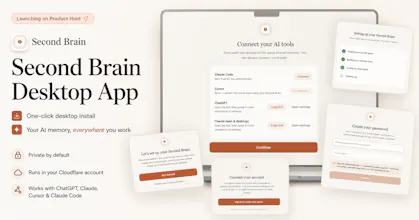
Here's what we built: Download. Choose a password. Sign in to Cloudflare (or create a free account if you don't have one, we walk you through it). Five minutes later, your Second Brain is provisioned and running on your machine. No terminal. No git. No technical knowledge required.
You get the full v2 experience, recall-by-meaning, the knowledge graph, all of it, running in a native app on Mac or Windows, pre-authenticated and ready to connect to Claude, Cursor, ChatGPT, and your other tools via MCP.
This is what community-driven product development looks like. Thank you for helping us build this. Now come try it, share your thoughts, and let us know what you think.
@rahilpirani Huge congrats on shipping Mac and Windows simultaneously.. Congrats👏 are there any plans down the road for a lightweight mobile app (iOS/Android) or browser extension to capture quick thoughts on the go?
Second Brain for AI
@vikramp7470 The extension already ships for Chrome and Firefox, one hotkey to grab a page or your highlighted text. Mobile is still the real gap, and on-the-go capture is why it keeps coming up.
Second Brain for AI
@thys_beesman Not a black box. The dashboard has a graph view where every edge carries a weight and its provenance, and if a link is wrong you can unlink it there, from any MCP client, or via the API. Weak inferred edges also get pruned nightly, so bad guesses fade instead of hardening into your model of you. On conflicts, it surfaces both. Promote a memory to canonical and it is protected, and a contradicting newcomer lands as a draft for reconciliation instead of overwriting it. Recall favors what survived the challenge rather than what arrived last. Recency alone was how we got confidently wrong answers.
I've been hand-maintaining something like this for months — a memory index plus per-topic files I update after every session — and the hardest part isn't storing new context, it's knowing when something old stops being true. A canonical memory that was accurate for a year but describes a relationship or process that's since changed completely — does anything nudge you to review or archive it, or does it just sit as ground truth until a new note happens to contradict it? That's the part that quietly breaks trust in any memory system once it's been running long enough to accumulate stale "facts."
Second Brain for AI
@podcast_ai Nothing nudges you today, and that is the honest gap. Canonical holds until something contradicts it or you demote it with set_status, so a fact that quietly stopped being true just sits there. Months of hand-maintaining is the part we have not solved. A staleness pass that flags long-untouched canonicals for review is going on the roadmap.
congrats on making this a real desktop app - the git/terminal barrier was a legit dealbreaker for a lot of people on the v2 launch. since it's pre-authenticated to Cloudflare on setup, does the app ever need you to re-auth or re-enter your password day to day, or is it truly a one-time five minute setup and then it just runs in the background like any other memory tool from then on?
Second Brain for AI
@omri_ben_shoham1 One time. Your password is the auth token and it lands in your OS keychain at setup, so you only retype it when connecting a second machine. The brain itself is a Worker in your own Cloudflare account, so it keeps answering Claude and Cursor whether or not the app is open. The app is the installer and control panel, not the thing that has to stay running.
@rahilpirani Congrats, one thing I'm wondering about though, once it's provisioned on your own cloudflare account, how does syncing work across multiple machines, is it pulling from the same cloudflare instance or does each install create its own graph that needs merging. asking because that's usually where "your data, your account" setups get messy.
Second Brain for AI
@moh_codokiai One brain, not one per install. The second machine signs into the same Cloudflare account and points at the same Worker, so there is nothing to merge. The app is only a client on top of it.
@rahilpirani The no-terminal, pre-authenticated setup is a smart move for adoption. One question does the desktop app sync memories in real-time across multiple devices, or is it single-machine only for now?
Second Brain for AI
@vishnu_kant_07 Nothing to sync. The app is a client, the brain is one Worker in your Cloudflare account, so every machine reads and writes the same memory.
Shipping a desktop installer on top of self-hosted Cloudflare memory removes the git barrier without giving up the your-account data model. Semantic recall plus a graph you can inspect is more useful than dumping the newest note into every chat. How do you scope memories per project or client so Cursor does not pull unrelated brand voice into a new codebase?
Second Brain for AI
@macitsimsek Tags are the lever today. Scope a recall to the client tag and Cursor only sees that project. What tags do not scope yet is where conflicts surface, so a draft from one codebase can still raise against another. Per-project partitioning is the fix and it is on the roadmap.