
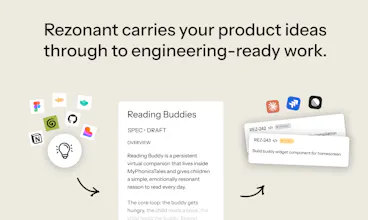
Rezonant is the product workspace for teams that build with coding agents. Feed in your context, drop in an idea, get your team on the same page, and walk away with specs and tasks your agents can run with.
This is the 3rd launch from Rezonant. View more

Rezonant
Launched this week
Rezonant helps product teams turn messy ideas into code-ready specs, tickets, and engineering tasks. Collaborate with PMs, engineers, designers, and AI agents in one shared workspace. Ground decisions in your actual codebase, keep everyone aligned on the same version, and create work that humans and coding agents can confidently ship.


Free Options
Launch Team / Built With


Rezonant
👋 Hello Product Hunt!
Now that anyone can ship code quickly, the bottleneck has moved upstream, to the question of what gets built and why.
Rezonant sits above tools like Cursor, Claude Code and GitHub Copilot. It gives product managers a live, multiplayer workspace to turn product ideas into structured specs and tasks that AI coding agents can actually execute - grounded in the codebase, not floating around in Notion docs and Slack threads.
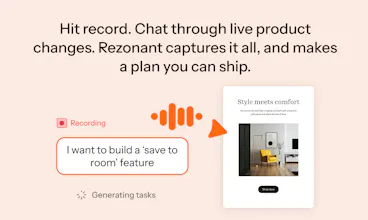
Capture ideas with our Chrome extension, Rezonant Alter. Hit record, point to anything on your live product, prototypes or designs, and talk through your thinking out loud, just like you would with a dev or designer. Alter captures what you said and what you pointed to, maps it to your codebase, and surfaces it as a spec or PRD ready to edit, comment on, break into tasks, and ship.
Try it for free: https://www.rezonant.app/
Can’t wait to see what you build!
Rezonant
@emma_burrows You can download the chrome extension Rezonant Alter here https://chromewebstore.google.com/detail/rezonant-alter/olikohappmhmbomllbhhbhganncolgfn
@emma_burrows Congrats on the launch Emma. What's the usp over something like slack here?
Rezonant
hey @zolani_matebese -- thanks for the question!
I'd say the focus is very different. Slack is meant to facilitate conversations between team members, customers, or agents.
Rezonant is meant to generate output (like markdown specs or JIRA/Linear tickets) that can be picked up by coding agents.
the ambition is for rezonant to be the best place where team can drop a feature idea (through the UI or chrome extension) and that quickly kicks off the delivery process, with a spec being generated and a coding agent picking the up the task.
Hope that clarifies?
@emma_burrows "The bottleneck moved upstream to what gets built and why" is the right read, shipping code stopped being the hard part the moment agents got good at it. Grounding specs in the actual codebase instead of a Notion doc is the real unlock here. The question that follows: a spec is a snapshot, but the codebase keeps moving. PM writes it Monday, three PRs land by Wednesday, and now the agent executes against a repo that no longer matches the spec it was handed. Does Rezonant re-ground a spec against the current code at execution time, or flag when the ground truth it was written on has drifted? For "humans and agents can confidently ship," that confidence lives entirely in whether the spec still describes the codebase it claims to. Stale spec, confident agent, wrong build is the failure mode I'd worry about most.
Hey @arturbrugeman - great questions. You currently can chat to Rezonant and say something like "update this spec with the current codebase" and it'll get everything back up to speed. It's on our roadmap to build this out further - updating automatically and flagging when anything's changed.
@emma_burrows Congrats on the launch. Quick question on Alter. When a PM points at a UI element and says "this button", how does Alter map that back to the right component in the repo? Especially curious about codebases with hashed class names (Tailwind JIT, CSS modules).
Rezonant
@whetlan hey there! Thanks :)
Alter actually works really well with Tailwind, CSS Modules, and other hashed-classname setups — when a PM points at an element, the agent locates the relevant components in the Github repo!
RiteKit Company Logo API
@emma_burrows This is a solid observation about where the real constraint lives now. The workflow you're describing—capturing context from live products and turning that into executable specs—directly addresses a pain point teams face when async communication breaks down. The Chrome extension angle for capturing intent is clever since product thinking often happens outside your tooling.
Rezonant
@emma_burrows @osakasaul thanks for the support, saul!
"Turn messy ideas into structured specs" is a deceptively hard problem because the messiness is where domain knowledge lives — strip too much of it out and the spec becomes generic; leave it in and the agent gets confused. I work on ModeLoop in financial modeling and the same pattern shows up there: the difference between a model an agent can build and one a human can defend is usually in the assumptions, not the cells. Curious how you've handled assumption capture in Rezonant.
Rezonant
@samir_asadov hey -- that's a great point and question!
Managing context and feeding the agent with the right context at the right time is indeed a hard problem to solve. And because it's hard, it's the main differentiator of Rezonant vs custom-built workflows on top of Claude Code/Cursor/Codex with GitHub repos and .MD files to manage context.
The way Rezonant solves that is by capturing both technical (codebase) context from GitHub and additional product context from Granola, docs, Figma etc. These are then organized in teams so that each agent and member in the workspace can access the right context at the right time.
Hope that makes sense?
@vincenzo_bianco2 Makes sense — and worth noting that "context at the right time" is the part most agent products underestimate. You can have all the right context loaded and still ship the wrong output if the agent gets it at step 3 when it needed it at step 1. The differentiation usually isn't context window size; it's the orchestration that decides what gets surfaced when. Curious how you're handling the failure modes where the user provides context that the agent technically has but doesn't weight properly — that one always seems to be where the trust breaks.
Revolte
Congrats on the launch!
ChatGPT-vs-Rezonant comparison on the landing page is the best pitch I've seen this week, where Rezonant pulls the actual src/services/integrations/ path instead of giving a generic playbook.
We're building in the SDLC execution space at Revolte (the agent runs from spec through deploy), so the spec-quality problem hits us directly downstream. Curious how you're handling the codebase index — persistent semantic index per repo, or retrieval at refinement time? We went persistent and the freshness problem is harder than I expected.
Thanks @rajagopalanar ! Definitely, context makes all the difference. On your codebase question, it's technically both. We run code research at refinement time, which solves the freshness problem, but only when the persistent index isn't enough. What was it in particular about persistent that was harder than you thought?
Revolte
@abi_church yeah hybrid definitely seems promising. The tricky part for us was when someone changes a function signature, every file that imported it has a stale embedding and nothing in the commit tells you which ones. We ended up building a small call graph just to track what to re-embed.
Does your refinement-time retrieval usually catch that or do you handle it on the index side?
Pulse for Elasticsearch and OpenSearch
@emma_burrows @vincenzo_bianco2 and team - first of all, congrats on the launch. Looks really impressive! Quick question on the Chrome extension - how does that workflow work in practice? If a PM or engineer submits feedback or feature requests through the extension, how does Rezonant turn that into something Claude Code can execute?
Rezonant
hey @zevi_reinitz -- appreciate the support and thanks for the question! :)
The chrome extension is meant to let you quickly capture feedback on your webapp. For example, you can use the 'record' mode to describe a feature your customers have been asking for.
From then:
- Rezonant elaborates your transcript + interactions with your product to understand your intent
- Rezonant connects to your GitHub and other context (your docs, product roadmap, meeting notes, etc.) to define what it takes to ship that feature: this is the crucial step in which the agent plans implementation while keeping your product context in mind.
- Rezonant will produce a spec and/or a number of tasks to implement that feature
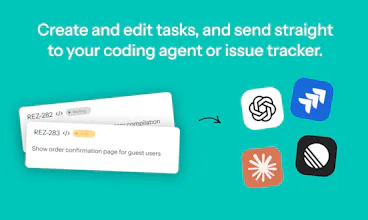
- You can export tasks as Linear / JIRA tickets. Docs can be exported as .md files
- You can ship the feature with a coding agent directly from Rezonant UI or from Claude Code/Codex!
Hope that clarifies the workflow!
Rezonant
Thanks for the support @zevi_reinitz !
Thanks @zevi_reinitz! 🫶
Congrats on the launch. Most broken features I've watched ship were already broken at the PRD stage. The engineering work just compiled the misunderstanding faster. With agents grabbing tickets directly out of Rezonant, what's the QA loop before that handoff?
Rezonant
@artstavenka1 Great question!
There's 2 layers of QA:
The Rezonant agent will flag edge cases and fill the gaps in your feature description while drafting a spec for you.
Rezonant is a collaborative workspace so you can review your PRDs/specs/tickets before 'handing off' to coding agents.
Hope that answers your question? How do you currently do that with your team?
Thanks for the support@artstavenka1! 🫶
Congrats on the launch @emma_burrows !
So this is automatic PRD creation, right? Do you also have a way to connect this with code agents like Codex or Claude code to implement directly on codebase too?
Rezonant
@aiswarya_s hey, thanks for the question! This can automate PRD creation, spec creation and task creation.
Tasks can be sent to coding agents directly in Rezonant. We’re also working on an MCP though for this particular workflow!
Spec-to-code via voice is a workflow I didn't know I wanted until now. Product teams burn so much time translating verbal ideas into structured tasks. We've been building in the ops-heavy SaaS space, and this kind of frictionless spec creation is something PMs ask about constantly. How does Rezonant handle ambiguity in voice input, does it ask clarifying questions?
@shivam_jaiswal36 Totally, so much can get lost in translation. Rezonant understands your product and codebase, and it'll ask clarifying questions or flag missing/ambiguous requirements before anything gets sent to your coding agents. Hope that answers your question?