
Most teams run a helpdesk, a feedback board and a survey tool, then copy between them all week. ProductBridge is one system. An AI agent answers support chats from your help center, calls your APIs via tools, workflows and MCP, and hands off when it should. Every chat, survey and vote is captured, deduplicated and scored by reach and revenue, so your roadmap runs on evidence, not opinions. Ship it and everyone who asked is notified. MCP for Claude, ChatGPT and Cursor. Flat pricing, free plan.
This is the 2nd launch from ProductBridge. View more

ProductBridge
Launched this week
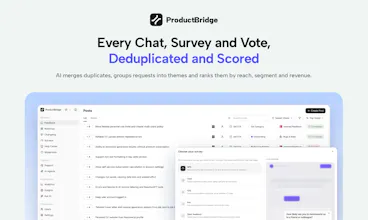
Most teams run a helpdesk, a feedback board and a survey tool, then copy between them all week. ProductBridge is one system.
An AI agent answers support chats from your help center, calls your APIs via tools, workflows and MCP, and hands off when it should. Every chat, survey and vote is captured, deduplicated and scored by reach and revenue, so your roadmap runs on evidence, not opinions. Ship it and everyone who asked is notified. MCP for Claude, ChatGPT and Cursor. Flat pricing, free plan.



Free Options
Launch Team / Built With


ProductBridge
ProductBridge
@hareesh_vemasani Congrats on the launch.. the problem space you're tackling is a massive headache for most startups
ProductBridge
@priya_kushwaha1 So true! Having more tools without sharing the context is always a problem for organizations. ProductBridge comes with tools that required to manage the customer support + feedback + surveys at one place - so that the context always shared.
@hareesh_vemasani nice launch! the closed loops approach are the really interesting and also the MCP servers with 36 tools cought my attention,
how well does this work with the clone requests???
ProductBridge
Thank you, @amrita_prajapati2! If by clone requests you mean duplicate or closely related feedback, ProductBridge detects and groups them into one request while retaining every customer, vote, and original conversation behind it.
When the request moves forward or ships, everyone linked to it can be notified—closing the loop without manually tracking each duplicate.
@hareesh_vemasani Does the agent learn from past support conversations and feedback support ?
ProductBridge
@dipanshu_kushwaha5 Yes! The agent uses past support conversations, customer feedback, help-center articles, your knowledge base, roadmaps, and changelogs as context when responding.
ProductBridge
@dipanshu_kushwaha5 It doesn’t retrain the underlying model; instead, its answers stay grounded in the latest information available in your ProductBridge workspace - your feedback items, roadmap, changelogs, support conversations, help center articles and knowledge base it is trained on.
Visla
@hareesh_vemasani congrats on the launch! Wish you the best with it.
@hareesh_vemasani Congratulations on the launch!
Congrats on the launch @hareesh_vemasani
quick question, does the platform support SSO and role-based access for larger product and support teams?
ProductBridge
@rajat_dangi1 Thanks! 😊 Yes, we support role-based access with Owner, Admin, and Member roles. For team SSO/SAML, get in touch with us about the setup. Happy to walk through what your product and support teams need!
TruGen AI
Congrats on the launch @hareesh_vemasani, With feedback coming from support chats, surveys, and votes, how do you handle conflicting feedback from different customer segments? Can the AI help identify which insights are worth prioritizing for the roadmap?
ProductBridge
Thanks a lot for the support, @bhavyasree!
ProductBridge keeps the customer segment and source attached to every piece of feedback, so teams can see where opinions agree or conflict.
The AI groups related feedback into themes and highlights signals such as reach, MRR, customer impact, and segment relevance. It helps teams understand what deserves attention, while the final roadmap decision remains with the product team.
TruGen AI
@hareesh_vemasani That makes sense! I like that the AI helps identify the important signals without taking the roadmap decision away from the product team. 🙌 Can teams customize which signals matter most based on their product goals, like retention, revenue, or enterprise customer needs?
ProductBridge
@bhavyasree Yes! Teams can segment feedback by customer type, plan, or MRR and focus on what matters most. We currently rank insights by reach and impact, and custom weighting is on our roadmap.
Does the help center also act as a knowledge source for the AI support agent when answering customer questions?
ProductBridge
@tushar_satani Yes, absolutely! The help center acts as a knowledge source for the AI support agent. Whenever an article is added or updated, the agent can use the latest information to answer customer questions accurately and consistently.
ProductBridge
@tushar_satani Not just that, support agent also understands the existing feedback items from the customers, your planned roadmap, changelogs you have already published - and responds to customer queries with this context.
Congrats on the launch. Can feedback collected from Slack, Intercom, Zendesk, and other sources be linked back to the same customer automatically?
ProductBridge
@deepaksingh09 Thank you!
Yes - when a unique identifier such as an email address or user ID is available, ProductBridge automatically links feedback from Slack, Intercom, Zendesk, and other sources to the same customer record.
This gives teams one view of the customer’s feedback and support history while preserving the original source.
1752vc Pitch Deck Analyzer
Congrats on a great product, Hareesh and team. One of the biggest challenges we’ve faced with AI customer support agents is keeping the knowledge base up to date and ensuring that new information is reflected in customer conversations. In the past, someone asked a question that was slightly different from the usual ones, and the agent provided an outdated answer. Does ProductBridge include checks and validations to prevent this?
ProductBridge
@tmaleh_ Thanks! That’s a very real concern.
ProductBridge lets you control which sources the agent uses, show sources in replies, and test questions with different wording before going live. Website content can be refreshed manually or on a schedule, and new Q&A snippets are picked up within minutes.
These controls help reduce outdated answers, but they don’t guarantee every answer is correct. Keeping the source content current still matters.