Launching today

MinkNote
Private macOS notes built on plain Markdown files
138 followers
Private macOS notes built on plain Markdown files
138 followers
MinkNote is a native macOS notes and journal app built on plain Markdown files you own. No database, no account, and no vendor lock-in. Organise work with projects, journals, tags, fast search, rich text or Markdown editing, and automatic image organisation in one private, local-first workspace.


Hey Product Hunt, I'm Demian, the maker of MinkNote.
MinkNote came about because I spent a long time trying to find the right notes app for my own work, and never could.
I loved parts of Obsidian, Day One, and Bear, but none of them ticked all the essential boxes. Obsidian gave me files + folders, strong search, and project separation via multiple vaults, but I still wanted something that felt more native on macOS, and less reliant on plugins. Day One was beautiful and polished, but I wanted direct access to the Markdown, better search, folder-based organisation, and notes that weren’t stored inside a database. Bear came close as the editing experience is amazing, but its database-backed storage and tag-first organisation never quite clicked for me.
So I ended up building the app I wanted to use every day.
MinkNote is a native macOS notes and journal app built on plain Markdown files that you own. There is no database, no account signup, no vendor lock-in. The focus is on a fast, polished writing experience based on simple files and folders you can reveal in the Finder at any time.
A few things it focuses on:
native macOS feel
plain Markdown files in folders, you can hit the Reveal in Finder to see what's going on
projects, journals, tags, and fast search
rich text, MD, or split view editing: the MD is not hidden from you
images organised automatically alongside your notes: drag a note to another journal and the images move too
no AI intrusion: your projects are just text files so you can point your agent there later if you want
privacy as a fundamental part of the design
I built MinkNote for people who care about writing, privacy and long-term ownership: your notes stay readable outside any one app.
If that sounds like your kind of tool, I'd love to hear your feedback! Especially if the mix of simplicity, privacy and ownership feels right.
Try it now: the app's a free download on the Mac App Store, no signup required
Storing images as sibling files in a subfolder instead of cramming them into base64 looks interesting! Most 'plain Markdown' apps fail that one in my experience. Question: the prose is portable but the structure usually isn't right? Tags, journal membership, note ordering all have to live somewhere. If that's in the .md frontmatter I carry it with me when I leave, if it's in a sidecar index then Reveal in Finder shows loose files with none of the organisation. Which way did you go? Does a tag survive a round trip out to Obsidian and back?
These are some great questions @artstavenka1 - thanks! Some things I haven't tried yet, until now.
Basically the project/journal/folder/file hierarchy matches what you see in the Finder exactly, so that's portable. Note ordering is currently stored app-wide as a Preference, but I intend to allow this to be customised per folder, shortly.
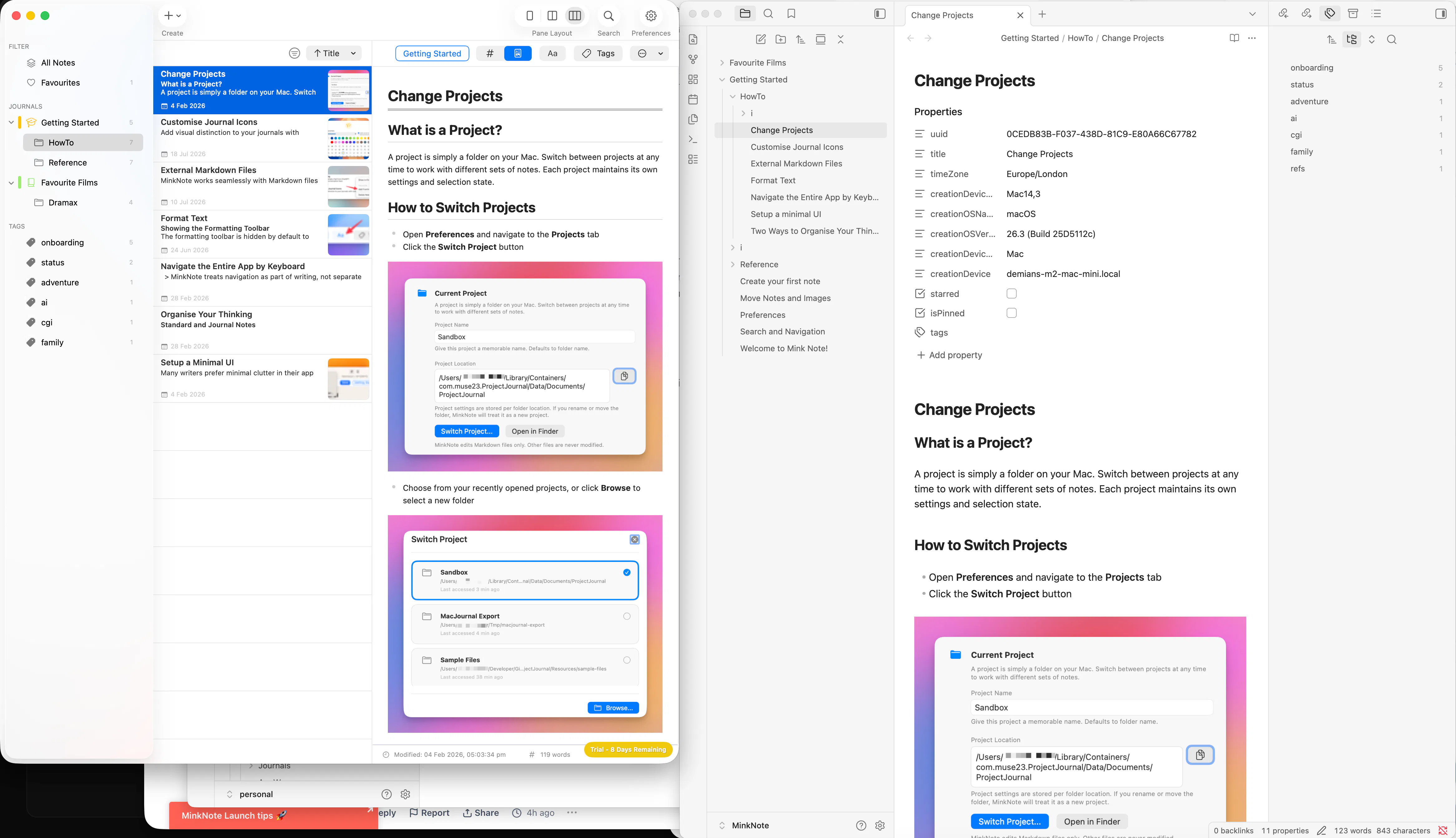
Note metadata like tags, favourite, pinned is stored per note in the frontmatter.
Regarding tag roundtrips to Obsidian and back, can confirm it works well, just tried it:
Obsidian doesn't seem to let you hide the frontmatter but MinkNote does.
@thys_beesman thanks for your feedback, important questions:
filesystem and app sync
currently MinkNote has a basic implementation: if you move notes, the images move along with them (links update), to new folders or new journals (collection).
I haven't yet implemented a filesystem watcher that syncs outside filesystem modifications back to the app, but plan on putting this important feature in the next month or so (it's on the roadmap).
Currently, if you change a folder name in Finder, it's picked up in the next app restart. The folder rename does not break the image links.
AI intrusion: "are you just leaving room for people to point their own agent at the plain files later while keeping the app itself free of any built in AI features"
exactly
I am thinking about adding some small details with local models, opt in only, like suggesting an appropriate icon for a journal based on name, maybe generating a note summary: will look for user feedback
I can't see every app having it's own AI service, people want their models to be personalised and have context across projects, I think we're moving towards a BYO-AI
Really like the plain-Markdown + no-database direction here. The part that stands out is not just portability, but keeping the app native enough that files and folders still feel like a feature instead of a compromise. One thing I'd be curious about as a heavy-note user: do you expose a lightweight conflict or duplicate-file recovery flow for people who also touch the same notes in Finder, iCloud Drive, or another editor? That edge case matters a lot in local-first tools.
Hi @sergbmw - thanks for the praise and thoughtful feedback!
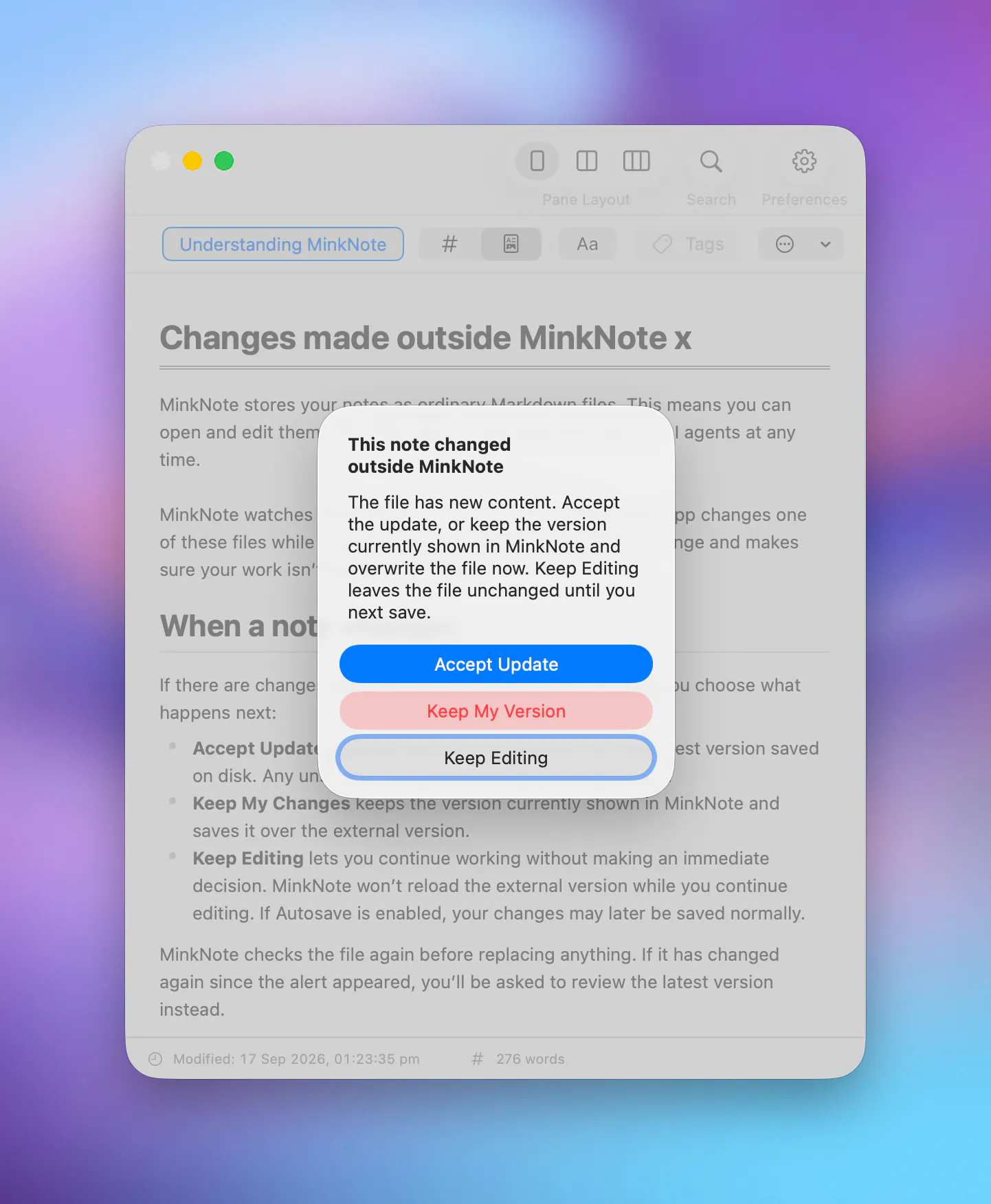
Great question about how MinkNote deals with edits made outside the app. Also the most common theme in today's comments. Short answer is a filesystem watcher is not implemented yet in the current version of the app, but it clearly needs to be at the top of the priority list. It's on the roadmap and after today's feedback I'll be moving it to the top.
My plan is to detect changes to the currently selected note and show a dialog when there’s a conflict, so you can choose between the external version and the current MinkNote version. For notes that aren’t currently open/selected, external changes will just be picked up automatically when you select them. That's the way Sublime does it and I think it'll work well for an initial version.
I agree this edge case matters a lot for a tool built around files you own, so thanks for calling it out so clearly.
Moving notes between folders and having the attached image assets automatically move alongside them is a massive quality-of-life detail that most plain-text Markdown editors mess up. Congrats for launch👏 Usually, you end up with orphaned media files scattered everywhere. qq Does MinkNote use relative pathing inside the Markdown syntax so those links stay intact if opened in another text editor like Nova or VS Code?
Thanks so much@vikramp7470 :-)
Yes I also experienced a lot of orphan files when using other apps so made sure this works right in MinkNote. The app also handles duplicate file and image names fairly gracefully.
So far MinkNote only supports linking to external resources, but top of the priority list is to implement inter-file linking. It will be easy to link directly to other files with something like minknote://{UUID} but ideally I'd like to support wiki links too. Am looking for community feedback especially on this point: what have folks used and what works well. I'll look at the Nova or VS Code implementations more closely.
Plain .md files as the storage layer is quietly the killer feature — it means scripts and agents can read/write my notes without an export step or an API. Which raises my question: how does MinkNote behave when something ELSE edits a file while it's open — file-watching with live reload, last-writer-wins, or a conflict prompt? That edge case decides whether the 'plain files' promise survives real workflows. Local-first + no lock-in is exactly what I want from a notes app.
Hi @nitish_garg4 - thanks for the positive feedback!
You’ve hit the most common question from today’s comments, and I agree it matters a lot for the plain-files promise.
In the current build, MinkNote picks up external changes on folder switching rather than live while the note is selected. A file watcher is now right at the top of the priority list based on today’s feedback.
The behaviour I’m aiming for is: external changes to non-selected notes are picked up automatically when you open/select them, and if the currently selected note changes externally while you’re editing it, MinkNote shows a lightweight conflict prompt so you can choose which version to keep.
I want scripts, agents, Finder, and other editors to be able to participate cleanly. That’s the whole point of using plain files as the storage layer.
The no account, no database line is the part that lands for me. I built something else where the pitch to the other side was also no account to create, and the thing that surprised me is who it actually converts. Almost nobody exercised the escape hatch and walked off with their files. But knowing the hatch was there is what made them commit in the first place. It read as a trust signal more than a feature people used day to day.
Curious whether you are seeing the same, or if your Markdown crowd genuinely round trips out to Obsidian and back the way the other folks here are asking. Those feel like two different kinds of user and I could never tell which one I was actually building for.
Hey @leomiller_dev - thanks for the feedback!
The product would have been way easier to manage if it had sign in, and I came pretty close to setting it up with SIWA. But have spent too much time on Reddit, and users there seem to really hate signups so I went with anon approach. Even the TestFlight was 100% anonymous which I regret because 400+ folks signed up and I have none of their details😭
Regarding no lock-in, this was a different aspect and really important for me. Have been searching for a decent notes app for about 15 years and several time I got locked into platforms along the way - each time getting my content out was so painful. Never again 😃
Do my users roundtrip to Obsidian: the optional analytics wouldn't even tell me. I plan to setup a user forum soon to get a healthy dialog going with users and customers.
I suspect for many people the “files you own” part is a trust signal: they may never leave, but knowing they can leave makes it easier to commit.
But the Product Hunt feedback today has also made it clear there’s a second group: people who already live in Markdown folders and want MinkNote to be a nicer native Mac layer over that existing system, not a new silo.
I think I’m building primarily for the second group, while making the first group feel safe enough to start.
@demianturner The anonymous TestFlight regret hits home. I made the same call on the client side and the blind spot is real. You optimize so hard for the other person never having to identify themselves that you end up with no idea who just used the thing. One thing that helped me was capturing intent without identity, a single non signup question like what are you here to do. No email, but it tells you which of your two groups just walked in.
The second group framing is the sharp part of your reply too. A nicer native layer over folders people already keep is a much easier yes than asking them to move into a new home.
@leomiller_dev great points!
I’ve had the same problem myself: lots of Markdown files and folders scattered across Finder, technically portable, but not especially pleasant to browse or work with. MinkNote is meant to make that existing folder-based setup feel native and calm, without turning it into a new silo.
Previewing other file types is on the roadmap too, closer to how Notebooks handles mixed content folders.
And I love your phrase “capturing intent without identity”. That’s probably something I should bring into onboarding: let people say what they’re here to do, without forcing them into an account.