Launching today

CentryAI
Subscription tracker built by someone who forgot 11 of them
178 followers
Subscription tracker built by someone who forgot 11 of them
178 followers
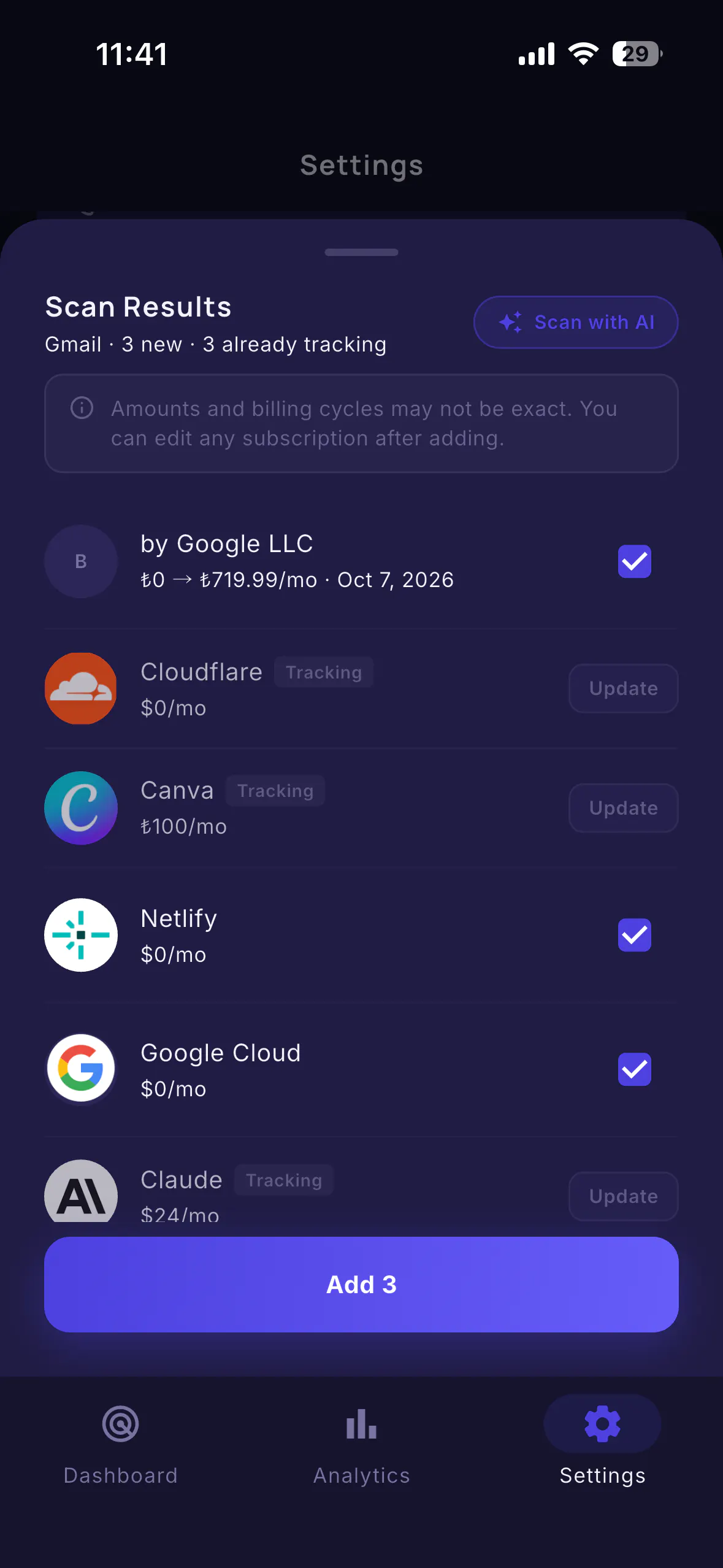
I built CentryAI because I have ADHD and was paying for 11 subscriptions I hadn't used in months. Most trackers make you enter everything manually β that doesn't work if you've forgotten what you're paying for. CentryAI scans your Gmail or iCloud, finds every recurring charge, and scores which ones you're not using. The real pain is cancelling. CentryAI's Cancel Finder locates the exact cancellation page in one tap. No bank linking. Emails are never stored. Available in 18 languages.


Free Options
Launch Team / Built With


CentryAI
RiteKit Company Logo API
@yilmazemreΒ Eleven forgotten subscriptions is the kind of origin story you can't fake, and it's exactly why I'd trust a tracker like this over the generic ones β you built it because the pain was yours.
Quick thing I spotted: your launch went up without a demo video, and a short one really does help people get it in ten seconds. So I made you one, free and yours to keep: https://www.youtube.com/watch?v=S6-hxU3J6QQ β it's whitelabel, branded only to CentryAI, no strings.
Your launch is still editable, so you can drop it straight into your gallery right now. Made it with https://foxplug.com. Rooting for you today β go get that spot.
CentryAI
@saulfleischmanΒ Saul, thank you β that's a really generous gesture, especially on launch day. I'll watch it properly today and see how it fits the gallery. Appreciate you rooting for us π
@yilmazemreΒ good work man!! all the best.. will look into it.
The inbox-scan then detect-recurring-charges then score-what-you-don't-use flow is the useful core, but connecting Gmail/iCloud is also the part I'd want to understand before granting access: does the email parsing run on-device, or does my mail get sent to a server to find the charges? And is it a one-time scan I can revoke, or a live connection that keeps reading new mail? For a utility like this, where the parsing actually runs is basically the whole trust decision.
CentryAI
@hi_i_am_mimoΒ Great question β where the parsing runs is exactly the right thing to ask before granting access. Full transparency:
The parsing runs server-side, not on-device β but your emails are processed in memory and never stored. The only thing that gets saved is what you confirm: service name, price, renewal date. Not the emails themselves, not even snippets.
It's a one-time scan per tap, not a live connection. Access is read-only, the scan runs only when you press the button, and we don't hold tokens that would let us read your mail in the background. You can revoke access anytime from your Google Account β Security β Third-party apps.
On the trust side: CentryAI is a Google-verified app β to keep Gmail access we went through CASA Tier 2, an independent security assessment Google requires for apps touching Gmail (penetration testing, code scanning, the works). We passed it this year and it's re-validated annually. iCloud works differently: an app-specific password that lives only in your device's Keychain and is wiped on sign-out.
Happy to go deeper on any part of this β it's the piece of the app I'm most opinionated about.
Congrats on the great launch! Like the skipping bank linking! Receipt emails carry the service name and renewal date while bank statements give you "PAYPAL *XYZ 9.99". Question on Cancel Finder. Cancellation pages get moved and buried on purpose, static index might rot fast etc. Is it a curated list, scraped on a schedule, or resolved live at tap time?
CentryAI
@artstavenka1Β Sharp question β link rot is exactly the failure mode we designed around. It's a hybrid, in three layers:
1. A curated base for well-known services β fastest path, reviewed URLs.
2. Live resolution at tap time for services we don't know yet β we search for the current cancellation page on demand, validate it, and only then open it (no blind redirects).
3. Community feedback as the rot detector: after a cancel attempt the app asks "did this page work?" β downvoted URLs get invalidated and re-resolved, upvoted ones get promoted for the next user.
So a page that moved last week gets healed by the first person who hits the dead end β everyone after them lands on the fresh URL. And you nailed the receipt-vs-statement point: "PAYPAL *XYZ 9.99" tells you nothing; the receipt email has the name, the price AND the renewal date.
The 'out of sight, out of mind' thing hits so close to home. honestly, the biggest barrier with existing tools is definitely the manual entry or the invasive bank syncing, so scanning the inbox without storing the data is a huge UX win.
Curious about how you handle the usage scoring though. if you don't link the bank and don't store the emails, what signals are you using to determine if someone isn't using a subscription? is it based on the frequency of receipt emails, or something else?
CentryAI
@andrasczeizelΒ Good catch β and honest answer: the scoring is deliberately low-tech, because the alternatives (bank data, tracking what apps you use) are exactly the invasiveness we built this to avoid.
Two signals: receipt cadence from your scans confirms a subscription is still alive β you're being charged. Usage comes from you: the app asks "when did you last use this?" and one-tap check-ins update it. No check-in while time passes β the score climbs at 15/31/60-day thresholds, and past a threshold it's flagged as a zombie with a push notification.
So yes, it needs a tiny bit of input from you. That's the trade-off we chose over surveillance β and for the "I haven't opened Netflix since March" cases it works surprisingly well, because those are exactly the ones you never check in on.
Congrats with your launch!
I see more and more products & media getting targeted towards people with ADHD.
As a person with basically zero ADHD myself (I can focus on a single task for hours without any distractions, I have an excellent memory, and enjoy staying on topic), I find it hard to relate to the advertisement, but I'm curious and I do support.
Could you please explain simply what differentiate a products build for people with ADHD from the other products? We all have subscriptions, and many people track them in some way or another.
Which product design decisions were you making following this direction?
Thanks.
CentryAI
Thanks @valzubkov β and genuinely good question, because "for ADHD" is often just marketing paint. For me it's not: I have ADHD myself. I kept forgetting subscriptions existed, and even when I found them, the detective work of tracking them down and the mental load of actually cancelling kept getting postponed forever. I built CentryAI for exactly that: finding the subscriptions I'd forgotten and making cancelling them easy. Here's what that concretely changed in the product:
1. Zero manual entry as a hard rule. Every tracker before this asked you to log subscriptions by hand. If your working memory is the problem, an app that depends on your working memory is dead on arrival. So the inbox scan does the remembering β that single decision is the product.
2. The app assumes you'll forget β it doesn't punish you for it. The zombie score climbs silently while you do nothing, and the app pings you: "you haven't touched this in 60 days, still want it?" It's external memory, not another dashboard you have to remember to open.
3. Friction removal at the action step. Knowing you should cancel and actually cancelling are different tasks when task-initiation is hard. Cancel Finder deep-links to the exact cancellation page β one tap, not a 15-minute hunt that gets postponed forever.
The honest part: none of this is ADHD-exclusive. It's the curb-cut effect β designed for the people who need it most, useful for everyone who's busy or distracted. You with your excellent memory probably don't need the reminders... but you also probably haven't audited your subscriptions in a year π
No bank linking is the right call here. How does the Gmail scan work under the hood - parsed locally, or sent through a server and discarded right after? People get understandably nervous about anything reading their inbox.
CentryAI
Great question @christian_knaut, and totally fair to ask β inbox access deserves a straight answer.
The scan runs through a Cloud Function on servers, not locally on-device. Here's exactly what happens:
1. You authorize read-only Gmail access via Google's OAuth (we only request gmail.readonly β no send, no delete, no compose)
2. Server fetches receipt-style emails matching subscription patterns
3. Subscription data is extracted in-memory and written to your account
4. The raw email content is discarded immediately β it's never stored, logged, or written to a database
We went through Google's CASA Tier 2 security assessment (completed June 2026) specifically because of the Gmail scope β it's an independent audit of exactly this data handling. The certificate is public.
The tradeoff vs. local parsing: on-device would mean shipping our detection logic inside the app (reversible, extractable), and it couldn't leverage server-side AI for ambiguous cases. Server-side with strict discard gives us better detection without retaining anything.
Short version: we see your emails for ~seconds, extract subscription signals, then they're gone.
Itβs an interesting idea, I have found subscriptions I forgot about before and wished I cancelled sooner.
But people who are looking to reduce subscriptions wonβt want to subscribe and pay? Maybe you can do ads or a different monitization scheme?
CentryAI
@mjohnson42Β Fair challenge β and honestly the question I asked myself before building it. Three thoughts:
There's a free tier: track up to 3 subscriptions, no payment. For a lot of people that's already enough to catch the forgotten ones.
For Pro, the math tends to defend itself: it costs less than one forgotten subscription. Find a single $10/month zombie you'd forgotten and the app has paid for itself several times over in a year. It's the one subscription whose job is to delete the others π
On ads: an app that reads your inbox AND shows you ads would be a terrifying combo β monetizing attention or data is exactly what we can't touch if "privacy-first" is the whole point. Charging users directly keeps us accountable to you, not advertisers.