
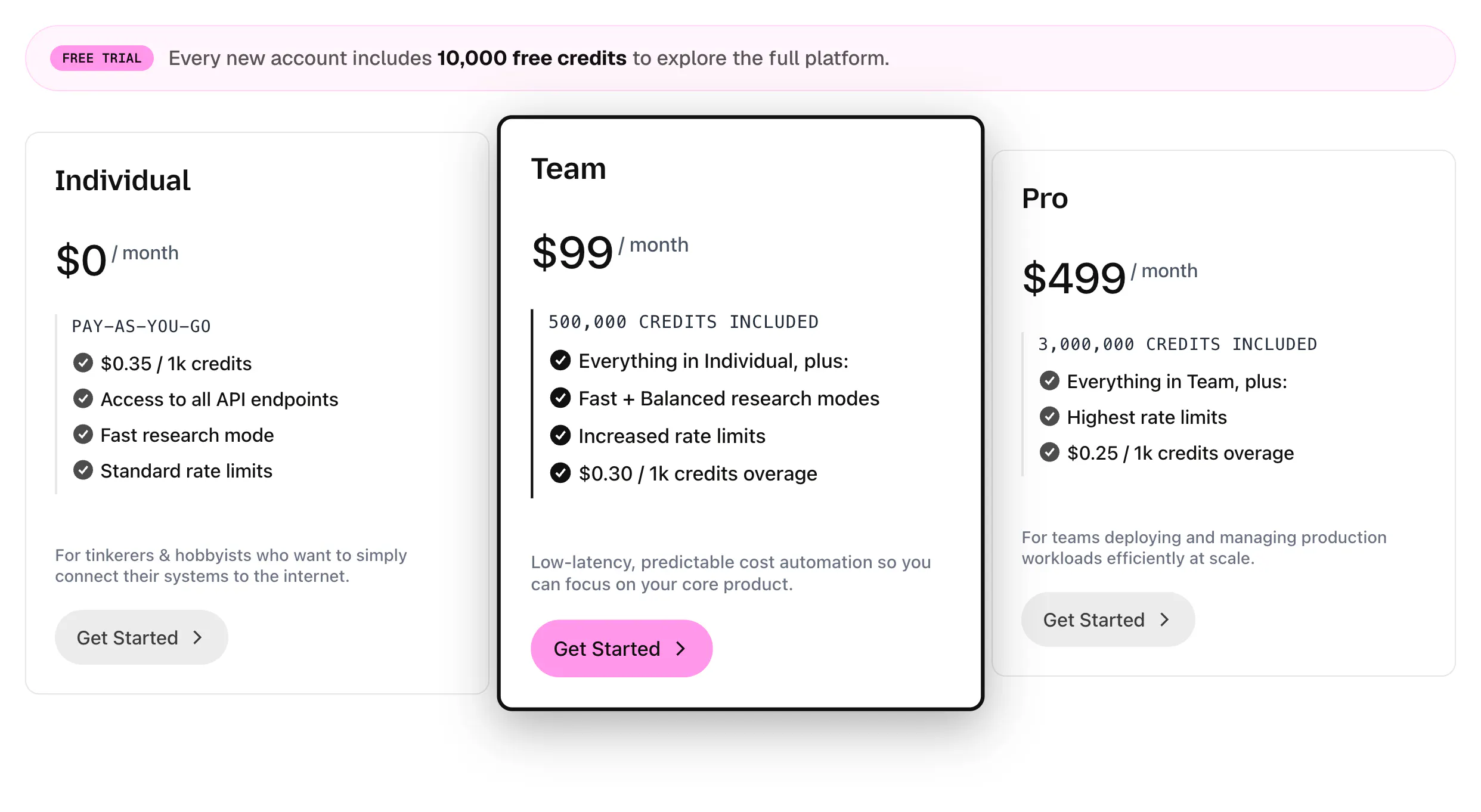
Tabstack gives your model or agent live web access through one managed API. Research live sources with citations, extract clean text or schema-matched JSON, and automate tasks on websites. We manage the browsers and web interactions outside your model, so you can build your agent without building its web stack. Never trained on. Private by default. Built by Mozilla. Start with 10,000 free credits, no credit card required.
This is the 7th launch from Tabstack by Mozilla. View more

Tabstack by Mozilla
Launching today
Research, extract, and automate the web from one managed API. Get a cited answer, clean text, matching JSON, or a completed browser task from the live web in one call. We run the browsers and the web loop outside your model, so you build your agent without building its web stack. Never trained on. Private by default. Built by Mozilla. Start free with 10,000 credits.


Free Options
Launch Team

AWS Startup AdvisorPersonalized AWS guidance that meets you where you’re already building
Promoted




new messaging, new positioning. curious what the community thinks about the new @Tabstack by Mozilla
Hey @fmerian, and @tessak22, congrats on the launch!
Appreciate that you’ve made privacy the default here.
Can an agent pause and ask the user for approval before submitting a form or changing something on a website?
@fmerian @nathan_tarbert Yes! There is an interactive mode so you can do exactly that on the automate endpoint.
What would you say are the advantages of this vs Firecrawl?
@arctictony Good question! There's real overlap, since both can turn pages into clean content or JSON and run browser tasks. Where Tabstack differs is that Research hands your model a cited answer in one call, with each source tied to the claims it supports. And everything you send is never trained on, private by default, and built by Mozilla. Privacy is probably the biggest differentiator.
@tessak22 Love it!
what happens with pages behind cookie walls or paywalls, does the cited answer just skip them or tell you it couldnt read them? knowing what it didnt see matters as much as the citations tbh
@bacelj Agreed, knowing what it didn't see matters. Research only cites pages it actually read, and the response tells you how many pages it couldn't get. With Extract, fields it couldn't find on the page come back null, so you can tell what was missing.
The privacy angle is what makes this stand out for me — most web-access tools for agents quietly end up holding a copy of everything the agent looked at. Real local browser sessions, no logging or training on the data, and both MCP and REST feels like the right default. Curious how you handle sites that need a login — does the session stay in the user's browser the whole time?
@jcbuilds thanks for noticing, it's a key part of Mozilla's mission. Sites that require a login would need to use the open-source version, called Pilo [https://github.com/mozilla/pilo]. We don't currently support that capability.
Yeah! Tabstack is taking browser automation to the next level by prioritizing our data privacy. I'm sure many founders will take the most of it!
thanks for the support! any experience with browser automation tools? would love your thoughts: tabstack.ai
Combining live web research, structured extraction, and browser automation in one API is compelling. How does Tabstack handle partial failures in multi-step browser tasks, and can developers resume from the last successful step without repeating earlier actions?
@mahmoud_shawkat Thanks! Each browser task streams every step as it runs: actions, page changes, and extracted data. If a run stops partway, you get the reason and how far it got. The agent also checks its own result before it calls a task done. There's no built-in resume, but you can start the next call from the last page it reached, pass in what it already collected, and give it just the steps that are left.