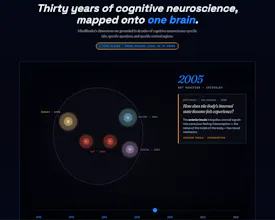
How do you feel? It is the oldest question in art and the newest one we can answer in technology. MindReader takes your content and simulates, region by region, how a brain responds to it. Completely Open Source - we encourage you to tinker. Exploring sales evals, neural evals for datasets and other esoteric product experiments w/ madhat founders. MindReader is built on Meta FAIR's TRIBE v2 + 35yrs of neuro research. Inviting collab from the academics et all.
Hello PH!
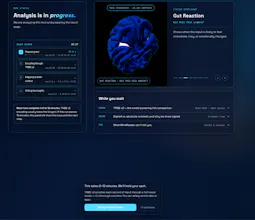
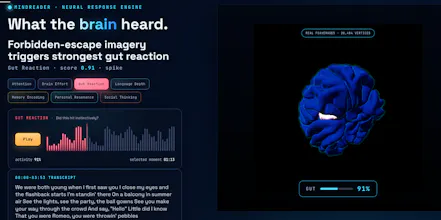
Introduction: MindReader simulates, second by second how a brain responds to any content
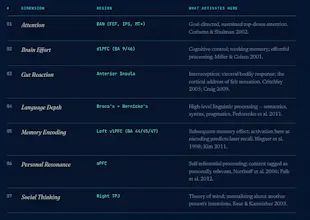
Explanation: It feeds TRIBEv2 data into an insights miner that is run by a neuro-analyst agent. 7-dimensions are explored. Attention (for eg) is based on Dr. Falks' research work etc.
Inspiration: How do you feel? EQ in AI
Evolution: initalyy started as brainDiff (focused on A vs B results for each 'similar content' to battle absence of baselines) - ended up normalizing output scores using basic stats.
CTA: Run you latest social media post through the platform - https://mindreaderai.vercel.app/
(self-host available)
Report
@ishita8088 Hi, Tried the product at the trial setup page and honestly the experience felt like stepping into a neuroscience lab 😄 The visualizations are fascinating and definitely spark curiosity. At the same time, I found myself wondering how much of the report reflects real cognitive signals versus an interpretive model. Either way, it's a very memorable experience and a fresh way to think about message analysis.
@harini_mukesh really appreciate the note. the UI/UX is us leaning into the sci-fi world on purpose- the product's inspired by a lot of sci-fi stories we love.
on your actual question, real cognitive signal vs interpretive model- it's both, and worth separating.
the brain map is a prediction from TRIBEv2, which is trained on ~1,000 hrs of real fMRI, so the regional activity you're seeing is grounded in real scan data, not invented.
the interpretive part is the layer on top: the 7 signals and scores like Personal Resonance 0.85. that's us mapping predicted activity in known regions to named functions, based on published research, then normalizing the output. so the activity is modeled from real brains; the labels are our reading of it.
that's exactly the layer we open-sourced- it's the part worth poking holes in.
PS: @jas_jaski actually has a '42' tattoo; v. devoted sci-fi fan
Report
Simulating how a brain reacts to content is a fascinating concept, and love that it's open source. How accurate are the neuro-metrics compared to real fMRI studies?
@doganakbulut good question, and the honest answer is it's a prediction, not a measurement. TRIBEv2 doesn't read a brain. It predicts the fMRI response an average brain would produce, trained on ~1,000 hrs of real scans across 720 subjects. Meta reports 2–3x better accuracy than prior encoding models, and zero-shot correlation around 0.4 on subjects it's never seen. So: good, not gospel.
What that means in practice one should trust it for relative signal (where attention holds vs. drops inside one piece of content) far more than absolute numbers.
The 7 signals sit as an interpretive layer I built on top of the voxel predictions, mapped to published region → function research. That layer carries its own assumptions, which is exactly why it's open source - so peers can audit / tweak it.
Report
This is what engineers must feel like when I show them my code. Essentially, you’ve created a visualization based on averaged fMRI data to help people conceptualize what brain areas are related to certain tasks and domains?
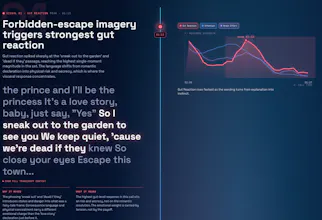
@mdgld so the platform runs your content second by second and pulls the top 3 moments where a signal spikes. so instead of "here's the gut reaction region," you get a snippet like this:
Open areas of conversation / areas we are keen to explore further:
neural-tags for dataset (voice in particular)
evals
content / sales / coaching
d: <enter your answer>
Report
congrats on the launch! super interesting ideas. I wonder what you use as a proxy for attention. Do users need to give inputs or do you estimate where the users might be focusing on based on moment-to-moment 'salience'?
Report
I also wonder whether your model also uses E/MEG data, because the simulation seems to be a stretch of fMRI's temporal resolution
there's no user in the loop. we take the content itself and simulate how an average brain would respond to it. so "attention" here isn't where someone's eyes go - it's what the content does to a specific network in the brain. and it's not the grab-your-eye kind (the salience you mentioned), it's the goal-directed kind, the focus you actually give something. that's the dorsal attention network, modeled from TRIBEv2.
second one - it's fMRI-only, no E/MEG. fMRI reads blood flow, so the timeline runs on a few-second grain, not milliseconds. the "second by second" is the rate we output a number - we're modeling how the response builds over a stretch of content (ideal inputs at least 20-30s long). that few-second grain is the right resolution for what we are experimenting around: where a pitch holds vs drops across a minute.
Report
simulated fMRI is an interesting framing because it lowers the barrier from clinical setting to anywhere with a laptop. curious which use cases you're seeing pull on this first. is it more researchers doing prototype experiments before booking real scanner time, or builders putting brain inspired models inside consumer apps?
@thenameisarian the most interesting use case I'm seeing is in sales. because there is a lot literature + clean datasets around sales call evals already - it is fun to start testing a lot of h0s in the real world.
we are experimenting with an SF-based voice AI team that is feeding their own agent's sales-call data through MindReader to get a signal for what does a "good call" mean.
Report
Very interesting, and great that it's open source. But I'm not sure I understand it correctly. So the goal is to determine how a demographic will respond to certain sales call scripts or ad creatives?
@jn263 the surface area for the product is much wider.
it is useful in anything that benefits from a proxy of human reaction to it.
we have already discussed sales calls coaching as a use case; content / marketing / ads would work in a similar way
some other use cases
neural tags for datasets (many YC audio start-ups (like usepanels.com) are selling expressive data, they can attach this as an objective measure of emotion). (would love for @garrytan to weigh in)
call centres for distress calls can use it to train their agents even better
there are also darker use cases: like reverse engineering a "calm video" to hit certain neural-metrics - which is why we have chosen to stay completely open source and are building on the frontier






MindReader v1
@ishita8088 Hi, Tried the product at the trial setup page and honestly the experience felt like stepping into a neuroscience lab 😄 The visualizations are fascinating and definitely spark curiosity. At the same time, I found myself wondering how much of the report reflects real cognitive signals versus an interpretive model. Either way, it's a very memorable experience and a fresh way to think about message analysis.
MindReader v1
@harini_mukesh really appreciate the note. the UI/UX is us leaning into the sci-fi world on purpose- the product's inspired by a lot of sci-fi stories we love.
on your actual question, real cognitive signal vs interpretive model- it's both, and worth separating.
the brain map is a prediction from TRIBEv2, which is trained on ~1,000 hrs of real fMRI, so the regional activity you're seeing is grounded in real scan data, not invented.
the interpretive part is the layer on top: the 7 signals and scores like Personal Resonance 0.85. that's us mapping predicted activity in known regions to named functions, based on published research, then normalizing the output. so the activity is modeled from real brains; the labels are our reading of it.
that's exactly the layer we open-sourced- it's the part worth poking holes in.
PS: @jas_jaski actually has a '42' tattoo; v. devoted sci-fi fan
Simulating how a brain reacts to content is a fascinating concept, and love that it's open source. How accurate are the neuro-metrics compared to real fMRI studies?
MindReader v1
@doganakbulut good question, and the honest answer is it's a prediction, not a measurement. TRIBEv2 doesn't read a brain. It predicts the fMRI response an average brain would produce, trained on ~1,000 hrs of real scans across 720 subjects. Meta reports 2–3x better accuracy than prior encoding models, and zero-shot correlation around 0.4 on subjects it's never seen. So: good, not gospel.
What that means in practice one should trust it for relative signal (where attention holds vs. drops inside one piece of content) far more than absolute numbers.
The 7 signals sit as an interpretive layer I built on top of the voxel predictions, mapped to published region → function research. That layer carries its own assumptions, which is exactly why it's open source - so peers can audit / tweak it.
MindReader v1
@mdgld so the platform runs your content second by second and pulls the top 3 moments where a signal spikes. so instead of "here's the gut reaction region," you get a snippet like this:
Open areas of conversation / areas we are keen to explore further:
neural-tags for dataset (voice in particular)
evals
content / sales / coaching
d: <enter your answer>
congrats on the launch! super interesting ideas. I wonder what you use as a proxy for attention. Do users need to give inputs or do you estimate where the users might be focusing on based on moment-to-moment 'salience'?
I also wonder whether your model also uses E/MEG data, because the simulation seems to be a stretch of fMRI's temporal resolution
MindReader v1
@looquee_26 ty for the questions.
there's no user in the loop. we take the content itself and simulate how an average brain would respond to it. so "attention" here isn't where someone's eyes go - it's what the content does to a specific network in the brain. and it's not the grab-your-eye kind (the salience you mentioned), it's the goal-directed kind, the focus you actually give something. that's the dorsal attention network, modeled from TRIBEv2.
full mapping's here: mindreaderai.vercel.app/methodology
second one - it's fMRI-only, no E/MEG. fMRI reads blood flow, so the timeline runs on a few-second grain, not milliseconds. the "second by second" is the rate we output a number - we're modeling how the response builds over a stretch of content (ideal inputs at least 20-30s long). that few-second grain is the right resolution for what we are experimenting around: where a pitch holds vs drops across a minute.
simulated fMRI is an interesting framing because it lowers the barrier from clinical setting to anywhere with a laptop. curious which use cases you're seeing pull on this first. is it more researchers doing prototype experiments before booking real scanner time, or builders putting brain inspired models inside consumer apps?
MindReader v1
@thenameisarian the most interesting use case I'm seeing is in sales. because there is a lot literature + clean datasets around sales call evals already - it is fun to start testing a lot of h0s in the real world.
we are experimenting with an SF-based voice AI team that is feeding their own agent's sales-call data through MindReader to get a signal for what does a "good call" mean.
Very interesting, and great that it's open source. But I'm not sure I understand it correctly. So the goal is to determine how a demographic will respond to certain sales call scripts or ad creatives?
MindReader v1
@jn263 the surface area for the product is much wider.
it is useful in anything that benefits from a proxy of human reaction to it.
we have already discussed sales calls coaching as a use case; content / marketing / ads would work in a similar way
some other use cases
neural tags for datasets (many YC audio start-ups (like usepanels.com) are selling expressive data, they can attach this as an objective measure of emotion). (would love for @garrytan to weigh in)
call centres for distress calls can use it to train their agents even better
there are also darker use cases: like reverse engineering a "calm video" to hit certain neural-metrics - which is why we have chosen to stay completely open source and are building on the frontier