
Walrus Memory
Enable agents to keep context & work across apps + sessions
139 followers
Enable agents to keep context & work across apps + sessions
139 followers
Walrus Memory enables AI agents to operate reliably across apps and sessions, without losing context. Portable, verifiable, and fully controlled by you, it is the memory layer that lets agents handle complex workflows and coordinate using data they can trust.





The part I’d be most curious about is the “trust boundary” around memory writes.
For agents, remembering everything is almost as risky as forgetting everything. I’d want memory to keep a trail of: who/what wrote it, source, confidence, freshness, and whether it’s a preference vs. a fact vs. a temporary project decision.
If Walrus makes that inspectable for users and agents, it becomes much easier to rely on memory in production instead of treating it like a black box.
@jim_jeffers Great point. Trust matters as much as recall. We think there are two layers here:
First, can a memory be owned, inspected, recovered, and independently verified? That's a core focus of Walrus Memory.
Second, can agents understand where a memory came from, how fresh it is, and whether it should be trusted? Those are important trust signals. Auditability is a key area we're actively exploring as we evolve the product.
We believe memory becomes far more useful when it's not a black box, but something users and agents can inspect, understand, and trust over time.
A lot of memory systems seem to work well when retrieving facts but struggle once the underlying reality changes.
How are you thinking about state changes over time? For example, if an agent learns a preference today and then learns an updated preference next week, is the challenge primarily retrieval or maintaining a correct current view of state?
@zaid_mallik1 Great question. We think the harder problem is maintaining an accurate view of state over time.
Memory gives agents access to history, but agents still need to reason about what's current, what's changed, and which memories should carry the most weight.
Walrus Memory already considers factors like recency during retrieval, helping surface the most relevant and up-to-date memories for a given topic. At the same time, how agents manage evolving preferences, context, and state over time is an area we're actively exploring.
@abner_pinto That's the part I keep coming back to as well.
Recency helps when newer information is usually correct, but there seem to be a lot of cases where the newest memory isn't necessarily the most important one.
For example, a temporary preference or a one-off correction might be newer than a long-standing user habit.
Do you think solving this ends up looking more like memory retrieval, or more like building a model of state transitions where the system explicitly understands what supersedes what over time?
Agents are getting better, but without memory across sessions and apps, the user still has to do too much of the thinking and re-explaining. I like the “portable and controlled by you” angle. For memory, trust matters as much as performance.
What’s the main use case today: coding agents, research workflows, or cross-app task execution?
@thamibenjelloun Great question. We think the opportunity is bigger than any one agent category.
Today we're seeing strong interest across:
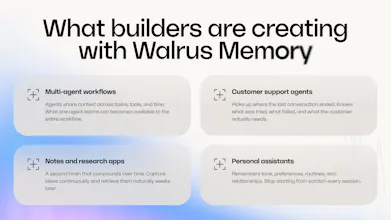
Coding agents that need to remember project context, preferences, decisions, and prior work across sessions.
Research agents that need to accumulate knowledge over time rather than start from scratch every time they run. One example is multi-agent research workflows where agents can share and build on previous findings.
Cross-app agent experiences, which is the long-term vision. If an agent helps you in one application, its memory shouldn't be trapped there. Your context, preferences, and history should move with you.
The common thread is portability. Most AI memory today is application-specific. We're focused on making memory something users own and agents can carry across tools, environments, and sessions.
We believe trust is a big part of that. Performance matters, but if memory becomes a core part of how agents work, users need confidence that it persists, remains under their control, and isn't locked into a single platform.