

honest one for the founders here (+ updates on the open-source YC data platform) 👇
by•

how do you actually check if your idea's been done before? like - gpt it, google it, ask friends, dig through YC's directory, or just.. cross fingers and build?
asking because i built ExploreYC trying to fix exactly that... through semantic search on over 8.6k startups, but genuinely curious what people reach for before a tool. what's your move?
big changes to the landing page yday, very happy with the result now 🔥
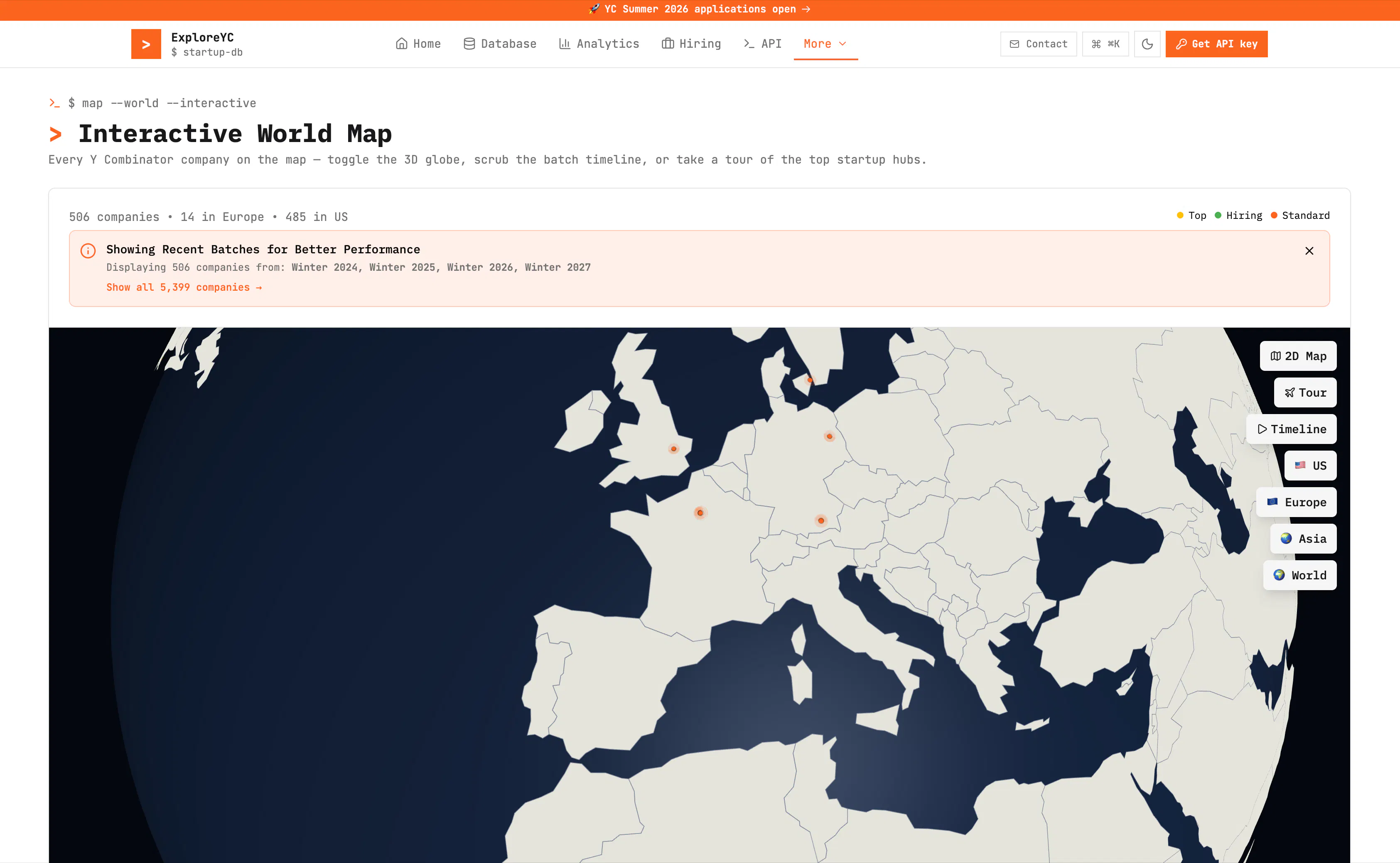
p.s. did my best with the 3d map view, if you have any tips let me know or contribute directly
100 views
Replies
All the above, plus an eventual patent to be comprehensive… https://patents.google.com or https://ppubs.uspto.gov/pubwebapp/
@brentcarlson nice one, thanks for adding it in!
For me, it's usually a mix of Google, Product Hunt, and some other random places.
But honestly, even if I find something similar, I don't see it as a reason to stop. Sometimes it's more about building a better one.
@hosseinyazdi of course! but would be great to see what is on the market - even for validation.. as competition as well as bad means good - the market is in need of the product!
honestly my move is usually just typing the idea into PH search plus a quick GPT sanity check, both feel incomplete because keyword search misses anything phrased differently and GPT just hallucinates competitors half the time. semantic search over an actual startup dataset sounds like the right fix rather than a workaround. one question - does ExploreYC only index companies that made it into a YC batch, or does it also catch stuff that applied and got rejected/pivoted? that second group feels like where the real "someone already tried this and it didn't work" signal would be
@omri_ben_shoham1 no, i extended it to go over 2.5k companies form ProductHunt itself, Hacker News, a16z.. so you get a vector search across the name/description/details of the companies so you can get the most out of the search!
Most people I know do a mix
quick Google for exact matches, then browse a few category leaders on Crunchbase or Product Hunt to see what's recent.
Curious if you're filtering by funding stage or geography, since "done before" often means "done before in my market" rather than globally.
@mohammed_messeguem si si
I have been thinking about this recently because I am building an Influencer discovery tool using the logic and python setup we used in-house for our agency. Before this, the solutions for influencer discovery were just Modash, fevikon and some of the top players. None of them were affordable nor were they solving the problem with the logic we were using. They were just database depended. Now when I am working on the tool's launch, I come across many influencer discovery tools people are building and some are even crazier than I think. However, as @hosseinyazdi said here in the comments, it doesn't stop me from building my tool. In fact, I use the competitors to study what market really need.
@hosseinyazdi @lakshya_singh really cool you got to discover that through here man! rooting for you
@Konstantin Borimechkov that's exactly the dataset I was hoping you'd say yes to. HN and a16z data alongside YC gives you a much broader "has this basically been tried" signal than YC alone, since plenty of ideas get built and die outside the YC pipeline entirely. does the vector search weight recency at all, or does a 2015 attempt at an idea rank the same as a 2025 one? for fast-moving categories like AI tooling a 10 year old failed attempt might not mean much anymore, the market and the tech underneath it are completely different now.
My actual move before building: exact-match Google + PH/HN for the obvious names, then I flip the question. "Has someone done this" almost always resolves to yes — there's a graveyard for every idea. The signal I'm actually hunting is why the last few attempts stalled — distribution, timing, or the thing being genuinely hard? That's what tells me whether to build.
+1 to @omri_ben_shoham1 's recency point, and I'd push it further. A 2015 attempt at an AI-tooling idea barely counts as prior art, because what killed it was usually a constraint that's since moved — inference cost, context windows, no agent runtime. The useful lookup isn't "does a similar company exist," it's "someone tried this in 2015, it died because of X — is X still true in 2026?"
Which is why semantic search over a real dataset is the right base layer, @konstantimb — existence search that survives different phrasing. The thing I'd kill for on top is outcome: dead / pivoted / acquired / still-going, plus the stated reason. Existence tells me I'm not first; outcome tells me whether first even mattered.
(And agreed with Hossein and Lakshya above — a match was never a stop sign for me either; it's just cheaper to learn from someone else's gravestone than to dig my own.)
I will say all of the above, but here's the thing we learned building Kednus (www.kednus.com): "has it been done" is the wrong question. It almost certainly has. The better question is "why did the existing versions not win my specific customers/ICPs?