

Can DNA become active computer storage infrastructure?
We keep responding to the explosion of digital data by building more data centers. More drives. More cooling. More electricity. More physical infrastructure.
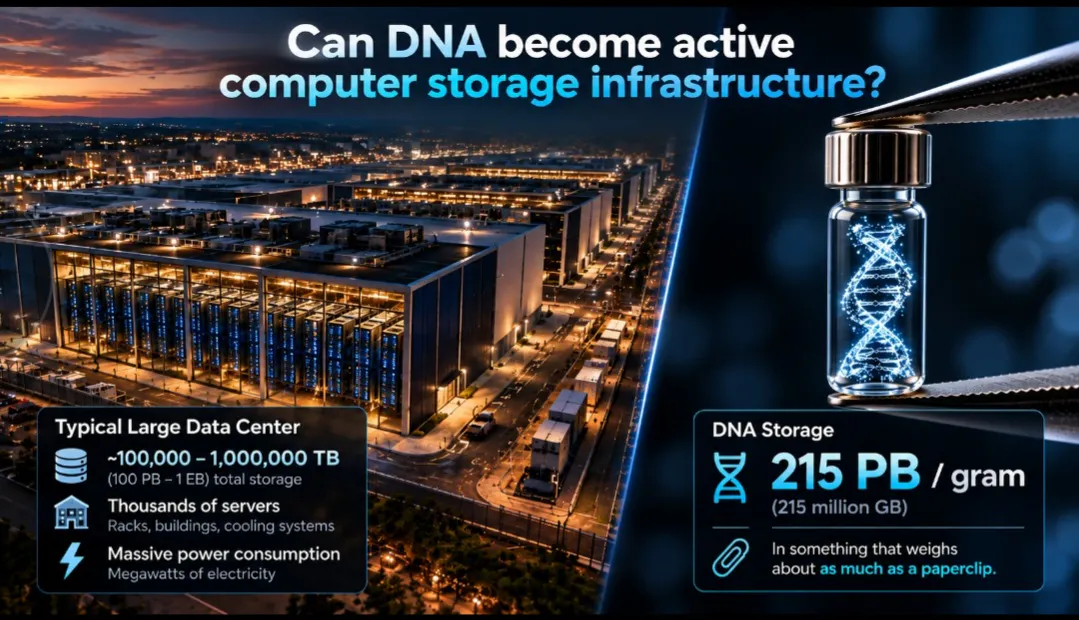
Meanwhile, DNA has a potential storage density so extraordinary that a single gram could hold around 215 petabytes of information. That is 215 million gigabytes in something that weighs about as much as a paperclip. Put simply, that is data-center-scale storage reduced to your pocket.
The obvious question is: why aren't we using it?
The problem is speed and accessibility.
Molecular storage is incredibly dense, but storing and retrieving information still involves processes such as synthesis, sequencing and laboratory workflows that can take hours or days. That makes it far more suitable for archives than the kind of storage a computer can actively use.
Companies and research groups are already making progress on the underlying molecular technologies. But there is another problem worth attacking alongside improvements in synthesis and sequencing:
What happens when we start designing the computing architecture around molecular storage itself?
Not just asking how much data DNA can store, but how it gets addressed, accessed, cached, read and written in parallel, error-corrected and exposed to a conventional computer.
That question has occupied a rather unreasonable amount of my time lately. 😂
Tomorrow I'm launching something I've been building around it here on Product Hunt.
But I'm interested in the larger discussion first:
What do you think has to change before molecular storage can move from archival technology into everyday computing infrastructure?
Replies
Be the first to reply
Have a question or a thought to share? Add a comment above to start the conversation.