

Quasar Community v0.0.3: Self-hosted, open-source Web3 transaction indexing engine
Hey Product Hunt community! 👋
Excited to share an official milestone for the TUWA ecosystem: Quasar Community Edition is officially public under Apache-2.0, tagged at v0.0.3.
Most dApp developers hit a common roadblock: either they get trapped in closed WaaS silos with per-user fees and vendor lock-in, or they write fragile custom scripts to track transaction states across page refreshes and network switches.
Quasar Community solves this by giving you a standalone, 100% self-hostable indexing engine with zero telemetry and no MAU limits.
What’s under the hood:
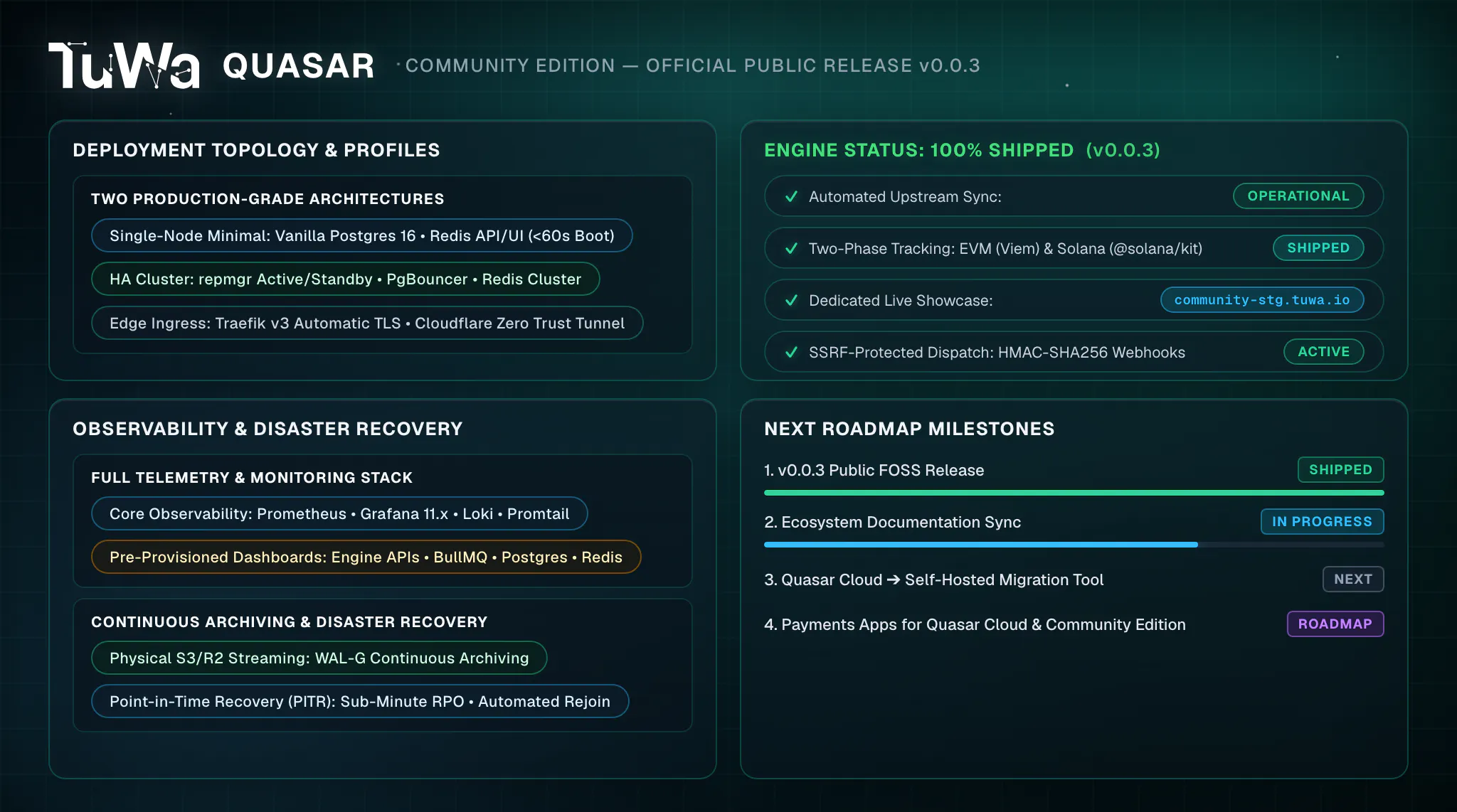
• Two-Phase Lifecycle Tracking: Deterministic EVM (Viem) & Solana (@solana/kit) tracking via persistent state machines.
• Production Data Layer: Time-series partitioned PostgreSQL 16 with BullMQ background job processing.
• Full Observability: Prometheus metrics, Loki log aggregation, and pre-configured Grafana 11.x dashboards out of the box.
• Disaster Recovery: Continuous physical streaming to S3/R2 with sub-minute Point-in-Time Recovery (PITR) via WAL-G.
• Reliable Dispatches: SSRF-protected, HMAC-SHA256 signed webhook delivery.
• Control Plane: Single-admin Payload panel secured with RFC 6238 TOTP 2FA.
Deployment Profiles:
1. Single-Node Minimal: Lean Docker Compose setup with vanilla Postgres 16 & Redis for local dev and community nodes.
2. High-Availability Cluster: repmgr automated failover, PgBouncer pooling, Redis Cluster, Traefik v3 ingress, and Cloudflare Zero Trust tunnel.
Explore & Test:
• GitHub Repository: https://github.com/TuwaIO/quasar-community
• Live Staging Showcase: https://community-stg.tuwa.io/admin
• Guides & Access: https://www.tuwa.io/quasar#self-hosted
Would love to hear your thoughts, feedback, and how you currently handle transaction state tracking in your Web3 stack!
Replies
Be the first to reply
Have a question or a thought to share? Add a comment above to start the conversation.