

Quasar Community Edition: Shedding SaaS bloat for a sovereign Web3 transaction engine
Hey Product Hunt community! 👋
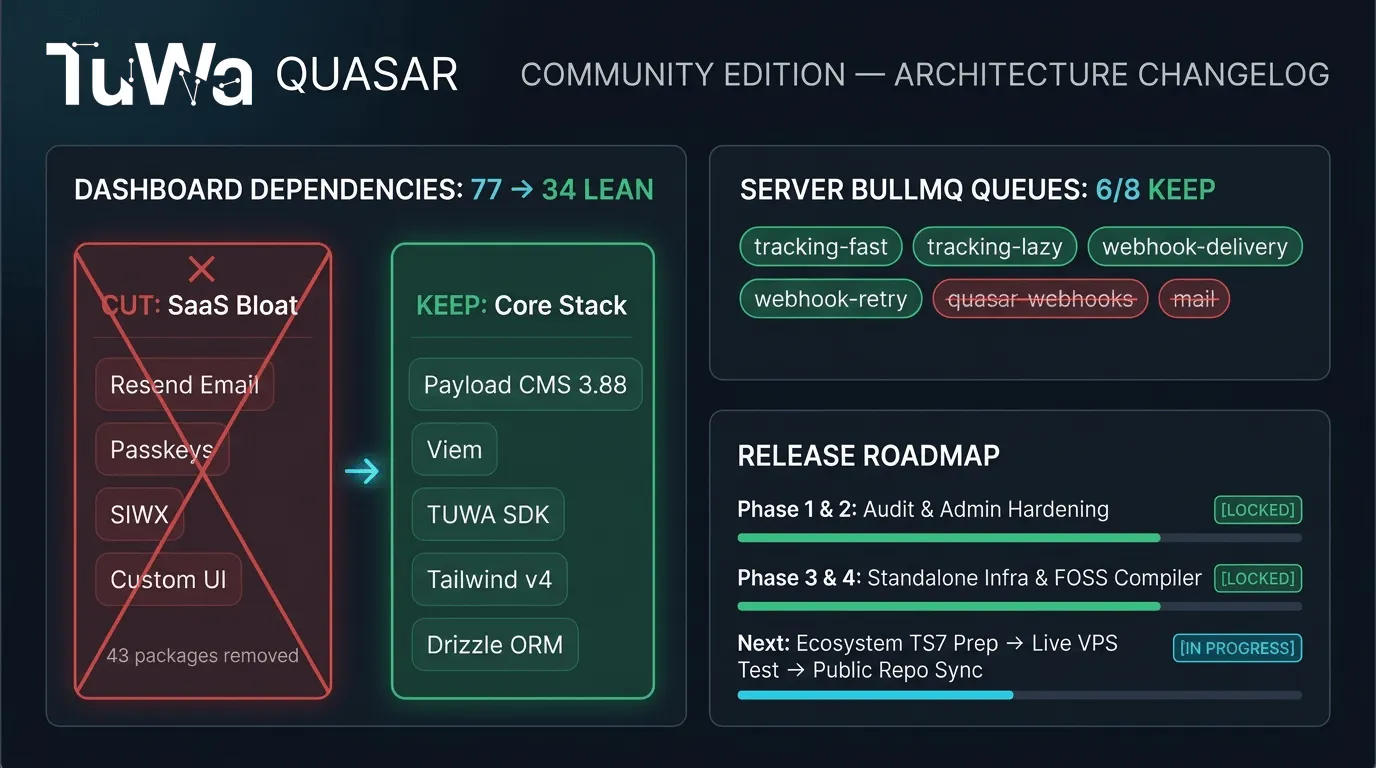
We’ve just locked in two major milestones for Quasar Community Edition (part of the TUWA open-source ecosystem): Phases 3 & 4 are officially completed.
Most modern developer tooling gets bloated with enterprise marketing layers, heavy dashboards, and SaaS overhead. We took the opposite approach: stripping Quasar down to a pure, sovereign, and self-hostable L5 transaction engine.
Here is what we shipped over the weekend:
1. Standalone Infra (Phase 3)
• Shipped docker-compose.minimal.yml with zero external S3 or repmgr bloat.
• A full local Web3 tracking node boots in <60 seconds via Traefik v3 and automated Cloudflare Tunnel CLI.
2. Compiler Pipeline & Pruning (Phase 4)
• Built an automated FOSS generator (pnpm generate:oss).
• Pruned 73 dead files via AST traversal.
• Shed 45 runtime dependencies, cutting the Dashboard from 77 down to 34 lean packages.
3. Zero Web3 Compromise
• Preserved 100% native multi-chain tracking for ERC-4337 Smart Accounts (Pimlico bundlers & paymasters), Gelato relayers, Safe multisigs, EVM, and Solana.
4. Hardened Quality Gate
• Integrated full test execution into the build-gate: 70 tests in Server, 39 in Dashboard (100% green) alongside strict TypeScript validation for all tooling scripts.
Why this architectural shift matters:
Quasar is built to be an L5 durable transaction engine, not a monolithic web portal. All end-user visual feedback (transaction toasts, lifecycle modals, pending feeds) already runs client-side inside our Nova UI Kit.
A self-hosted node doesn't need team invite flows, centralized billing, or marketing pages. It runs on a lean single-admin model:
• Native Payload credentials + RFC 6238 TOTP 2FA
• Zero external SMTP dependencies
• Zero telemetry leakage
Pure self-custody, direct RPC provider ownership, and bare-metal performance.
What’s next on our radar:
1️⃣ Ecosystem Sync & TypeScript 7: Full package upgrade across all core TUWA repositories (orbit, pulsar-core, satellite-connect, nova-uikit, siwx, sdk) and preparing the codebase for TypeScript 7.
2️⃣ Phase 5 Staging Run: Live deployment and end-to-end smoke-testing of the Community Edition stack on a production VPS environment.
3️⃣ Public Release: Launching TuwaIO/quasar-community on GitHub with an automated, cryptographically signed CI sync pipeline directly from our private upstream.
For the builders, DevOps engineers, and Web3 developers here: how do you balance providing a clean self-hosted developer experience without letting cloud/SaaS dependencies creep into your codebase? Would love to hear your thoughts! 👇
Replies
Be the first to reply
Have a question or a thought to share? Add a comment above to start the conversation.