

Demystifying ERC-4337: Why Account Abstraction does not require proprietary WaaS lock-in
Account Abstraction promised to solve the clunky UX of Web3: sponsored gas, atomic batching, and no manual seed phrase bottlenecks.
Yet, mainstream adoption took a massive shortcut by pushing teams into closed Wallet-as-a-Service (WaaS) suites. Developers traded sovereignty for convenience, tying application frontends to proprietary relayer clouds and vendor-locked key schemes.
True Account Abstraction requires no custodial or vendor-locked compromises. By decoupling the Signer (key authority) from the Account (on-chain execution engine), engineering teams can build ultra-lean smart accounts while keeping keys 100% sovereign.
In our latest engineering guide, we break down:
• The Dual-Identifier Dilemma: Why standard frontends break when confusing userOpHash (living in the Alternative Mempool) with on-chain settlement txHash.
• The Silent Revert Trap: Why receipt.status === 1 falsely confirms failed contract calls when an inner UserOp reverts inside EntryPoint.handleOps.
• Solady Assembly Mechanics: Why passing an unpadded salt to Solady's factory (shr(96, ownSalt)) will not revert, but permanently bricks the smart account to a phantom owner.
• State Management & Persistence: How to coordinate two-stage transaction tracking without messy useState race conditions, and how to persist state across tab-closes without building custom event indexers.
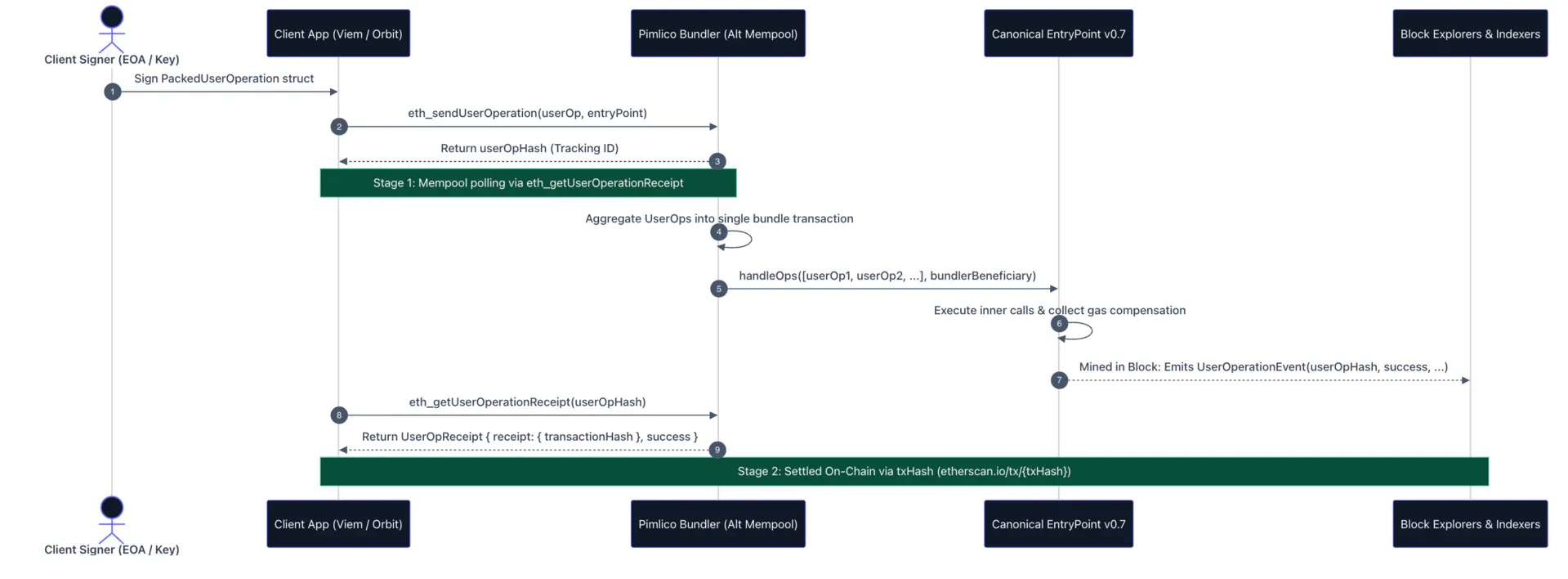
Read the full architectural guide on docs: https://docs.tuwa.io/guides/erc-4337-sovereign-account-abstraction
How is your engineering team currently approaching Account Abstraction: sticking to vanilla EOAs, using modular smart accounts (Solady / ERC-7579), or adopting embedded WaaS?
Replies
Be the first to reply
Have a question or a thought to share? Add a comment above to start the conversation.