

Is Product Hunt worth it? My homework before asking for votes
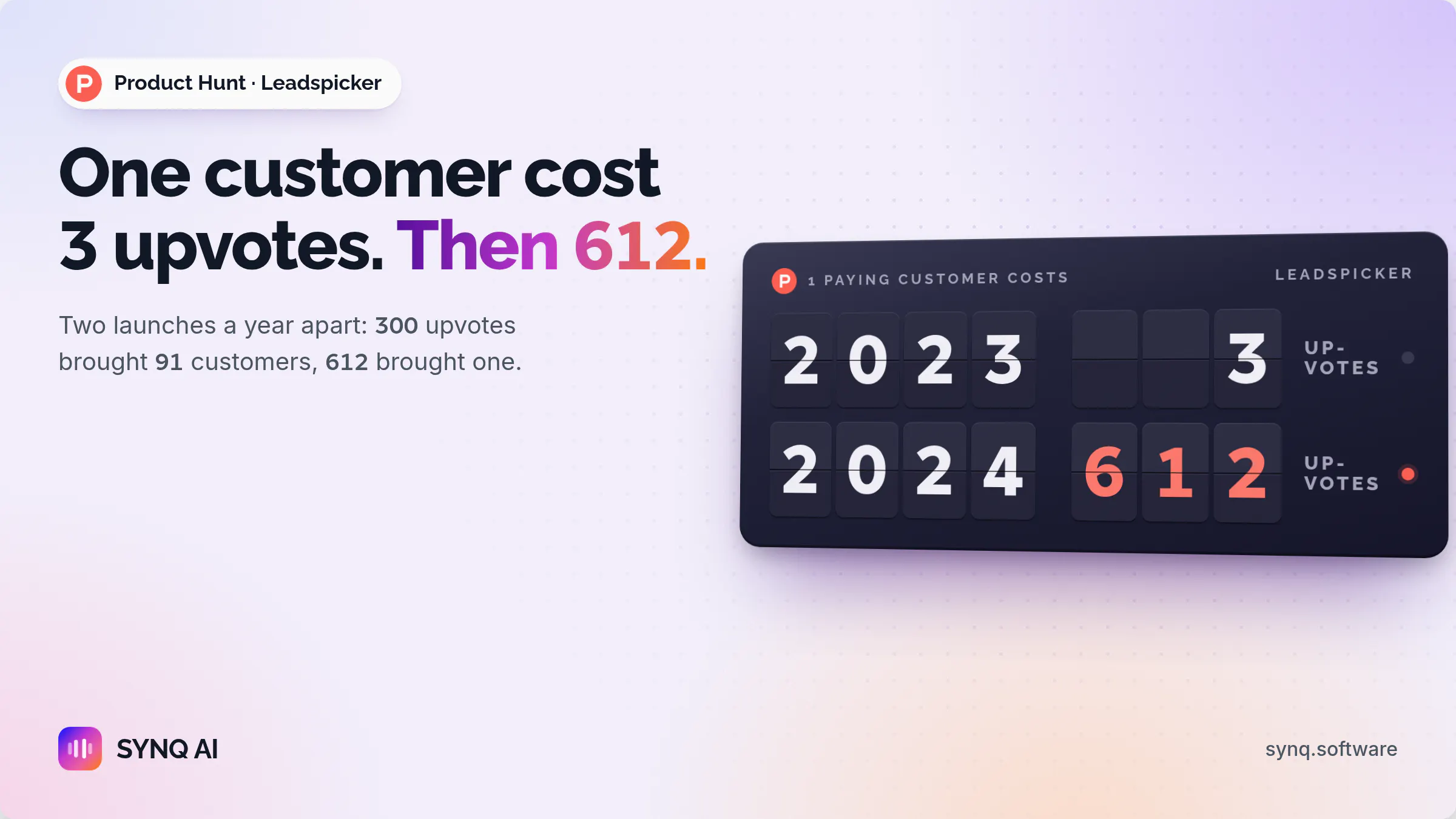
In June 2023 Tomas Blatak and the @Leadspicker team put a side project on Product Hunt. It got featured, collected 300 upvotes, finished seventh product of the day and brought them 91 paying customers.
In September 2024 they launched their main product. It got 612 upvotes and was the most upvoted launch for most of that day. They got one paying customer.
The product was better the second time. Something else changed, and it's the most useful thing I found while doing this homework.
Most of our marketing effort at SYNQ AI goes into social: Instagram, Threads, YouTube and LinkedIn. We shoot reels, film videos, make posts, carousels and articles like this one. But when you're a startup, you also need to be listed in all the places where people check startups out. So SYNQ AI is on G2, Capterra, Crunchbase, Trustpilot and TrustRadius. We test every page, network and directory we can reach, and every lead that comes in carries a tag with the channel that brought it.
The one big place we haven't touched yet is Product Hunt.
Before I start sending "we're launching on Product Hunt, vote for us" to everyone I know, I wanted straight answers for myself. Does Product Hunt bring leads, subscribers, buyers, any real audience? Do buyers even look for products there? Does it help you show up in ChatGPT? And if you do it, how deep do you have to go?
I wrote this as prep work for myself, and I found an answer to every one of these questions. By the end of this article you'll have them too, before your own launch day.
I counted who would actually show up
Everyone around wants to build their own startup right now, and everyone has a launch day coming.
So picture your list. Friends, colleagues, relatives, partners. This is a motivated audience: they like you and they want you to win. From everyone you reach, I think maybe half will actually open the link and do something.
I don't know about you. I'm a pretty sociable, extroverted guy, and I have a lot of colleagues and partners in different fields. Even for me honest number is around twenty people.
Now look at the bar. Tom Dekan, who won Product of the Week, says you need about 1,000 upvotes in a day to take Product of the Day with high confidence. He compares it to Kickstarter, where raising $100,000 means you bring the first $30,000 from friends and family yourself.
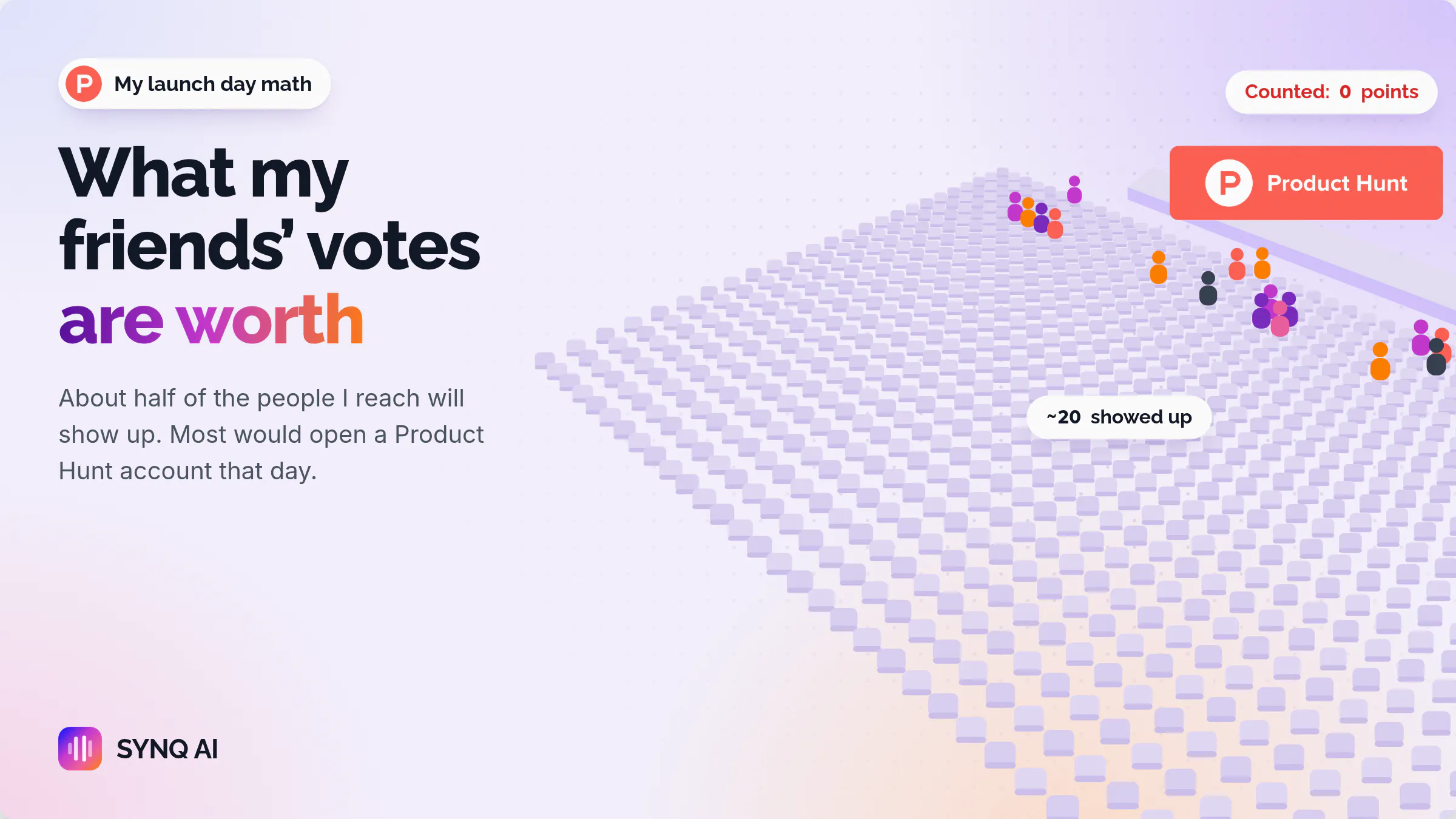
Twenty is a long way from a thousand.
Product Hunt counts most of those votes as zero
And those twenty are worth less than you think.
Not everyone I message will come. The half who do are the people who really want me to win, and most of them don't have a Product Hunt account. They'd create one on launch day, click the arrow and close the tab.
The Product Hunt team explained on their forum what that vote is worth. A fresh gmail account with no history on the platform counts for 0 points. A vote from a company email tied to a real LinkedIn profile, with a history of useful comments, carries real weight.
Then there's the message itself. "Vote for us" is the one thing Product Hunt asks you not to send. Their help center answers "can I ask my friends and family to upvote?" with "Please don't." Asking for upvotes can drop your product in the ranking or take it off the homepage, and the community guidelines list it right next to using bots.
So the classic launch routine, a mass DM with a link and "vote for us", fails twice.
Too few people come, and the ones who come barely count.
Only one launch in ten gets seen now
Back to Leadspicker. Their second launch, the one with 612 upvotes, wasn't featured.
That's what changed. Product Hunt now splits launches into featured and everything else, and only featured ones get real exposure. Rashi Umapathi writes that roughly one launch in ten gets featured today, down from 60 to 98 percent before January 2024.
More votes and no feature gave Leadspicker one customer. So your launch day is a bet on an editorial decision you don't control, and twenty friends won't move it.
Product Hunt is full of founders. Are they your buyers?
Who is actually scrolling Product Hunt at launch hour? Mostly other makers, founders and early adopters, people who enjoy trying new tools. Rashi's point is that a typical B2B customer is unlikely to be online just after midnight, upvoting SaaS launches. She puts launch conversion at 1 to 3 percent and calls it awareness at the top of the funnel.
When I read that, I realized it describes SYNQ AI's audience pretty well. More than half of our paying clients are startups: founders who need an AI employee to talk to their users, answer questions about the product and sell it. So for us the Product Hunt crowd sits close to the buyer, and the question gets harder to wave away.
If you sell to dentists, restaurants or accountants, it's simpler. They're probably not scrolling Product Hunt at all.
Your buyers ask ChatGPT first
This was my GEO question. G2 surveyed 1,076 software buyers in March 2026, and 51 percent now start their software research in an AI chatbot more often than in Google, up from 29 percent a year before. So the thing that matters is which sources the chatbot trusts.
Peec AI went through 30 million sources that AI search engines cite. LinkedIn sits near the top of their list, and G2 shows up for B2B questions on Perplexity. I couldn't find Product Hunt anywhere in their top lists.
Our own numbers taught me more than any study. More than 100 people came to SYNQ AI from ChatGPT, and six of them moved to a paid plan after the trial. We know it was ChatGPT because the platform tags every lead with its source.
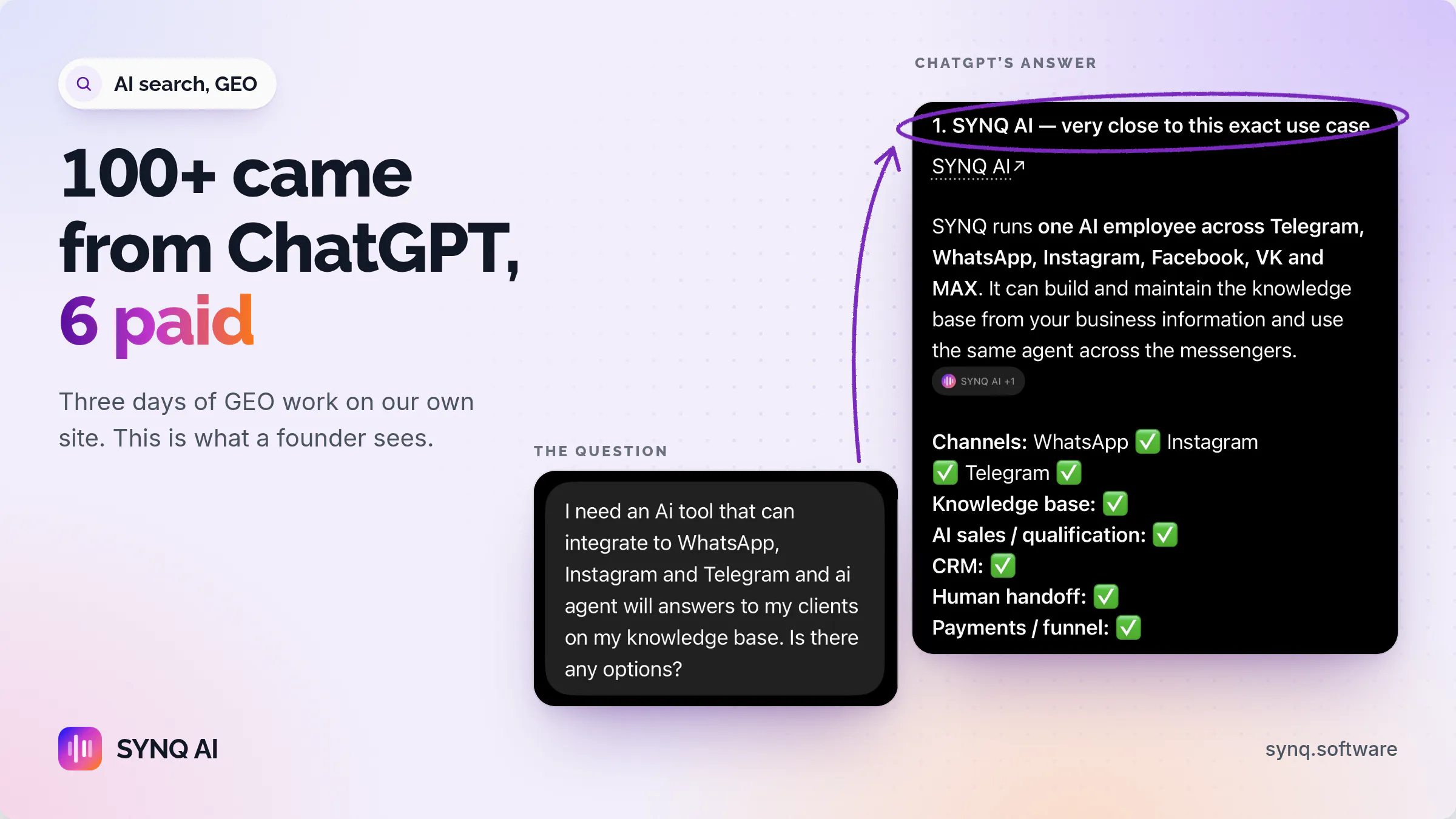
We got there with GEO, AI search optimization done carefully and on purpose. Listings, LinkedIn and Reddit had nothing to do with it. I'll write separately about how we did it, it took us literally three days. By the way, we do the same GEO work for other companies at SYNQ AI Studio.
A Product Hunt page still helps a little: it's an indexed page on a domain with a rating around 91, and one more place that spells your name the same way. For showing up in AI answers, though, it's a small piece.
Where Product Hunt still earns its day
I don't want to be unfair. Product Hunt does give you real things:
A badge for your landing page. Several founders say the badge alone justified the effort.
A news hook. Fewer than 10 percent of successful launches get press by themselves, but a good day gives you a reason to write to journalists.
A permanent page on a strong domain.
Feedback from people who try new products for fun. Comments from other makers can be harsh, and useful.
A room full of founders. If founders are your buyers, that's your market in one place.
For us that last one is the strongest argument. So Product Hunt stays on our list. The open question is when.
Product Hunt multiplies the audience you already have.
If you go, go all the way
Without the feature nobody sees you, so half a launch is pretty much no launch. That leaves two honest answers to "how deep should I go": all the way, or not yet.
All the way costs real time. Awesome Directories puts proper prep at 50 to 120 hours. It also says you need 200 to 400 engaged supporters from established accounts, meaning people who were active on Product Hunt for weeks before your launch. Rashi says many founders end up spending 100 to 200 hours.
Here's what I'd want in place before we launch:
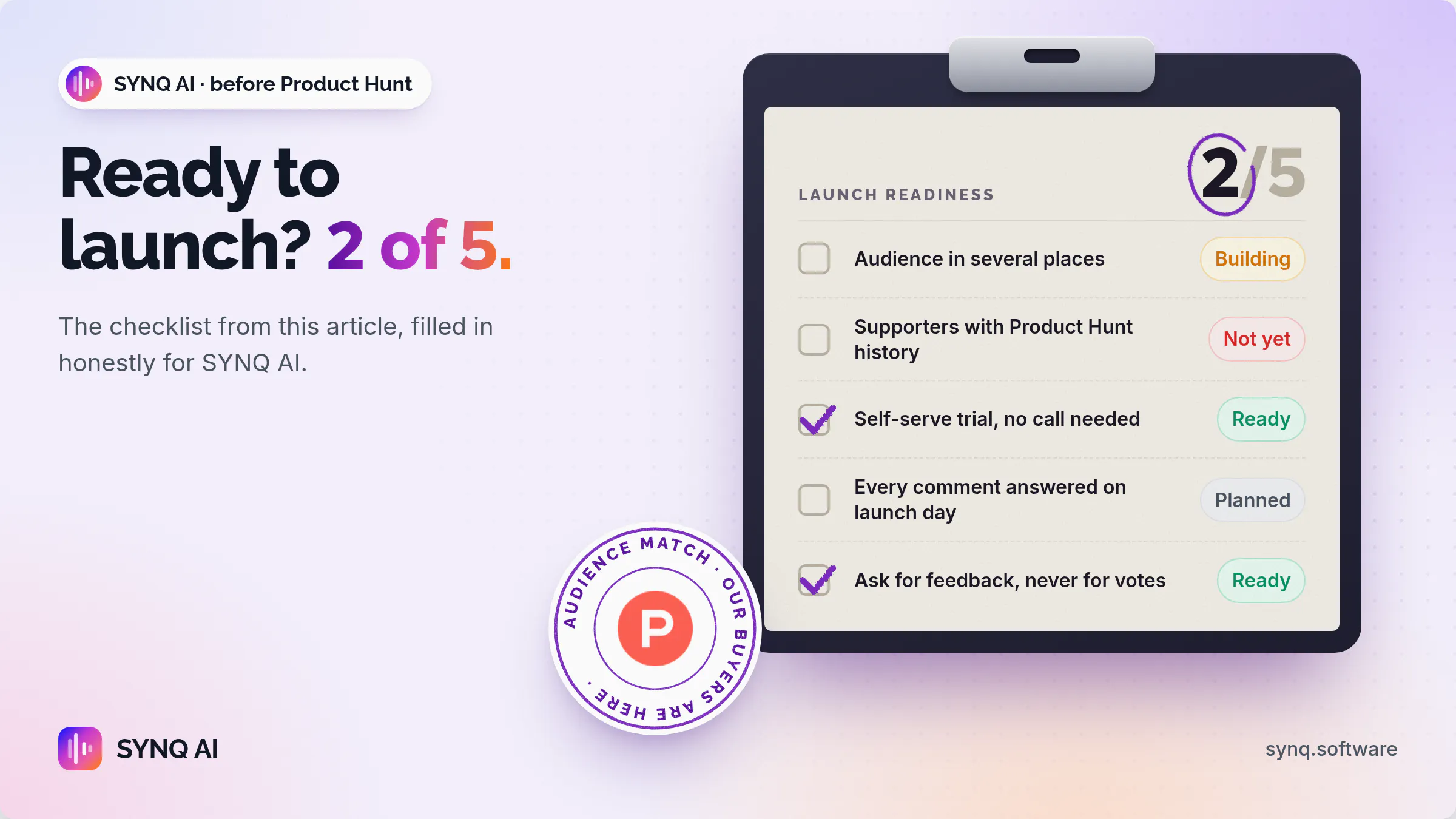
Two of those boxes are real today. The trial is self-serve, and I'm not sending a single "vote for us" message to anyone. The audience is still being built, the supporters with real Product Hunt history don't exist yet, and the full day of answering comments is planned rather than done.
We're launching on Friday with two of the five
You've seen the channels we work with. Every lead carries its source, so we see which one brings people who pay and which one brings noise. One Meta ads test brought around 300 leads. Our own AI employee qualified them and showed us the targeting was off. We fixed it in four days, and after that two clients came in and paid.
Product Hunt was the last one on that list, and by my own standard we're not ready. We're going on Friday, September 25 anyway. My twenty-people math is worth nothing until somebody runs it, and I'd rather run it on us than keep arguing about it in a document.
So this article is the experiment, and you're holding the other half of it. The page is live now: follow SYNQ AI on Product Hunt.
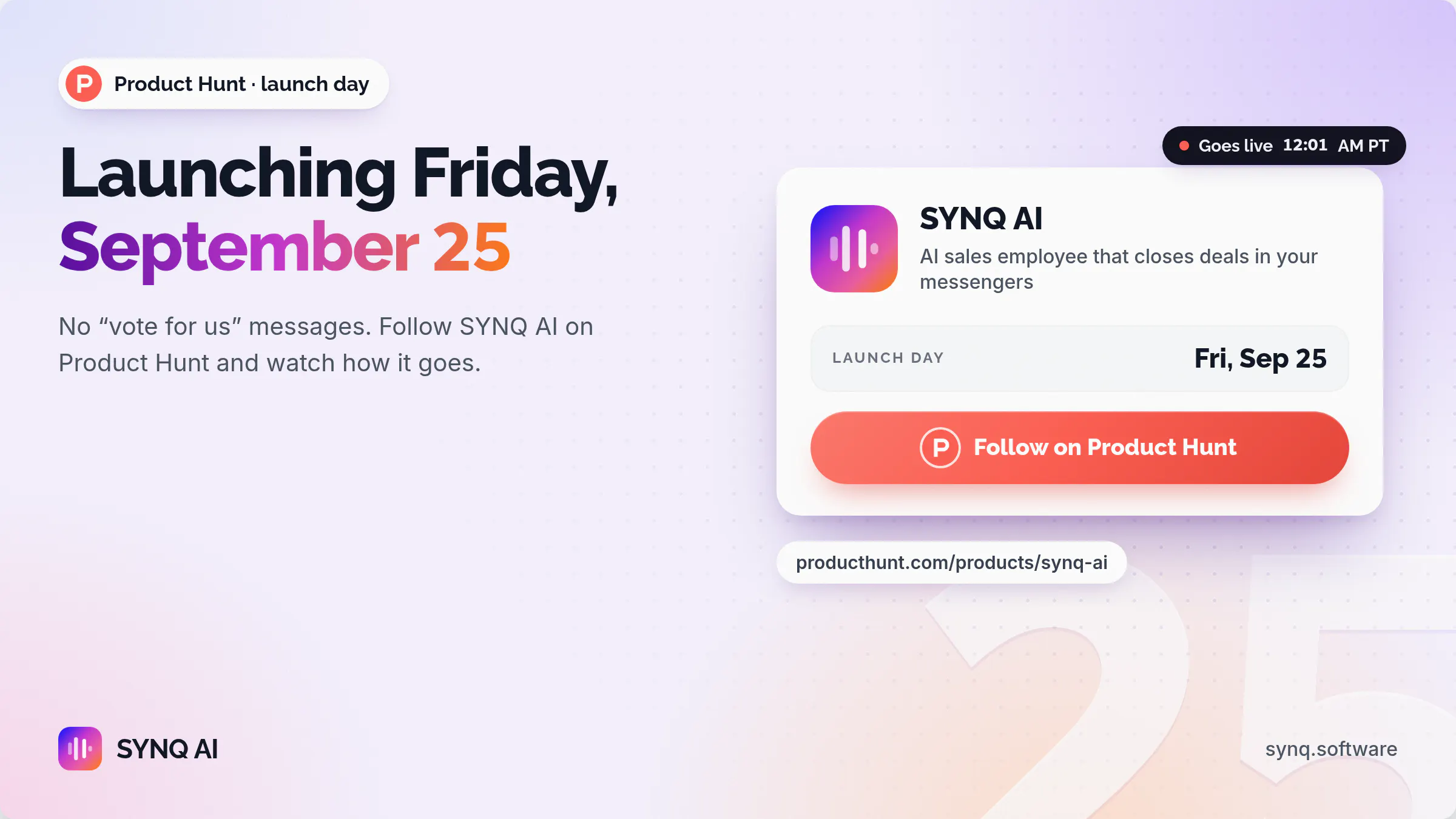
I'm not asking anyone to upvote. I quoted the guidelines four sections up, and asking would turn this whole article into a lie. What I'm asking is smaller: follow the page before Friday, and on launch day come and tell me where the product is wrong. Be harsh, that's the useful kind of comment.
Then we both get the number. Twenty people, the way my own math says. Or enough founders to show that a company that did the homework first can still get something real out of a launch day.
I'll publish the result here either way: upvotes, signups, and how many of those people paid. If you launched in the last year, put your numbers in the comments, especially if you think my twenty-people math is wrong. Friday is when I find out.
Savva Kulakov is co-founder and CEO of SYNQ AI, a platform for AI employees that talk to customers in messengers and take them from the first message to payment.
Replies