

Coordination is not orchestration
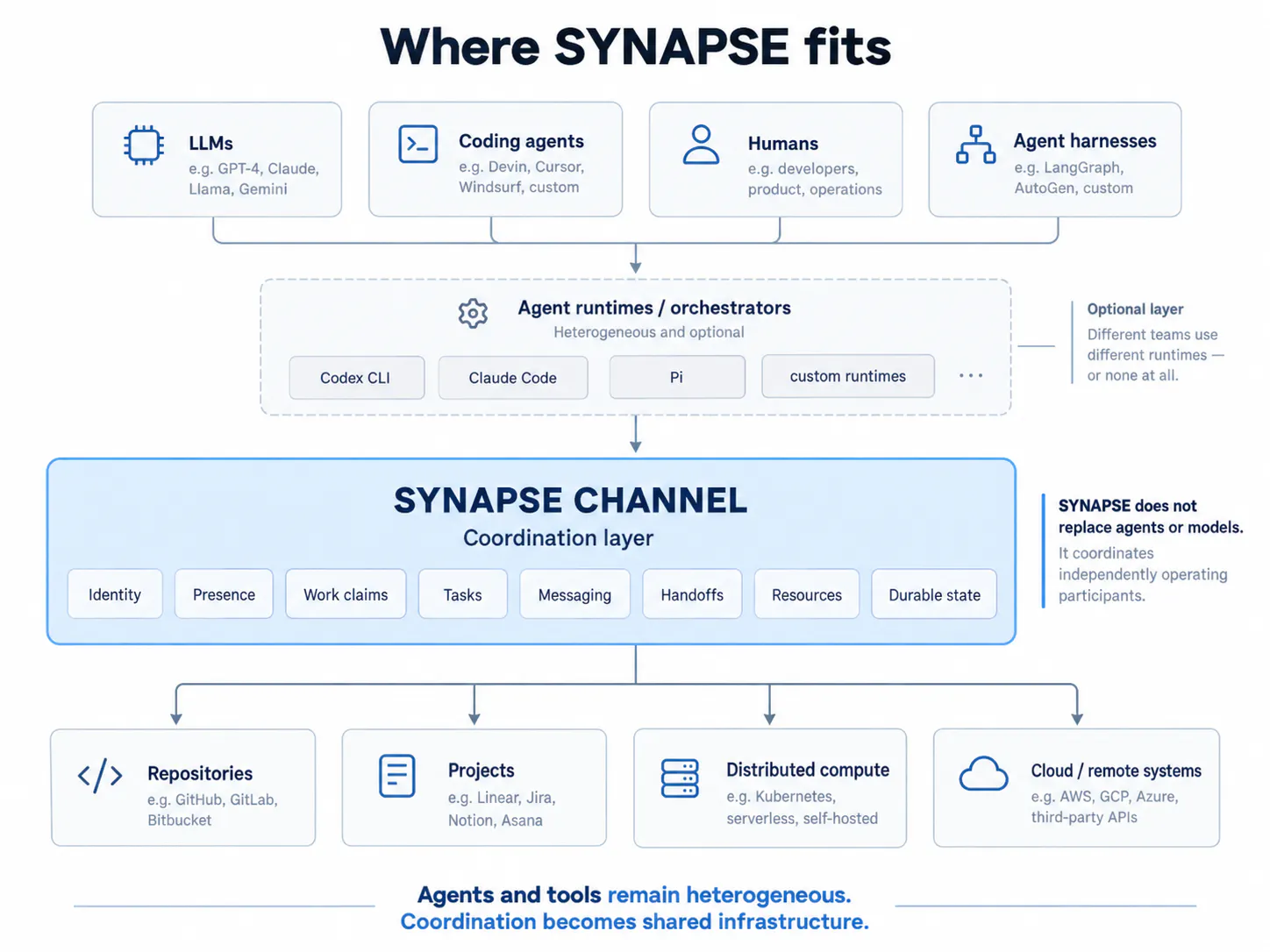
Coordination is not orchestration: where SYNAPSE fits
One of the easiest ways to misunderstand SYNAPSE is to think of it as another agent framework.
It isn't.
There is already a growing ecosystem of excellent tools for building and running agents: coding agents, agent harnesses, orchestration frameworks, model SDKs and custom runtimes.
SYNAPSE is designed to work with those systems rather than replace them.
Orchestration and coordination solve different problems
An orchestration framework typically defines how an agent or a group of agents executes a workflow:
which step happens next,
which model or tool is called,
how reasoning branches,
how agents are composed,
and how a particular workflow progresses.
That is extremely useful, but it is a different problem.
SYNAPSE operates between independently running participants.
Those participants might be Codex, Claude Code, another coding agent, an agent harness, a custom runtime, an orchestration framework containing several internal agents, or a human developer.
SYNAPSE does not need to own their reasoning loop.
Instead, it provides shared coordination primitives around them:
identity · presence · work claims · tasks · dependencies · messaging · handoffs · resources · durable state
Why does that distinction matter?
Imagine two independent coding agents running in separate terminals.
Neither agent necessarily controls the other.
They may use different models.
They may have been launched by different tools.
They may even belong to different repositories or projects.
What they still need is a reliable way to answer questions such as:
Who owns this work?
Can I safely modify this scope?
Is someone else already working here?
What task is blocked?
Who should receive this handoff?
What happened before I joined or restarted?
That is the coordination layer SYNAPSE provides.
Existing tools do not have to be abandoned
This is an important design principle.
If a team already uses coding agents or orchestration systems that work well, adopting SYNAPSE should not require replacing them with a new proprietary agent stack.
They can remain heterogeneous.
The shared layer is the coordination infrastructure beneath or between them.
So I do not see SYNAPSE as a replacement for systems such as CrewAI, LangGraph, AutoGen, Codex, Claude Code or other agent environments.
They solve adjacent parts of the stack.
The agent or orchestrator determines how work is performed.
SYNAPSE coordinates how independently operating actors share that work.
That separation is also why the core architecture is model- and vendor-independent.
More detail on this distinction is documented here:
https://github.com/anulum/synapse-channel/blob/main/docs/comparison.md
Replies