

Launching today: Instructions vs. Memory 🧠 aka Context v2

Not all context is equal.
So we stopped treating it that way.
Most AI tools store everything the same:
Writing rules
Personal background
Preferences
Temporary notes
But a rule like:
“Use bullet points.”
…shouldn’t behave the same as:
“I run a fintech startup and we've just raise $4m”
So we rebuilt our context system, to help Pretty Prompt give better results.
(Best part, the user owns that context, and can use it across any LLM)
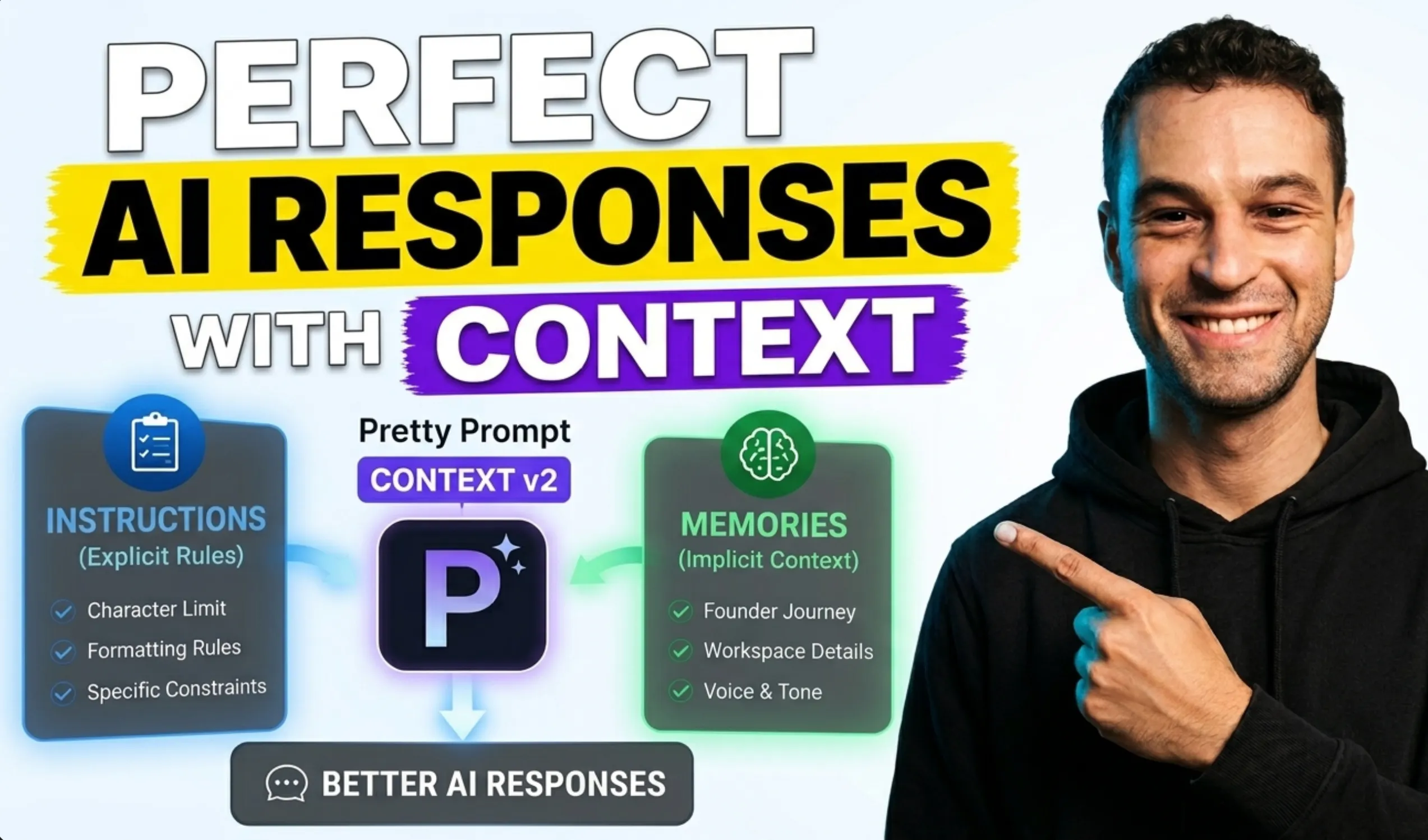
Launching today Instructions vs Memory.
🔒 Instructions
Explicit rules that always apply. Examples:
“No em-dashes”
“Keep answers under 512 characters”
“Use bullet points”
🧠 Memory
Background context that only appears when relevant. Examples:
“My audience is non-technical”
“I'm launching on Product Hunt and like to post from a builder's mindset”
“I’m writing a client proposal that should include...”
The best part:
You don’t organize any of this manually.
You just write naturally.
Pretty Prompt auto-classifies everything on the backend.
The goal is simple:
Make AI outputs be personal — without adding more work.
Still bootstrapped. Still shipping 🚀
PH community, give us feedback; we need it.
(PS - I vibed this thumbnail, don't judge me 🙈)
Replies
My LLM isn't following the explicit rules no matter how many times I repeat them. Thoughts?
@zanc_zhao Drop me an email to help@pretty-prompt.com and I'll personally look into it and help :)
Easier there so I don't miss anything
Really like this distinction. Treating “instruction” and “memory” as the same thing is one of those small product choices that quietly creates a lot of mediocre AI output.
The auto-classification piece feels especially important. Most people will not maintain a context system manually, but they *will* write naturally if the product can infer what should persist, what should be temporary, and what should act like a rule.
One thing I’d be curious about: do you let users inspect or correct the classification after the fact? I’ve found that trust in AI memory often depends less on perfect recall and more on whether people feel they can see and shape what the system thinks it knows.