

Enterprise Web Search AI Agents: Turning Live Search Into Trusted Business Intelligence
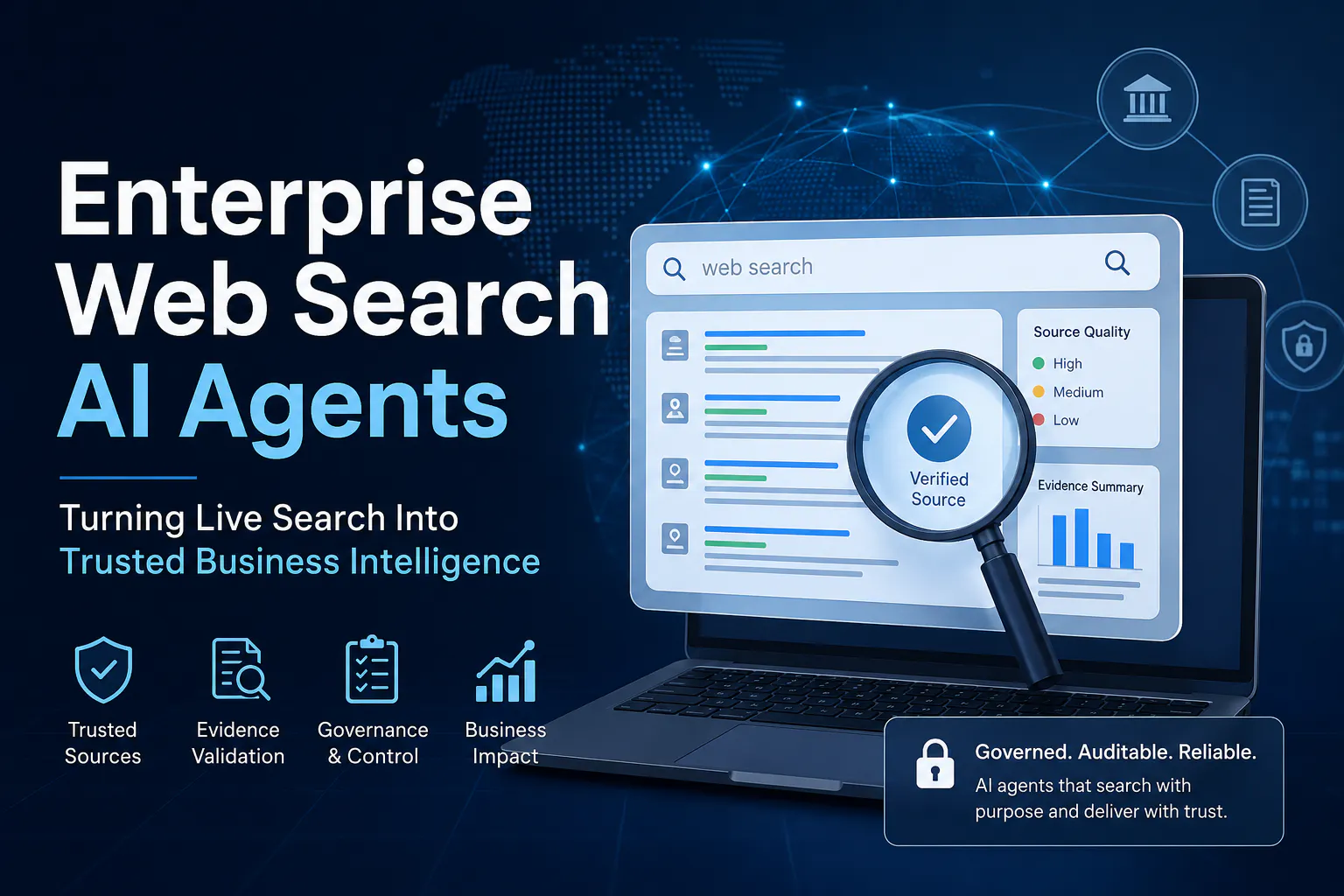
Web search AI agents can look useful because they retrieve live information. But that strength also creates risk.
The open web contains outdated pages, weak sources, biased vendor claims, duplicate content, and SEO articles that rank well without adding real evidence. If an AI agent uses these sources without control, it may produce answers that sound precise but fail under review.
That is why enterprises should not view web search as a simple AI feature. They should treat it as a governed business capability.
For a practical breakdown of the core workflow, AIQuinta explains how a web search AI agent works across query planning, source retrieval, evidence checking, and response generation. The next step is to understand how enterprises can make that workflow reliable, auditable, and safe for business use.
Why Web Search Agents Need Enterprise Controls
A normal search tool gives users a list of links. A web search AI agent goes further. It searches, reads, compares, summarizes, and turns web content into an answer.
This creates leverage. It also creates exposure.
A weak web search agent may:
Cite low-quality sources
Miss recent changes
Overuse outdated information
Treat marketing pages as proof
Combine weak signals into a strong claim
Skip important context
Search too much and increase cost
In a personal workflow, this may be acceptable. In an enterprise workflow, it is not. A poor answer can affect sales planning, compliance review, vendor selection, market analysis, or customer communication.
The issue is not whether the agent can search. The issue is whether the agent can search with discipline.
What Makes a Web Search AI Agent Enterprise-Ready?
An enterprise-ready web search agent needs clear operating rules. It should not browse the internet without limits. It should follow a defined process that reflects business risk.
The first control is intent detection. The agent should decide whether web search is needed. If a user asks about an internal policy, the agent should use approved internal knowledge first. If the user asks about current laws, product updates, market news, or competitor activity, web search becomes relevant.
The second control is source policy. The agent should know which sources to trust. Official documentation, government websites, company filings, standards bodies, and primary research should rank above blogs, forums, and aggregator pages. Source quality should change based on the task. A compliance answer needs stricter sources than a general market scan.
The third control is evidence validation. The agent should not cite a page just because it found it. It should check whether the source is current, relevant, and strong enough to support the claim. For high-risk topics, one source is rarely enough. The agent should compare evidence and surface conflicts.
The fourth control is stop logic. A web search agent needs a hard brake. Without stop rules, it may keep searching even when more information does not improve the answer. Stop rules help manage cost, speed, and quality.
The fifth control is escalation. Some answers should not be automated end to end. If sources conflict, evidence is weak, or the topic carries legal or financial risk, the agent should flag the issue for human review.
High-Value Use Cases
Enterprise web search agents create the most value when the task depends on current external information.
One strong use case is competitive intelligence. The agent can track competitor websites, product pages, pricing updates, funding news, hiring signals, and partnership announcements. Instead of asking teams to scan the market by hand, the agent can highlight what changed and why it matters.
Another use case is sales research. Before a sales call, the agent can review a prospect’s latest company news, leadership changes, public initiatives, and industry context. This helps sales teams create sharper account briefs and more relevant outreach.
A third use case is vendor evaluation. Procurement teams can use agents to compare product claims, security pages, certifications, customer proof, and pricing signals. The agent should separate vendor-owned claims from independent evidence.
Regulatory monitoring is also a strong fit, but it needs stricter governance. The agent should prioritize official sources and avoid relying on secondary summaries when rules, deadlines, or obligations are involved.
The Risk of False Confidence
The strongest case against web search AI agents is false confidence.
A response with citations can still be wrong. Citations prove that the agent found sources. They do not prove that the answer is complete, current, or fair.
This is why enterprises need auditability. Teams should be able to see:
Which queries the agent used
Which sources it opened
Which sources it ignored
Which claims each citation supports
Where evidence was weak
Why the agent escalated or stopped
Audit trails help teams improve the system. They also make the agent easier to trust.
Practical Governance Checklist
Before deploying a web search AI agent, enterprises should define:
Approved source categories
Blocked source categories
Minimum source requirements
Recency rules
Citation standards
Human review triggers
Cost and time limits
Escalation paths
Quality metrics
The goal is not to slow the agent down. The goal is to remove random behavior. Clear rules help the agent work faster because it knows where to search, what to trust, and when to stop.
Final Thoughts
Web search AI agents can become a powerful layer for business intelligence, sales enablement, compliance monitoring, and market research. But live web access is not enough.
The real value comes from controlled execution.
Enterprises need agents that can search with purpose, validate evidence, cite sources correctly, manage cost, and escalate when confidence is low. The future of agentic search will not belong to systems that read more pages. It will belong to systems that know which information deserves trust.
___________
AIQuinta - An Agentic Enterprise Platform, where your knowledge base powers AI.
- Website: https://aiquinta.ai/
- Email: info@aiquinta.ai
Replies
Be the first to reply
Have a question or a thought to share? Add a comment above to start the conversation.