
The Leaderboard
by Product Hunt
Friday, Jun 05
Friday, Jun 05
Weights in the wild
gm legends, happy Friday.
Four ex-Google Brain researchers just opened the vault, Arena handed the wheel to its AI, and someone quit Pinterest and built their own.
Google Brain finally opened the box

Ideogram 4.0 is the first open-weight model from the four ex-Google Brain researchers who built Ideogram: a 9.3B diffusion transformer with native 2K output and JSON layout control, so you specify where elements go instead of hoping a paragraph prompt figures it out.
🔥 Our Take: Ideogram's differentiator has always been text rendering: legible words inside an image when every other model was still hallucinating fonts. Every previous version lived behind a closed API. 4.0 ships the weights publicly the same day it goes live on their own platform, sitting first among open models on the designer preference leaderboard with only OpenAI and Google above it.
The judge became the agent

Arena Agent Mode brings autonomous AI agents to arena.ai. The same platform that built its reputation benchmarking and comparing frontier models now deploys them to browse, research, code, and complete real-world tasks.
🔥 Our Take: Arena has spent years ranking which AI model is best. Agent Mode is what happens when the rankers decide to run it themselves. The interesting question isn't whether they built this — it's what they learn when the leaderboard stops being theoretical.
Someone finally quit Pinterest

Moodloom is an ad-free visual discovery platform for fashion, decor, and art, with a toggle to hide AI-generated content and an import tool that pulls your existing Pinterest boards over.
🔥 Our Take: Pinterest didn't fail on ads. It failed on curation, and ads are how that happened. Moodloom's bet is that removing the noise is worth starting from scratch on the network.
How much money is enough to start?
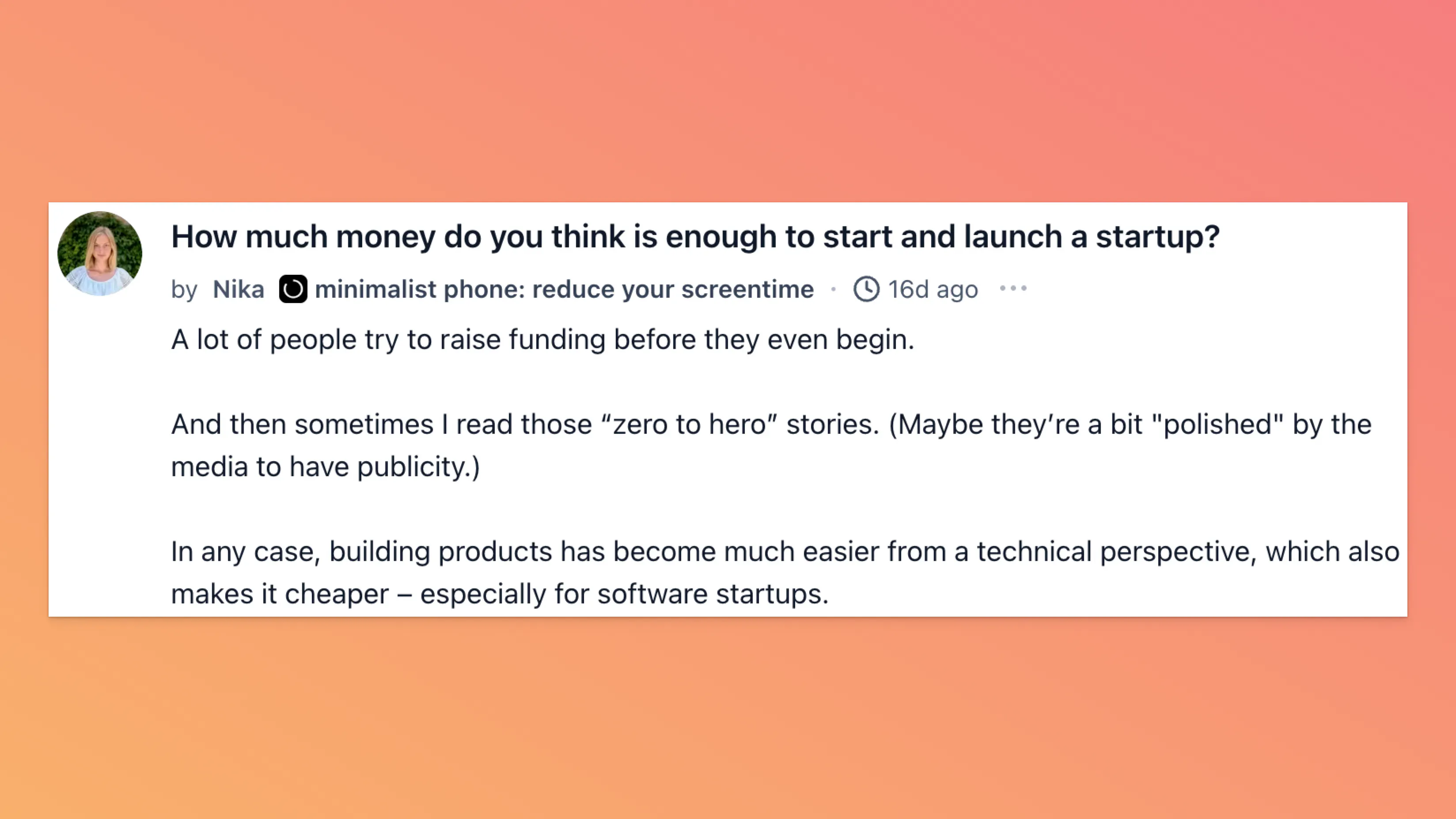
Nika (@busmark_w_nika) asked how much capital it actually takes to launch a startup now that AI has gutted the technical cost of building. The thread split fast: Jonathan Goodman shipped an app in four weeks for under $3K using ChatGPT. Vivek Bohara said that was still too much and named free-tier alternatives for everything. John Hammond, who has shipped 28 apps, came in with the real answer.
Hammond's point landed hardest: build costs are $100 to $500 now. The actual constraint is 12 months of distribution effort to find out if anything is working. The disagreement underneath all of it is whether cheap-to-build democratizes entrepreneurship or just creates more crowding in the marketing layer.
"Enough to start differs vastly from enough to last long enough to find out if it's working." — Edikan Peters, cutting to it.
Daily Top Products


