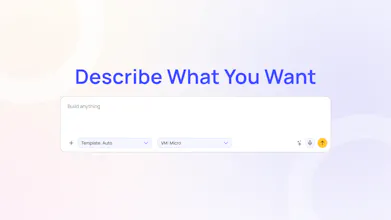
AppWizzy gives you a private VM with Codex installed where you build, run, and host production web apps by chatting with AI. Your code is yours, the workspace persists, and the app lives in the same environment where it was created. Pay only for AI usage, hosting days, and optional templates
Hi Product Hunt
I am Philip Daineka, founder of AppWizzy.
I have been building software for around 16 years and running Flatlogic, our software development company, for 13+ years. Over that time, we have delivered many client projects and spent hundreds of thousands of hours building real business software: SaaS products, CRMs, ERPs, admin panels, portals, internal tools, and custom web apps.
One thing I have learned very clearly:
Making a prototype is easy. Shipping and maintaining production software is the hard part.
That's why I've always been skeptical of many vibe-coding platforms. They are impressive for quick demos, but I would not start a serious client project on something that only gives me a front-end preview, hides the infrastructure, or locks the app into a platform that is hard to control later.
So we built AppWizzy.
AppWizzy gives you a private dedicated VM with Codex installed, where you can build, run, and host production web apps by chatting with AI.
The key difference is that your app does not just get generated and exported somewhere. It lives in the same cloud environment where it was built. You get a real development machine, real backend capability, database support, hosting, source code access, different environment, and much more control over the stack - basically, everything you can do when you do indeed have full control over your VM.
AppWizzy started from our internal tooling at Flatlogic and has now become a standalone product.
We are also working on vertical production-ready templates for different use cases, so users can start from a strong foundation instead of a blank page and ship faster from day one.
For the Product Hunt launch, we are offering 20% off. Use promocode: APPWIZZY-LAUNCH2026
I would love feedback from founders, developers, agencies, and anyone who has tried vibe-coding tools but eventually hit the question:
"Okay, nice demo... but how do I turn this into a real production app?"
Thanks for checking out AppWizzy!
Philip
@okendoken Love what you're building here. One thing I kept noticing while going through your page though, there's a lot happening at once and it gets hard to know where to look first. When someone lands on your page for the first time, they're skimming, not reading. If the layout doesn't guide their eye, they leave before they even get to the good stuff.
I design landing pages for SaaS products and I'd love to put together a sample page for this, just to show you what a cleaner, more structured version could look like. No commitment, just something concrete you can actually see and react to.
We are already working on making the first-time experience clearer and more focused. Feel free to share your thoughts, but for now our priority is improving the product flow and helping users ship real apps faster.
Report
AppWizzy's approach of co-locating the coding agent, runtime, and host in one VM is smart. Separating build environment from deployment creates an entire class of 'works on my machine' bugs in AI-generated apps. How does Codex handle long sessions where the agent needs to reference files it created hours earlier: does it keep a persistent context index, or re-scan the workspace on each request?
@anand_thakkar1 Exactly. For us the VM/workspace is the durable memory: files, Git history, logs, configs, and build output. Codex can resume sessions, but we don’t rely on LLM context as a perfect long-term memory, the agent re-inspects the repo when needed.
Report
@okendoken The “works in the same environment it was built in” distinction is underrated. Every vibe-coding demo I’ve seen eventually hits the “okay but where does it actually run” wall. The co-located VM approach is a clean answer to that. Curious how you handle rollbacks - if the AI makes a destructive change mid-session, is that recoverable from within the same environment or does it require external Git discipline?
@okendoken@skyninety Yes, recoverable inside the same environment. We treat the VM as a versioned workspace, not just a runtime. The AI works through files and Git/checkpoints, so if it breaks something, we can inspect the diff and roll back from there. External Git is still useful, but rollback should not depend on the user having perfect engineering discipline.
Report
the 'app lives in the same environment where it was created' is a good idea in theory but production hosting on a development VM raises some questions. what does the security model look like for a production app running in a shared infrastructure environment and what happens to uptime when the VM needs maintenance or updates. those are different requirements than a dev environment and usually require different infrastructure
@ansari_adin "Same environment" doesn’t mean one fragile dev box pretending to be enterprise infra. The idea is to remove the build/run mismatch during creation. For production, we still care about isolation, secrets/env separation, restricted access, backups, Git/checkpoints, and redeploy/migration paths when uptime requirements grow.
Report
Cool project! I wanted to know, is there any reason why Codex was chosen over Claude? Why not both options?
Because Codex cli is open-source, unlike Claude. We love being able to tweak, control, and understand how things work under the hood, and it also gives us a better path to support many different models in the future
Report
Why only Codex? We usually use Claude Code. And second question: where are the hosting servers located?
We chose Codex because it's open-source, which gives us more flexibility, transparency, and control under the hood. It also makes it easier for us to support multiple models in the future.
As for hosting, our servers are currently located in the USA.
If you can share with us how you usually work with Claude Code it will be very interesting.
Thank you.
Report
Cool project! I wanted to know, is there any reason why Codex was chosen over Claude? Why not both options?
@jitendra_thakur4 Because Codex cli is open-source, unlike Claude. We love being able to tweak, control, and understand how things work under the hood, and it also gives us a better path to support many different models in the future
Flatlogic LLC
Incredible
@okendoken very interesting
@okendoken Love what you're building here. One thing I kept noticing while going through your page though, there's a lot happening at once and it gets hard to know where to look first. When someone lands on your page for the first time, they're skimming, not reading. If the layout doesn't guide their eye, they leave before they even get to the good stuff.
I design landing pages for SaaS products and I'd love to put together a sample page for this, just to show you what a cleaner, more structured version could look like. No commitment, just something concrete you can actually see and react to.
Would that be useful to you?
Flatlogic LLC
@okendoken @grace_unleash Thanks for the thoughtful feedback, Grace.
We are already working on making the first-time experience clearer and more focused. Feel free to share your thoughts, but for now our priority is improving the product flow and helping users ship real apps faster.
AppWizzy's approach of co-locating the coding agent, runtime, and host in one VM is smart. Separating build environment from deployment creates an entire class of 'works on my machine' bugs in AI-generated apps. How does Codex handle long sessions where the agent needs to reference files it created hours earlier: does it keep a persistent context index, or re-scan the workspace on each request?
AppWizzy
@anand_thakkar1 Exactly. For us the VM/workspace is the durable memory: files, Git history, logs, configs, and build output. Codex can resume sessions, but we don’t rely on LLM context as a perfect long-term memory, the agent re-inspects the repo when needed.
AppWizzy
@okendoken @skyninety Yes, recoverable inside the same environment. We treat the VM as a versioned workspace, not just a runtime. The AI works through files and Git/checkpoints, so if it breaks something, we can inspect the diff and roll back from there. External Git is still useful, but rollback should not depend on the user having perfect engineering discipline.
the 'app lives in the same environment where it was created' is a good idea in theory but production hosting on a development VM raises some questions. what does the security model look like for a production app running in a shared infrastructure environment and what happens to uptime when the VM needs maintenance or updates. those are different requirements than a dev environment and usually require different infrastructure
AppWizzy
@ansari_adin "Same environment" doesn’t mean one fragile dev box pretending to be enterprise infra. The idea is to remove the build/run mismatch during creation. For production, we still care about isolation, secrets/env separation, restricted access, backups, Git/checkpoints, and redeploy/migration paths when uptime requirements grow.
Cool project! I wanted to know, is there any reason why Codex was chosen over Claude? Why not both options?
Flatlogic LLC
Hi @ashishkingdom ! Thanks for your question!
Because Codex cli is open-source, unlike Claude. We love being able to tweak, control, and understand how things work under the hood, and it also gives us a better path to support many different models in the future
Why only Codex? We usually use Claude Code. And second question: where are the hosting servers located?
Flatlogic LLC
Hello @natalia_iankovych ,
Thank you for your questions!
We chose Codex because it's open-source, which gives us more flexibility, transparency, and control under the hood. It also makes it easier for us to support multiple models in the future.
As for hosting, our servers are currently located in the USA.
If you can share with us how you usually work with Claude Code it will be very interesting.
Thank you.
Cool project! I wanted to know, is there any reason why Codex was chosen over Claude? Why not both options?
AppWizzy
@jitendra_thakur4 Because Codex cli is open-source, unlike Claude. We love being able to tweak, control, and understand how things work under the hood, and it also gives us a better path to support many different models in the future