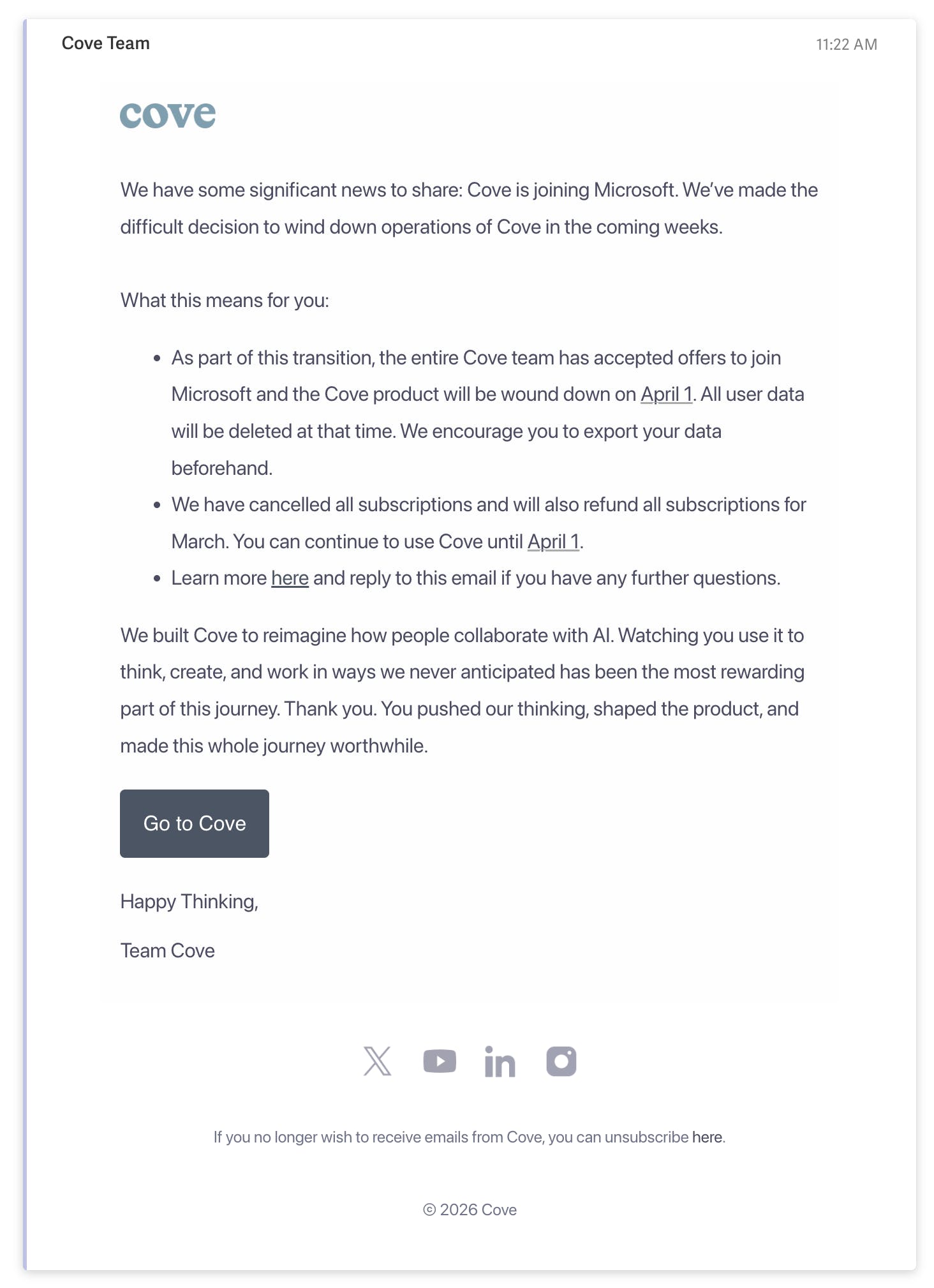
Cove has announced that they've been acquihired by Microsoft:
If you were a Cove user:
What this means for Cove
As part of this transition, the entire Cove team has accepted offers to join Microsoft, and the Cove product will be wound down on April 1. Existing users can continue using Cove until then, but we are no longer accepting new sign-ups.
We've built a data export feature so you can take your work with you. We recommend exporting as soon as possible all user data will be permanently deleted on April 1.
To export your data:
Sign in to your Cove account and go to your Account page.
Click the Export button.
You'll receive an email with a download link when your export is ready. The export will be a ZIP of HTML files containing all spaces you've created.
To export spaces created by others and shared with you, export each of those spaces individually.
We've spent the last few months building Genie, an AI analyst inside Databox. Tomorrow it goes live on Product Hunt.
The short version: you ask a question about your data in plain language, Genie finds the right metrics, runs the analysis, and returns an answer with a chart in seconds. No SQL, no waiting on someone else.
If you've been following along in this forum, thank you the conversations here genuinely shaped how we think about the product.
We go live at midnight PT. If you want to support the launch, the one thing that matters most: make sure you have a Product Hunt account before midnight. Votes from accounts created on launch day carry much less weight in the algorithm.
I ve been working on a chat widget designed to help businesses turn website visitors into customers using AI-powered conversations. The goal is simple: make it easier for companies to engage visitors, answer questions instantly, and increase conversions.
Cyber risk today is mostly documented in spreadsheets, PDFs, and slide decks formats that are hard to version, automate, or integrate with tooling.
CRML (Cyber Risk Modeling Language) aims to represent cyber risk as structured, machine-readable models instead of documents. This allows risk scenarios to be version-controlled, generated by tools, and executed through simulations.
First off: WOW. It's been 2 days since we launched Seagull on Product Hunt and the response has been incredible. We're genuinely blown away by the support, the upvotes, and especially the thoughtful feedback you've all shared. Thank you.
While you've been busy breaking down language barriers with real-time subtitles, we've been building something we're really excited about: Conversation Mode .
Here's the idea: instead of just translating what you hear, imagine sitting across from someone who speaks a completely different language and having a fluid, natural conversation. Seagull listens to both of you, figures out who's speaking and in what language, and shows each person the translation in real time. Up to 4 languages, simultaneously, in a clean split-screen grid.
We re making three frontier open-source models free* on Zo until the end of February. GLM-5, Kimi K2.5, and MiniMax M2.5 are now free to use on Zo. And we ve increased the AI usage limits on our free plan significantly.
We re incredibly excited about recent progress in open-source models. Three labs dropped big releases just weeks apart, ahead of the highly anticipated DeepSeek R2. These open models are quickly catching up to closed models like ChatGPT and Claude, which are much more expensive.
1. Startup founders get lost in legal, accounting, and administrative tasks after incorporation, leading to stress and risks due to the lack of a clear, step-by-step plan.
2. The owner of a relaunched bar on the French coast cannot attract an audience in the evening due to the legacy of its past format (nightclub) and its isolated location.
If your launch does not go as planned, do not judge it too quickly. Avoid the instinct to immediately add more features or pivot the product.
Instead, pause and evaluate what already exists. Check whether the core features are clearly communicated, fully polished, and genuinely solve the intended problem. Often, the issue is not the idea, but the execution, positioning, or user experience.
Refine what you have. Improve clarity, usability, onboarding, and messaging. Then relaunch with focus and confidence.
Many products fail not because they were wrong, but because they were unfinished, unclear, or rushed.