I've always been on the personal brand side. More and more founders are building it now (sometimes even before the product is ready while it's still in development, before seed fundraising). The CEO builds their position so the product sells more easily at the official launch.
But I have experience with people who built the product, scaled it, and only then did we discover who was behind it.
Honestly, with the first approach, I'd be concerned that people invest more in me as a person than in the product. People would idealise the founder and overlook the product's flaws (which could hurt development and constructive feedback).
+ I noticed the most common mistake that many people who started building a personal brand first, connected their product to their personal accounts (emails, social media, etc.) and started having a problem selling these things, because they cannot "give someone keys" to their personal profiles.
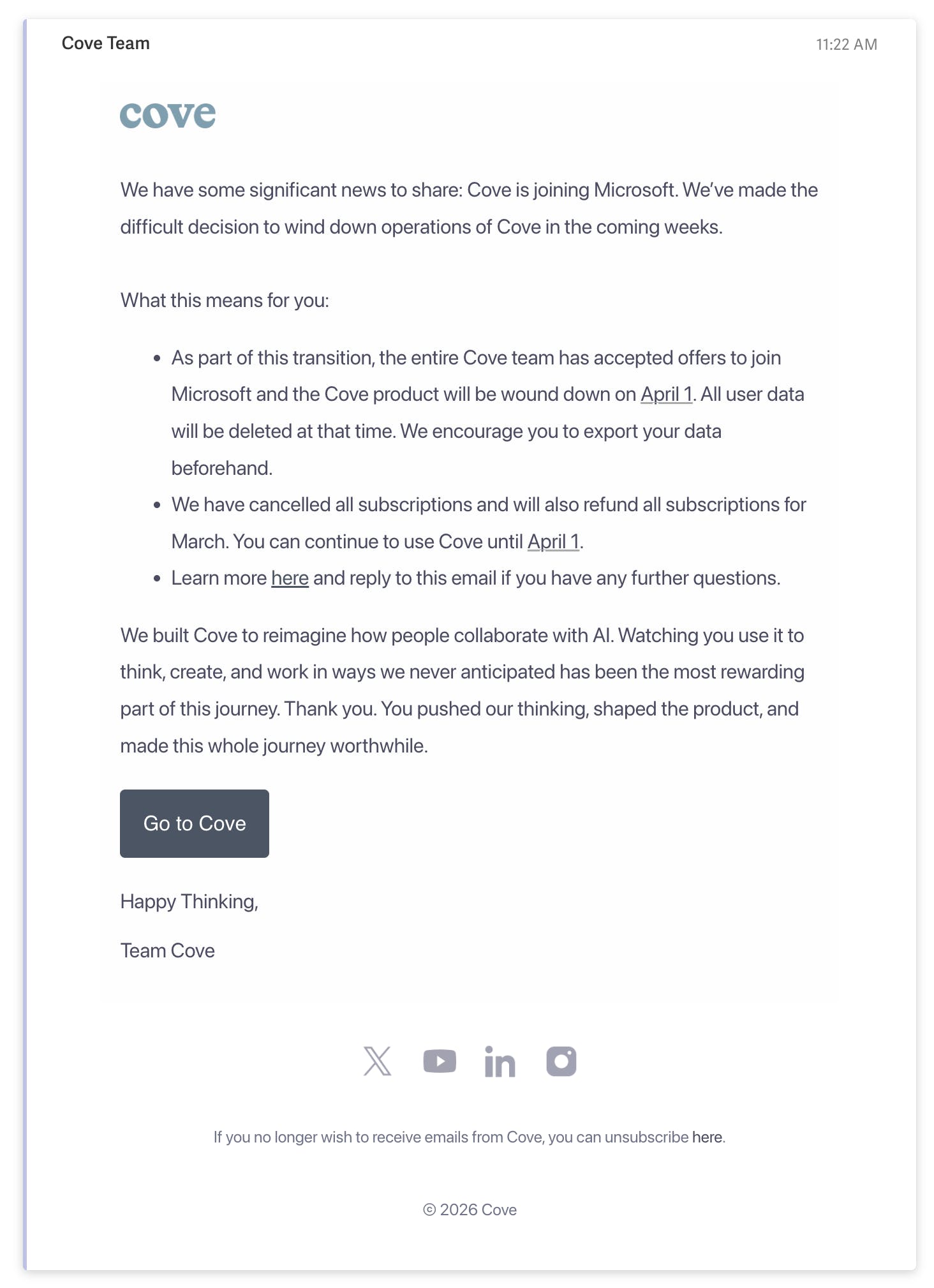
Cove has announced that they've been acquihired by Microsoft:
If you were a Cove user:
What this means for Cove
As part of this transition, the entire Cove team has accepted offers to join Microsoft, and the Cove product will be wound down on April 1. Existing users can continue using Cove until then, but we are no longer accepting new sign-ups.
We've built a data export feature so you can take your work with you. We recommend exporting as soon as possible all user data will be permanently deleted on April 1.
To export your data:
Sign in to your Cove account and go to your Account page.
Click the Export button.
You'll receive an email with a download link when your export is ready. The export will be a ZIP of HTML files containing all spaces you've created.
To export spaces created by others and shared with you, export each of those spaces individually.
Look forward to giving up the streak I get so much outreach on LinkedIn and across social because of my streak. Which is long, but not as long as others. Happy that this will force people to find something else to say to me when they reach out to me. It was a good run.
AI Director Mode is Visla’s new way to build videos. You start with any input, and Visla plans your video scene by scene with AI-generated storyboard images. Next, you set the direction, like pace, voiceover style, and the exact characters, objects, and environments you want on screen. Then you lock in products, logos, and other brand assets so your visuals stay consistent across every scene. Finally, you choose what stays as storyboard images and what becomes full AI video clips.
I ve noticed two main narratives in how companies view their competitors.
Either it s a fight to the death approach exactly like what we see between Replit and Lovable (though it seems Replit does more of the provoking ) basically: We speak badly about our competition.
Today, I read 2 messages that are contradictory in nature, and it seems like one branch is rebelling against the other.
Meta and other big tech companies are replacing human workers with AI.
Heineken, Aerie, Polaroid, and even Cadbury are riding the anti-AI wave, mocking Big Tech and positioning human-made creativity as the ultimate authenticity flex.
How do you think that these pro and anti streams can affect the evolution of AI and our perception of its use?
What did we at @Visla learn this time around? It s less stressful than the first one. that's for sure, but definitely not less important. We re at #6 right now, and it feels rewarding in a different way, because the team and the platform have been through so many iterations to get here. There s a maturity that only comes after shipping, learning, and doing it again.
A few lessons this time around:
Each launch teaches you something, even when you think you ve done it before.
The reaching out never stops, whether it s us asking for support, or others sliding in promising to get you to #1. You learn to tune most of it out.
Chasing the leaderboard isn t the goal. Building something that actually resonates with users is.
I've been pretty impressed at the amount of products people (including myself) have been able to create which got me curious... do vibe coders or AI-primary builders have a place in a company or team? My thinking is the more technically adept would work on the core-focus while vibecoders can assist with other tasks that shouldn't be the main devs focus...like a potential feature add, minor changes, or even exploring different ways of modifying the existing product. I'm curious what you all think, would you hire a vibe coder?
I've been pretty impressed at the amount of products people (including myself) have been able to create which got me curious... do vibe coders or AI-primary builders have a place in a company or team? My thinking is the more technically adept would work on the core-focus while vibecoders can assist with other tasks that shouldn't be the main devs focus...like a potential feature add, minor changes, or even exploring different ways of modifying the existing product. I'm curious what you all think, would you hire a vibe coder?
We know that productivity is a daily challenge for remote workers. I am guilty. So I am curious how you guys keep productivity at peak (or at a functioning level, at least) while working remotely? A good night's sleep and a cup of coffee/matcha are great boosts for me. How about you?


 Visla
Visla