
ZooWork lets you build, deploy, and deliver AI agents to teams or clients — experts start in the Builder UI, developers ship with the Managed Agent API. Turn your expertise into AI solutions built for real business operations.


Free Options
Launch Team / Built With


Render Sandboxes: a computer for every agentIsolated compute, persistent state and a real filesystem
Promoted
Hi Product Hunt! 👋
I'm Ning, founder & CEO of ZooWork. Some of you may remember us as ZooClaw from our launch here in April.
Since then, we've heard one thing over and over, and felt it ourselves: there are countless tools for building AI agents, but almost nothing for delivering them. Everyone has an agent that works beautifully on their laptop. Almost no one can hand it to a client, a team, or a paying user as a reliable service.
That gap changed what we build, and our name along with it. ZooWork is our answer: an agent delivery platform for forward-deployed engineers, developers, and domain experts, with the whole path from build to production in one place.
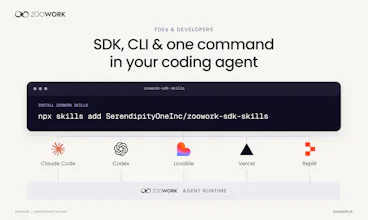
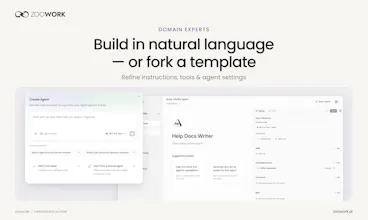
Build: Describe what you want in the no-code Builder, or stay in the coding agent you already use (Claude Code, Codex, and more) and ship through our Managed Agent API. Setup is one line:
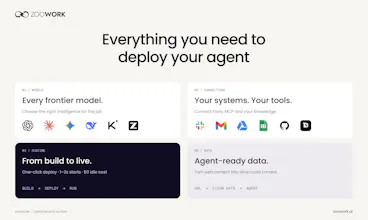
Deploy: One click to the cloud, from a single agent to a multi-agent pipeline. Agents cold-start in 1–2 seconds, and you pay nothing while they're idle.
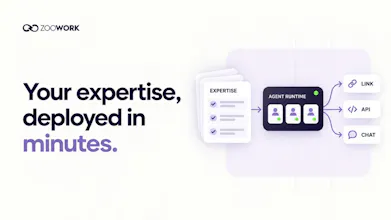
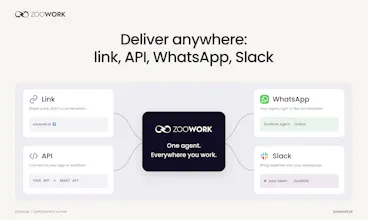
Deliver: Reach users where they already are: a shareable link, an API, or directly in WhatsApp, Slack, and more.
Under the hood, we handle the hardest part: the runtime. Every agent runs in its own managed, isolated sandbox, so what you ship keeps working without you babysitting servers. You own the interface, the customers, and the business. We run the agents.
A few of my favorite agents running on ZooWork today:
A proposal deck studio: drop in your notes, get back a client-ready deck. Built by a consultant, not an engineer.
A personal stylist: describe the occasion, get a complete look and the reasoning behind it.
A home layout designer: snap a photo of your room, get a new layout with an interior designer's eye.
If you've ever built an agent that died on your laptop because there was no good way to share it, I'd love to hear the story. And tell us which coding agent or channel you want next. Your answers go straight into our roadmap.
Thanks for being here on launch day! 🙏
How does pricing work when you deliver to clients? Do they need a ZooWork seat?
I love how seamless and fast it was to integrate with my code. I thought I'd run into problems but I did not. Besides, the run time is impressive!
Zero idle cost is the detail that makes a weekend agent project feel less wasteful. I'd still check the running costs, but I don't want to pay simply because an experiment exists.
@felix_wang5 That's exactly the cost we didn't want experiments to carry. On the Managed Agent API, the sandbox is billed only for the time it actually runs, plus model tokens, and Agents start in a second or two when called, so a weekend project sitting idle between runs costs nothing. Run it a few times over a weekend and check the usage afterwards to see what a real week costs.
Giving domain experts a builder UI while developers get a managed API is a nice split, it usually means the people who know the work can actually ship without waiting on engineering. Turning expertise into a deliverable agent for clients is a solid framing. Do the experts own the agents after delivery or do they stay tied to your platform?
@karimbenkeroum You can move all your Agent code elsewhere or run it locally. What we bring is the models and tools working smoothly together, so you spend less time wiring everything up. Try the same Agent on ZooWork and with another setup; I think you'll feel the difference in how much easier it is to get things running.
Congrats on the launch, Ning, David and the ZooWork team. Reading the docs, config_version is a counter rather than a history and rollback is left to the app, while per-user agents each get their own copy of the template. For an FDE shipping one agent to 20 clients, is there a plan for staged rollout and one-click rollback when an SOP change makes things worse? That feels like the part that turns delivery into something you can actually maintain.
@genedai Thanks for digging into the docs, Gene. The original author can update an Agent's Skills and AGENT.md in bulk, and end users can update to the latest version with one click. With API delivery, you can have runs use the latest Agent automatically. I still need to check staged rollout and one-click rollback with the team. Try changing one SOP in a Skill and updating a test user's Agent to see how that works.
the domain-expert-builds-it-in-the-UI model is the interesting bet here. at Dial we've seen non-technical team members want to tweak a live call flow and the thing we worry about isn't whether they can, it's whether a change they make on a Tuesday afternoon quietly breaks something for a client on Wednesday. is there any review or staging step before an expert's agent update goes live for a client, or does it publish straight through once they're happy with it in the Builder?
@galdayan You can test changes in a new chat session inside the Builder before they go live. An update is only published when you manually click Publish. Try revising one instruction, testing it in a fresh session, then using Publish when you're happy with the result.
@david_srp good to know, the test-then-manually-publish split is exactly the right default for this. that said, the failure mode I'd still worry about is the expert testing the happy path in their fresh session and never trying the edge case that actually breaks - is there anything like a diff view or a changelog so a second person can sanity check what changed before it goes live, or is it fully trust-the-editor?