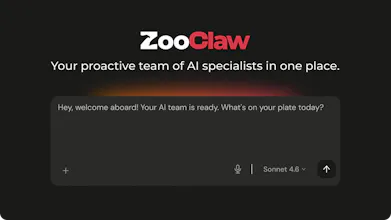
ZooClaw is a single entry point to a team of AI specialists. Ask in natural language and your task is routed to the right agent, each with structured domain knowledge and a native-sounding voice. Built on OpenClaw, it stays synced with the latest models and can fall back to top open-source models, so work keeps moving. No setup, no deployment, no API keys, no token anxiety.
No reviews yetBe the first to leave a review for ZooClaw
"The era of the one-person company" resonates hard. Built Krafl-IO solo and the biggest challenge isn't the code, it's wearing every hat simultaneously. The idea of specialized agents handling different domains is compelling. We use a similar approach but narrower- 3 agents that each own one step of LinkedIn post generation. Curious how you handle agent handoffs when tasks cross domains.
@flowghost Love the 3-agent setup — though we went a different direction: an agent should be a person, not a cog in the pipeline. If one person owns LinkedIn post generation end-to-end, one agent should too. Context stays intact, coordination overhead disappears.
Handoffs only kick in when you'd genuinely loop in someone else. Wonder if that'd make things feel more natural for your use case?
Report
@ninghu That's a great design philosophy. Our 3 agents are specialized by function (voice analysis, emotion reading, writing) each focused on one thing (we are adding 2 more for formatting and quality). The tradeoff is exactly what you said: coordination overhead and context passing between agents.
Your approach (one agent owns everything) probably produces more coherent output with less latency. Ours catches more edge cases (fabricated facts, passive voice, wrong emotional tone) because each agent is laser-focused.
Honestly, both work. The right answer probably depends on how much you trust a single model to self-correct vs. having checkpoints. Would love to compare outputs sometime.
@flowghost The deeper difference might be philosophical: your approach treats the agent as a mechanical step in an established workflow. We believe the latest models are already capable enough to be treated like a person — given context and a goal, they figure it out with the tools at hand.
AGI is here. It's just not evenly distributed yet.
Report
congrats on the launch, the proactive scheduling angle is genuinely different from most agent tools i've seen.
one thing i'm curious about though. "zero token anxiety" sounds great as a user but someone's eating that cost. is there a usage ceiling on the free tier, or are you subsidizing compute to grow and then switching to a credit model later? asking because i've watched a few AI tools launch with generous free tiers and then hit a wall when the unit economics catch up.
not trying to be cynical, honestly excited about what you're building.
@futurestackreviews This is exactly the right question to ask — we've watched the same pattern play out.
We run our own GPU cluster with heavy inference optimization, so our cost structure is pretty different from teams relying on proprietary APIs.
When credits run out, we don't shut the agent down — we keep a generous baseline of tokens from top open-source models flowing so the agent stays always-on and proactive. An agent that goes dark when credits run out kind of defeats the purpose.
We're absorbing some of that cost, yes — but we think it's sustainable.
the "no token anxiety" line hits hard. constantly monitoring usage across different APIs is such a productivity killer. how does the fallback to open-source models work when the main ones are overloaded? does it maintain quality or just keep things moving?
@piotreksedzik Glad it resonates! Just to clarify — the fallback kicks in when credits run out, not due to overload. We run our own GPU cluster with inference optimization, so we can serve top open-source models at quality levels that handle real work. Of course it won't perform as well as the best proprietary models, but your agent stays functional and proactive regardless. That's the whole point.
Report
Cool project! Can the bot learn on its own? For example, I say that tomorrow we’re launching project X, so it should study A and B for this, and then it goes and collects information on the internet for it?
@natalia_iankovych Great observation! Deep Research is actually already a polished skill in ZooClaw. The proactive layer you're describing — where it picks up on context and decides what to research on its own — is a great idea and something we'd love to explore. Thanks for the suggestion!
@ermakovich_sergey Exactly — like a real team! Not there yet, but inter-agent communication and coordination is our next big focus. Stay tuned!
Report
Love the idea that your HR lead with zero technical background built a career planning agent in one afternoon. That's exactly the kind of unlock I keep hoping to see in HR tech. The people closest to the problem rarely have the technical skills to build the solution, so a platform that removes that barrier is huge. Curious how teams are using the proactive scheduling feature for things like candidate follow-ups or onboarding workflows?
@ceciliatran So glad that example resonated! You're spot on — candidate follow-ups and onboarding workflows are a natural fit. We don't have a dedicated HR scheduling agent built out yet, but the platform is fully capable of supporting it. The barrier is really just mapping out the right business logic, not the tech. And honestly, someone with your HR expertise would be the perfect person to build it — would love to have you give it a try!
@james001 Yes! We track OpenClaw closely and stay up to date. The idea is zero friction — no setup, no token anxiety, just open it and your specialist agents are ready. Safer too :-p




"The era of the one-person company" resonates hard. Built Krafl-IO solo and the biggest challenge isn't the code, it's wearing every hat simultaneously. The idea of specialized agents handling different domains is compelling. We use a similar approach but narrower- 3 agents that each own one step of LinkedIn post generation. Curious how you handle agent handoffs when tasks cross domains.
ZooClaw
@flowghost Love the 3-agent setup — though we went a different direction: an agent should be a person, not a cog in the pipeline. If one person owns LinkedIn post generation end-to-end, one agent should too. Context stays intact, coordination overhead disappears.
Handoffs only kick in when you'd genuinely loop in someone else. Wonder if that'd make things feel more natural for your use case?
@ninghu That's a great design philosophy. Our 3 agents are specialized by function (voice analysis, emotion reading, writing) each focused on one thing (we are adding 2 more for formatting and quality). The tradeoff is exactly what you said: coordination overhead and context passing between agents.
Your approach (one agent owns everything) probably produces more coherent output with less latency. Ours catches more edge cases (fabricated facts, passive voice, wrong emotional tone) because each agent is laser-focused.
Honestly, both work. The right answer probably depends on how much you trust a single model to self-correct vs. having checkpoints. Would love to compare outputs sometime.
ZooClaw
@flowghost The deeper difference might be philosophical: your approach treats the agent as a mechanical step in an established workflow. We believe the latest models are already capable enough to be treated like a person — given context and a goal, they figure it out with the tools at hand.
AGI is here. It's just not evenly distributed yet.
congrats on the launch, the proactive scheduling angle is genuinely different from most agent tools i've seen.
one thing i'm curious about though. "zero token anxiety" sounds great as a user but someone's eating that cost. is there a usage ceiling on the free tier, or are you subsidizing compute to grow and then switching to a credit model later? asking because i've watched a few AI tools launch with generous free tiers and then hit a wall when the unit economics catch up.
not trying to be cynical, honestly excited about what you're building.
ZooClaw
@futurestackreviews This is exactly the right question to ask — we've watched the same pattern play out.
We run our own GPU cluster with heavy inference optimization, so our cost structure is pretty different from teams relying on proprietary APIs.
When credits run out, we don't shut the agent down — we keep a generous baseline of tokens from top open-source models flowing so the agent stays always-on and proactive. An agent that goes dark when credits run out kind of defeats the purpose.
We're absorbing some of that cost, yes — but we think it's sustainable.
Open Wearables
the "no token anxiety" line hits hard. constantly monitoring usage across different APIs is such a productivity killer. how does the fallback to open-source models work when the main ones are overloaded? does it maintain quality or just keep things moving?
ZooClaw
@piotreksedzik Glad it resonates! Just to clarify — the fallback kicks in when credits run out, not due to overload. We run our own GPU cluster with inference optimization, so we can serve top open-source models at quality levels that handle real work. Of course it won't perform as well as the best proprietary models, but your agent stays functional and proactive regardless. That's the whole point.
Cool project! Can the bot learn on its own? For example, I say that tomorrow we’re launching project X, so it should study A and B for this, and then it goes and collects information on the internet for it?
ZooClaw
@natalia_iankovych Great observation! Deep Research is actually already a polished skill in ZooClaw. The proactive layer you're describing — where it picks up on context and decides what to research on its own — is a great idea and something we'd love to explore. Thanks for the suggestion!
HasData
This is really cool. Can a specialist hand off part of a task to another one mid-conversation?
ZooClaw
@ermakovich_sergey Exactly — like a real team! Not there yet, but inter-agent communication and coordination is our next big focus. Stay tuned!
Love the idea that your HR lead with zero technical background built a career planning agent in one afternoon. That's exactly the kind of unlock I keep hoping to see in HR tech. The people closest to the problem rarely have the technical skills to build the solution, so a platform that removes that barrier is huge. Curious how teams are using the proactive scheduling feature for things like candidate follow-ups or onboarding workflows?
ZooClaw
@ceciliatran So glad that example resonated! You're spot on — candidate follow-ups and onboarding workflows are a natural fit. We don't have a dedicated HR scheduling agent built out yet, but the platform is fully capable of supporting it. The barrier is really just mapping out the right business logic, not the tech. And honestly, someone with your HR expertise would be the perfect person to build it — would love to have you give it a try!
Looks cool, is this built on openclaw?
ZooClaw
@james001 Yes! We track OpenClaw closely and stay up to date. The idea is zero friction — no setup, no token anxiety, just open it and your specialist agents are ready. Safer too :-p