Launched this week

Would you pay?
Find out who'd pay before you build more
195 followers
Find out who'd pay before you build more
195 followers
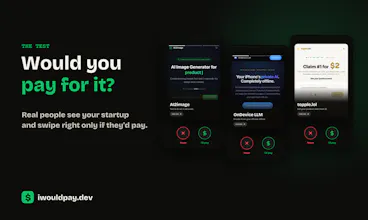
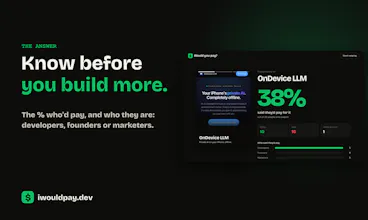
Most side projects fail quietly: months of building, then nobody pays. Would you pay? shows your startup to real people who swipe right only if they'd pay for it. You see the % who'd pay, who they are, and who clicked through. Free.


Free
Launch Team

Context.devAPI to scrape anything for AI, 20,000+ developers trust us.
Promoted
How do you decide which people see a particular startup idea? Is it based on their interests or the type of product?
@julian_ting2 Great question! Right now everyone sees the same deck in random order, with one rule: new startups that haven't reached 10 swipes go first, so every maker gets results fast.
Instead of filtering who sees what, we ask swipers their role (developer, founder, marketer), so makers see who would pay, not just how many.
Matching by interest is on my list as the deck grows. Would you want to pick categories before swiping, or should it learn from your swipes?
@mustafaergisi I think letting it learn from swipes would feel more natural. Over time, it could understand what someone is actually interested in instead of making them choose categories upfront.
Love the idea. Validating whether people would actually pay before spending months building is such a simple but valuable concept. Congrats on the launch! 🚀
@farukdurak Thank you Faruk! 🙏 That's exactly the pain I kept running into myself. Add MonitUp to the deck too, would love to see what people say 🚀
Would you run your next idea through a quick validation tool like this before writing a single line of code?
genuinely curious how you handle the gap between a swipe and a wallet. people are famously generous with "yes I'd pay for that" when there's no card on the line, it's a big part of why founders get burned chasing validation that never converts. do you push anyone past the swipe to an actual pre-order or waitlist deposit, or is the signal here meant to be directional only, more people to keep talking to rather than a real demand number?
@galdayan great question, and you're right. a swipe isn't a wallet.
today it's directional: a cheap first filter before you spend months building. it's most useful comparatively. same crowd, same question, so 35% vs 15% says something even if neither number is a real conversion rate.
we also track who clicks through to the site after swiping, which is a stronger signal than the swipe alone.
next step is exactly what you describe: letting "I'd pay" swipers join a maker's waitlist or pre-order, so the signal turns into real people to talk to.
@mustafaergisi appreciate the straight answer, most people selling a validation tool would've oversold what a swipe means. the comparative framing (35% vs 15% on the same crowd) is the honest way to use a number like this, and the waitlist step is what actually turns it into evidence. good luck with the launch.
@galdayan thank you, really appreciate that. honest numbers are the whole point, a tool that oversells signal would be ironic 😅
waitlist + a "how much would you pay?" step are next. I'll share what we learn.
@cem_ozcelik thank you so much! 🙏 that's exactly the idea: likes are easy, a "yes I'd pay" is the signal that matters