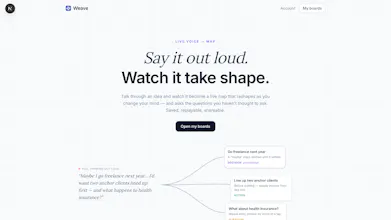
Talk through an idea and watch it become a live map that reshapes as you change your mind and asks the questions you haven't thought to ask. Capture meetings, replay how a thought unfolded, share a link, export anywhere. Free to start, no card.
Hey Product Hunt! 👋
I built Weave because my best thinking happens out loud — pacing around, half-sentences, changing my mind mid-thought. Every tool I tried made me stop thinking to do the writing: transcripts I never reread, mind-mapping apps where I spent more time dragging boxes than deciding anything.
So Weave doesn't transcribe. It maps. Hold Space (or go hands-free) and talk:
🧠 Your words become linked cards in seconds — decisions, facts, questions, risks — each one atomic, each one connected. Say "maybe" and the card appears dashed; it stays provisional and keeps reshaping until you settle it.
✨ Pause, and Weave thinks with you. A pause is the trigger — it tidies the board and floats in glance-length questions you haven't thought to ask ("What about health insurance?"). Answer by voice, keep it, or wave it away. Any card breaks open into its options and risks with one tap.
🎙️ New this week: meeting capture. Share a Meet/Teams tab and Weave maps the whole conversation — with speaker labels, so you can see who committed to what, and where two people actually disagree.
💾 Nothing evaporates. Every board is saved and replayable — scrub back through how a decision actually unfolded. Share a read-only link, or export Markdown / PNG / SVG.
A few things I sweated that you might notice:
It's genuinely live — cards appear while you're mid-sentence, not after you stop.
Manual edits always win. Drag, rewire, rewrite anything; the AI works around you, never over you.
The questions only show up when they're specific. If Weave has nothing sharp to ask, it stays silent.
Pricing: free tier with 15 voice minutes/month, no card. Pro is £4.99/$4.99 a month for 100 minutes.
I'd love to hear how you think out loud — and what Weave gets wrong when you do. I'll be here all day. 🙏
Report
@emmanueladesola some tools make you structure first and think second, which is exactly backwards.
when the map gets big, how do you find the thread that matters right now? Dense knowledge maps are great for capture and terrible for retrieval, especially under time pressure. Have you built a relevance score, something like a "what's most relevant to what I'm working on right now", or is the map still mostly navigated manually?
Report
The pause-triggers-questions part is the bit I'd actually use. Half my thinking stalls because I never notice the question I'm avoiding. How does it decide which questions to float without derailing the train of thought? And does the Markdown export keep the card links or flatten it to a plain outline?
@hung_tran_from_notebook_os Glad that’s the bit that landed. When you go quiet, it looks at what you just said plus the map, and it’s only allowed to ask something tied to a specific card. If it has nothing specific, it stays silent — no padding, no repeats. Questions are a few words long, float beside the relevant card, and never touch your map unless you keep one; talk past them and they slide into a side tray.
Export doesn’t flatten — nested outline plus a “Connections” section for every link (with labels) and an “Open questions” section.
Report
Congrats on Weave. The live map feels more useful than a plain transcript because it keeps the structure of the thinking, not just the words. The pause-triggered questions are a nice touch too. Curious how you handle messy spoken thoughts: do you preserve the original phrasing anywhere, or only the cleaned-up cards and connections?
@simon_dao Thanks and glad the structure-over-words point landed, that’s exactly the bet.
On messy thoughts: the mess is treated as signal, not noise. While you talk, your raw words stream into a transcript feed beside the canvas, and the cards deliberately keep your tense and stance — “I think we should…” doesn’t get flattened into “Team should…”. Half-finished thoughts land immediately as visibly provisional cards the model is free to reshape as you keep going, so circling back or contradicting yourself re-forms the map instead of breaking it. The word-for-word transcript isn’t stored with the board today, but every board keeps its full history — you can replay it building itself and watch how the thinking actually evolved.
Report
Love this concept. Thinking through the map is always much easier to get clarity. How does it handle things if your thought process goes in a different direction while brainstorming an idea? Does it store those orphaned blocks somewhere so we can look at them later?
Report
Hi @emmanueladesola , I always think more clearly out loud than on a blank page, so watching my rambling turn into something I can actually look at later sounds really nice. Replaying how an idea took shape is a lovely bonus.
@emmanuel_costa5 Exactly, a blank page asks you to already know the structure, but talking doesn’t. You just start, and the map catches up with you.
Would love to hear how your first board goes. (It usually maps better than people expect — the mess is where the structure hides.)
Weave
The pause-triggers-questions part is the bit I'd actually use. Half my thinking stalls because I never notice the question I'm avoiding. How does it decide which questions to float without derailing the train of thought? And does the Markdown export keep the card links or flatten it to a plain outline?
Weave
Congrats on Weave. The live map feels more useful than a plain transcript because it keeps the structure of the thinking, not just the words. The pause-triggered questions are a nice touch too. Curious how you handle messy spoken thoughts: do you preserve the original phrasing anywhere, or only the cleaned-up cards and connections?
Weave
Love this concept. Thinking through the map is always much easier to get clarity. How does it handle things if your thought process goes in a different direction while brainstorming an idea? Does it store those orphaned blocks somewhere so we can look at them later?
Hi @emmanueladesola , I always think more clearly out loud than on a blank page, so watching my rambling turn into something I can actually look at later sounds really nice. Replaying how an idea took shape is a lovely bonus.
Weave
Weave