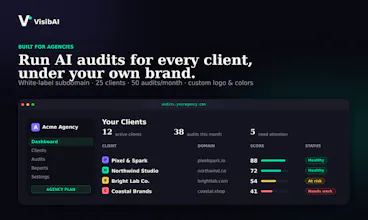
VisibAI shows whether your business appears when people ask AI for recommendations, and helps you fix it. It runs queries across six AI platforms (ChatGPT, Perplexity, Claude, Gemini, Mistral, You.com), scores your visibility 0-100, reveals which competitors show up instead, and returns a prioritized fix list plus ready-to-ship fix files and a branded report. One-off audits or monthly tracking. White-label for agencies. EU-hosted and GDPR-native.
The visibility gap in AI-generated answers is real and most brands have no idea they're invisible. Excited to see tooling for this, does VisibAI track citation sources across different LLMs or just ChatGPT/Perplexity?
Hi @productrambler 👋
Thanks, and yes, “they have no idea” is the whole reason this exists.
Coverage isn’t just ChatGPT/Perplexity, we run across the major answer engines including Claude and Google’s AI too, so you see your visibility per platform, not one blended guess.
Today we surface which competitors get named instead of you in those answers.
Source-level citation tracking (the exact pages an engine pulls from, per LLM) is the next big piece I’m building, since Reddit and a handful of sources punch way above their weight in what AI cites.
If that’s the angle you care most about, tell me which engines matter to you and I’ll factor it into how I prioritize it.
Report
The 'are you in AI answers' question is one I've been thinking about a lot lately - SEO taught us to optimize for search engines, and now there's this whole new discovery layer in ChatGPT, Perplexity, Claude that most tools don't even measure. What sources does this check - just the big three, or does it also cover the AI integrations in search like Bing and Google AI overviews?
Spot on, this layer sits on top of SEO where nobody's measuring.
We cover six engines directly: ChatGPT, Perplexity, Claude, Gemini, Mistral and You.com (Perplexity and You.com retrieve live, closest to that search-plus-AI surface). Google AI Overviews and Bing/Copilot pull differently, so I'm not claiming them until I can measure them properly, both are on the roadmap.
Have you already run your free audit on https://getvisibai.com ? If you'd like a multi-platform audit or a competitor comparison, I'd be happy to set you up with a one month trial.
Report
Smart idea. Which AI platform tends to show the widest visibility gaps for most businesses?
Perplexity and Google's AI tend to show the widest gaps.
They lean on fresh, citation-heavy sources, so if your content isn't structured to be cited, you drop out fast. ChatGPT is more forgiving because it leans on broader trained knowledge, so a brand can look fine there and be near invisible on the engines pulling live sources.
That split is exactly why the per-platform view matters more than one blended score.
GEO is going to be as important as SEO was 10 years ago and most businesses haven't even started thinking about it. the multi-platform scoring across chatgpt, claude, perplexity etc is smart because your visibility can vary wildly between them. one model might recommend you and another might not even know you exist. curious how fast the fix recommendations actually move the needle. with traditional SEO you're waiting weeks for changes to reflect. how quickly do AI models pick up on changes you make to your site or content?
@shubham4real Love the SEO parallel, that's exactly the bet.
Two speeds on the fixes: technical changes (schema, llms.txt, crawler access) show up in days to weeks on the grounded engines that retrieve live, like Perplexity and Google AI. The base ChatGPT/Claude models only shift when they retrain, so that side is slow. The bigger lever, getting cited in the sources they pull from (Reddit, G2, listicles), is a slower build but it's what sticks. We re-scan over time so you see which change moved which engine, instead of guessing.
Report
It's a great solution.. however some confusions are there, I ran the free audit and got a score of 46, with all zeros on all queries run. So it's not clear where the score came from, my assumption was some comparisons in the query resulted into it, but it wasn't clear in the scoring.. also the compitition mapping was way off, still that's understandable as we are still to create data on it..
now we are a deterministic engine enterprise focused startup so I understand data reaching AI platforms would take time.. still askOdin.app get it's limited organic traffic from founders engagement via social platforms, maybe the traffic is lesser than most consumer startups, still I think the system wasnt able to pinpoint that either..
Still overall I liked the offering, thank you, keep bettering.. good wishes..
@dhirajwohra
Thank you, this is really useful feedback, and you’ve put your finger on a real weakness in how we present things.
On the score: you’re right that it’s not clear, and that’s on us. The 46 is not coming from your AI mentions, those were genuinely zero on the free run. It comes from the technical-readiness half of the score (site structure, schema, crawlability, trust signals). We currently fuse “is your site built to be cited” and “are you actually being cited” into one number, which makes a 46 next to a wall of zeros look broken.
We’re splitting those into two separate scores precisely so this stops being confusing.
On why the zeros: the free audit only runs ChatGPT, on generic category queries. For a deterministic, enterprise-focused engine like Odin, the big consumer category terms won’t surface you, and a single-engine slice can’t see the founder-led social traffic you mention. A multi-platform run (Perplexity, Claude, Gemini) on queries closer to how your actual buyers search would give a far truer read, the free slice is the narrowest, harshest view.
On competitor mapping being off: fair, and noted. For a novel category it leans on weaker signals. Custom competitors on the paid tiers fix most of that.
checking visibility across six AI engines is smart, the answers diverge way more than people expect. is the fix list stuff you ship to your site, or mostly content nudges?
@reallynattu
Both, and they split cleanly. The shippable stuff is concrete: robots.txt rules to unblock AI crawlers, JSON-LD schema, an llms.txt file, FAQ markup, fixing content that’s hidden behind JS so crawlers can actually read it. We generate those files for you.
The content nudges are the slower, higher-impact half: getting cited in the sources these engines actually pull from (G2, Reddit, comparison pages, category listicles). That’s where most of the real visibility gains come from, since the engines lean on third-party mentions more than your own site copy.
So the site fixes are the quick wins you ship in an afternoon, and the content/citation work is the compounding play.
Report
For me the most useful nugget here is the split Francesco gave Henry: grounded engines biting on ranking, memory-mode engines on brand presence. My audience is German-speaking, and I keep wondering if that diagnosis holds when queries are in German or country-scoped. Does the grounded/memory split shift noticeably across languages, or is it pretty universal?
@yannikga
The split is universal, it’s about how each engine gets its answer, not the language. What changes in German is which side matters more.
For the memory-based engines (the normal ChatGPT/Claude models), the gap usually gets bigger. They’re trained mostly on English, so a brand that’s well known in English can show up weaker, or not at all, when you ask in German.
For the live-search engines (Perplexity, Google’s AI), there’s usually less German content competing, so your presence in German sources counts more.
And here's the key part: even in the same country, the language of the question changes the answer. Ask in English and ask in German from the same place, and you can get a different set of brands back. So don't assume your English visibility carries over, run your audit in German and for your country. The English version will make you look better than you really are.
Mira
The visibility gap in AI-generated answers is real and most brands have no idea they're invisible. Excited to see tooling for this, does VisibAI track citation sources across different LLMs or just ChatGPT/Perplexity?
VisibAI
The 'are you in AI answers' question is one I've been thinking about a lot lately - SEO taught us to optimize for search engines, and now there's this whole new discovery layer in ChatGPT, Perplexity, Claude that most tools don't even measure. What sources does this check - just the big three, or does it also cover the AI integrations in search like Bing and Google AI overviews?
VisibAI
@omri_ben_shoham1
Spot on, this layer sits on top of SEO where nobody's measuring.
We cover six engines directly: ChatGPT, Perplexity, Claude, Gemini, Mistral and You.com (Perplexity and You.com retrieve live, closest to that search-plus-AI surface). Google AI Overviews and Bing/Copilot pull differently, so I'm not claiming them until I can measure them properly, both are on the roadmap.
Have you already run your free audit on https://getvisibai.com ? If you'd like a multi-platform audit or a competitor comparison, I'd be happy to set you up with a one month trial.
Smart idea. Which AI platform tends to show the widest visibility gaps for most businesses?
VisibAI
@dhiraj_patel5 Thanks for your question =)
Perplexity and Google's AI tend to show the widest gaps.
They lean on fresh, citation-heavy sources, so if your content isn't structured to be cited, you drop out fast. ChatGPT is more forgiving because it leans on broader trained knowledge, so a brand can look fine there and be near invisible on the engines pulling live sources.
That split is exactly why the per-platform view matters more than one blended score.
BetterClaw
GEO is going to be as important as SEO was 10 years ago and most businesses haven't even started thinking about it. the multi-platform scoring across chatgpt, claude, perplexity etc is smart because your visibility can vary wildly between them. one model might recommend you and another might not even know you exist. curious how fast the fix recommendations actually move the needle. with traditional SEO you're waiting weeks for changes to reflect. how quickly do AI models pick up on changes you make to your site or content?
VisibAI
@shubham4real Love the SEO parallel, that's exactly the bet.
Two speeds on the fixes: technical changes (schema, llms.txt, crawler access) show up in days to weeks on the grounded engines that retrieve live, like Perplexity and Google AI.
The base ChatGPT/Claude models only shift when they retrain, so that side is slow.
The bigger lever, getting cited in the sources they pull from (Reddit, G2, listicles), is a slower build but it's what sticks. We re-scan over time so you see which change moved which engine, instead of guessing.
VisibAI
LottieFiles
checking visibility across six AI engines is smart, the answers diverge way more than people expect. is the fix list stuff you ship to your site, or mostly content nudges?
VisibAI
For me the most useful nugget here is the split Francesco gave Henry: grounded engines biting on ranking, memory-mode engines on brand presence. My audience is German-speaking, and I keep wondering if that diagnosis holds when queries are in German or country-scoped. Does the grounded/memory split shift noticeably across languages, or is it pretty universal?
VisibAI