
Vida
Clone yourself. Let AI do the work before you ask
734 followers
Clone yourself. Let AI do the work before you ask
734 followers
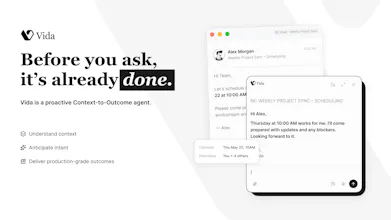
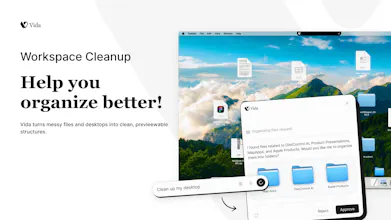
Vida is an AI that learns how you work, remembers what matters, and becomes more like you over time. The more you use Vida, the more it understands your habits, your projects, and your way of getting things done. Eventually, it works like a second version of you—quietly handling repetitive work in the background before you even ask. Today, we’re launching our first 5 SOTA use cases: Reply Rescue · Prompt Rescue · Resume Rescue · Workspace Cleanup · Daily Wrap 95 more to conquer in public.




Free Options
Launch Team / Built With


Context.devAPI to scrape anything for AI, 20,000+ developers trust us.
Promoted
The strongest part here is not just “AI does tasks,” but the trust curve. Vida starts with rescue workflows and gradually earns more autonomy.
Curious about the memory layer. Can users inspect, correct, or delete what Vida has learned about their habits and projects over time?
@liam_chung Thanks for the great question !
Browser automation is one of the key directions we’re actively building toward, but not fully available in Vida yet.
We’ve open-sourced BrowserBC, which learns reusable agent skills from human browser trajectories—essentially turning one recorded workflow into a generalized capability.
GitHub:
https://github.com/Einsia/Browser-BC
This is part of the foundation we’re building for bringing more real-world execution abilities into Vida over time 🚀
'Before you ask' is the bold part - proactive agents live or die on that judgment call. In my experience running agents for a business, the hard threshold isn't doing the work, it's knowing when acting early helps vs when it creates cleanup. How does Vida decide something is safe to do unprompted? Congrats on the launch.
@david_marko Thanks so much—and I completely agree.
We actually think that’s the hardest problem in proactive AI.
Our principle is that proactivity should reduce cognitive load, not create more of it—and it should never interrupt your workflow just for the sake of being proactive.
So Vida starts with low-risk, high-confidence work—things like organizing information, preparing drafts, or surfacing context—while actions that could have meaningful consequences always require user confirmation.
Over time, as Vida learns your preferences and consistently earns your trust, it can become more proactive. We believe autonomy shouldn’t be assumed—it should be earned.
Handling memory in agents is the biggest friction point I've seen as a solo dev—it’s either too shallow or it consumes too many tokens. Curious if you're caching interaction styles locally to speed up the learning curve.
@ayeshabuilds Great point—we’ve run into the same trade-off.
Yes, local-first memory is a core part of our approach. Vida keeps interaction history on your device whenever possible, which not only helps preserve privacy but also gives it richer long-term context without relying entirely on growing prompt windows.
We also open-sourced OpenChronicle, which explores this direction further. It lets you use local models to summarize memory, keep all your data on your own device, and pause or resume recording whenever you want.
We believe memory can be incredibly useful without becoming all-or-nothing surveillance.
GitHub: https://github.com/Einsia/OpenChronicle
how does Vida actually learn my habits day to day, does it just watch what I do across apps or do I have to feed it examples for it to get useful quickly?
@sattapanbmta Great question!
Vida doesn’t require you to manually teach it with examples before it becomes useful.
Instead, it builds understanding from your work context—what you’re working on, your interaction history, and the tasks you ask it to help with. As you use Vida over time, it gradually learns your preferences and working style to provide better assistance.
Our goal is to make the learning process as natural as possible, without creating extra setup work for users.
I like the idea of earning autonomy instead of assuming it. My first thought was how the learning loop works. If Vida gets my style or context slightly wrong at the beginning, is it easy to nudge it in the right direction so it improves over time? Congrats on the launch!
@jared_salois Thanks so much!
Absolutely. We don’t expect Vida to get everything perfect from day one.
The learning loop is designed to be as natural as possible—you can simply correct it through normal interactions, and as Vida accumulates more context and understands your preferences over time, it becomes more aligned with how you work.
We think the best learning experience shouldn’t feel like “training an AI.” It should feel like working with someone who gets to know you better every day.
@konstant_gk Hi! Thanks so much for the thoughtful questions—and I’d love to connect as well!
Absolutely. Users always stay in control. For things like Quick Reply, you can edit the draft before sending. For Workspace Cleanup, Vida shows a preview first and only organizes or archives files after you confirm—it never deletes your files.
As for building your “second self,” we don’t think there’s a fixed timeline. It’s a gradual process where Vida learns from your work context, interactions, and preferences over time. The goal isn’t to create a perfect clone overnight, but to steadily earn your trust by getting more things right every day.
the 100 use cases challenge is a smart move — it forces you to prove depth instead of just showing breadth. most AI productivity tools demo one impressive thing and hope you extrapolate. shipping 100 specific workflows is the opposite approach and honestly more convincing. curious which of the first 5 gets the most repeat usage vs which gets the most wow-factor on first try.
@ozandag Thanks so much—that’s exactly the thinking behind it.
We don’t want people to imagine what Vida could do. We’d rather prove it, one real workflow at a time.
So far, Reply Rescue tends to get the most repeat usage because it’s something people deal with every day. Workspace Cleanup probably delivers the biggest “wow” moment, since the results are so immediate and visible.
Hopefully, as we ship more use cases, both lists will keep growing.