
Theysaid is more than a survey, it's an opportunity to engage your customers, employees, donors, and etc. Training AI takes less than 1 min by pointing it to URL or internal doc. Your audience can answer and ask questions as if they are talking to you!
This is the 4th launch from Theysaid. View more

TheySaid 4.0
Launching today
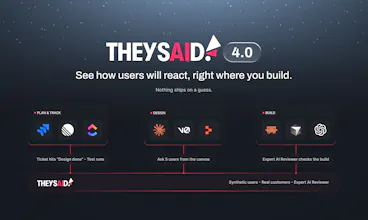
Put what you’re building in front of real customers or synthetic users trained on them when you need an answer in minutes without leaving Claude, Cursor, or Jira. Nothing ships on a guess.



Free Options
Launch Team / Built With


@sidraarifali thank you Sidra! the deck problem is so real. the part i like most is that the MCP isn't just for launching tests, you can ask questions about your existing research right from claude too, like pull the recent responses on a project or compare two projects, and get the answer where you're already working instead of digging through a report. which tool does your team mostly build in?
saw in the reviews that the voice mode gets people way more honest than a form, makes sense. how close do the synthetic users get to the real customers they’re trained on?
@aurelia_zambon on this page you can download a white paper we published on the results:
https://www.theysaid.io/v4
TLDR; Humans and Synthetic overlap between 85-90% of the time, once synthetic is trained on human data.
Having said that, you should just launch a test on your own. 20 humans vs 20 synthetic, and see the results for yourself!
@aurelia_zambon Adding one thing to Chris's point: the "trained on human data" part matters a lot. In our Dyson vs Shark study, each AI tester was built from one real shopper's session (their motivation, worldview and what they already knew going in). The biggest difference wasn't what they chose, it was how they shopped. AI testers were very diligent: more products compared, deeper into the reviews. Humans skimmed stars and stopped at "good enough." So synthetic gets you the direction fast, and real people add the taste and emotion. Running both side by side, like Chris said, is the best way to see it on your own product.
@chrishickenThank you for your reply. I've worked extensively with tools like lyssna.com, so I'm really interested in this approach to user research.
@aurelia_zambon oh nice, then you'll probably spot the differences fast. the way i think about it synthetic isn't a replacement for the human round, it's the first pass. AI testers click through the flow in a real browser and talk out loud while the screen records, so the obvious stuff gets fixed before real people ever see it. what kind of studies were you mostly running on lyssna?
@aurelia_zambon I've heard good things about their team. I was the 4th hire at UserTesting, and COO there for 8 years. So I'm as "OG" as it comes in this category, and I have a pretty good sense of where the category is headed. We've been building our synthetic technology for over a year ... it's WAY harder to make AI behave and think like humans than we expected.
When you try it out, let me know what you think.
I'd be interested in the cases where real people and synthetic testers disagree. Those differences sound useful for deciding which assumptions need another look.
@oleksii_sekundant yes, that's honestly my favorite part of the data. in our dyson vs shark study the AI testers kept pushing for hard proof, battery runtime per power mode, actual suction numbers, warranty length. came up in about 7 sessions and most humans just scrolled past it. for a brand that's a pretty clear signal the product page is leaning on vague claims. the humans on the other side brought stuff like strong opinions about dyson or shark from past experience and caring about the color. since synthetic and human responses sit in the same study with a filter, you can line them up and see exactly where they split
@oleksii_sekundant Love this question! The disagreements are often where the most useful insights come from.
@oleksii_sekundant the results are different from what you expect. Here's what happens in almost every head to head study with synthetic vs human audiences:
Humans and Synthetic Identify about 80% of the same issues
Synthetic identifies 10% of issues that humans don't
Humans identify 10% of issues that synthetic don't
So you synthetic audiences end up being a new source of feedback not available previously.
Getting feedback on a half finished screen without leaving Cursor is where I would actually use this, since setting up a proper usability test never survives contact with a normal Tuesday.