
Theysaid is more than a survey, it's an opportunity to engage your customers, employees, donors, and etc. Training AI takes less than 1 min by pointing it to URL or internal doc. Your audience can answer and ask questions as if they are talking to you!
This is the 4th launch from Theysaid. View more

TheySaid 4.0
Launched this week
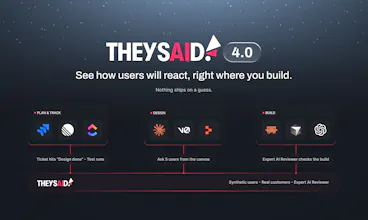
Put what you’re building in front of real customers or synthetic users trained on them when you need an answer in minutes without leaving Claude, Cursor, or Jira. Nothing ships on a guess.



Free Options
Launch Team / Built With


Framer AI AgentsDesign and publish professional sites with AI
Promoted


@tadej_jevsevar Thank you so much, Really appreciate the support!
@tadej_jevsevar Thank you!
@tadej_jevsevar Thank you !!
@tadej_jevsevar Appreciate your support!
CONGRATULATIONS!
Thank you! @emma_watson21
@emma_watson21 Thank you!!
@emma_watson21 Thank you for your support Emma!
Having a ticket finishing design in Jira or Linear trigger a synthetic test on its own is a handy idea. how do you keep the synthetic users from just agreeing with everything?
@neerajnathany Great question! Synthetic testers in TheySaid aren’t generic “yes-bots.” You can build them from your real human testers’ responses, so each one picks up how an actual customer thinks, decides, and reacts. You can also shape an audience yourself: their goals and motivation, their worldview (trusting or suspicious, optimistic or cynical), and their knowledge base. They also have to complete real tasks, so you see exactly where they hesitate or get stuck. In our Dyson vs Shark study, the AI testers were actually tougher than the humans.
@neerajnathany adding the engineering side to Jaala's answer, this was a real problem for us early on. we measured one project where 18 of 22 generated testers came out as basically the same polite 44 year old ops director, so we rebuilt how the batch gets created. now each tester gets its own mix of traits like how people pleasing they are, how direct they are, how patient, and who they blame when something breaks, and those actually change how they scroll, type and critique. a low people pleasing, low patience tester will just tell you the flow is annoying and bail
@neerajnathany I'll add that we've done extensive work to get AI to think and act like a human. You'll be pleasantly surprised by the types of critiques and problems synthetic encounters. They'll even miss things when scanning a page, just like a human.
@chrishicken good to know they skim and miss things like a person would. do you let people pick how distracted or rushed a tester is for a given run?
@neerajnathany partly, yes. on the audience you get ranges for things like patience, how they read (skim vs read every word), how much they care about finishing the task and how picky they are, so a low patience, skimming range gets you a pretty rushed tester. the mood itself, hurried, tired, frustrated, and things like being easily distracted get drawn per tester inside those ranges so a batch doesn't all behave the same, you don't pin that one directly yet
saw in the reviews that the voice mode gets people way more honest than a form, makes sense. how close do the synthetic users get to the real customers they’re trained on?
@aurelia_zambon on this page you can download a white paper we published on the results:
https://www.theysaid.io/v4
TLDR; Humans and Synthetic overlap between 85-90% of the time, once synthetic is trained on human data.
Having said that, you should just launch a test on your own. 20 humans vs 20 synthetic, and see the results for yourself!
@aurelia_zambon Adding one thing to Chris's point: the "trained on human data" part matters a lot. In our Dyson vs Shark study, each AI tester was built from one real shopper's session (their motivation, worldview and what they already knew going in). The biggest difference wasn't what they chose, it was how they shopped. AI testers were very diligent: more products compared, deeper into the reviews. Humans skimmed stars and stopped at "good enough." So synthetic gets you the direction fast, and real people add the taste and emotion. Running both side by side, like Chris said, is the best way to see it on your own product.
@chrishickenThank you for your reply. I've worked extensively with tools like lyssna.com, so I'm really interested in this approach to user research.
@aurelia_zambon oh nice, then you'll probably spot the differences fast. the way i think about it synthetic isn't a replacement for the human round, it's the first pass. AI testers click through the flow in a real browser and talk out loud while the screen records, so the obvious stuff gets fixed before real people ever see it. what kind of studies were you mostly running on lyssna?
@aurelia_zambon I've heard good things about their team. I was the 4th hire at UserTesting, and COO there for 8 years. So I'm as "OG" as it comes in this category, and I have a pretty good sense of where the category is headed. We've been building our synthetic technology for over a year ... it's WAY harder to make AI behave and think like humans than we expected.
When you try it out, let me know what you think.
@aurelia_zambon Great question! We've actually been running side-by-side studies to measure exactly that!
We start with real humans, record their behavior, reasoning, and decisions, then create synthetic twins and give them the same tasks.
In our Shark vs. Dyson study, 84% of synthetic twins made the same brand choice as their human counterparts (21 out of 25). Pretty strong alignment!
What we've learned is that replicating usability behavior and product comparisons is relatively straightforward. Personal preferences and emotional decisions are trickier, but we've made a lot of progress through repeated studies. We're now working on our next feature, reusable digital twins, to take this even further.
The goal isn't to replace humans, but to learn from real customers and bring their perspectives into future product decisions without recruiting them every single time.
We published the full study, including where AI performed well and where it didn't: https://www.theysaid.io/human-vs-synthetic-testers
"Validation Debt" is a great name for it. As a solo maker who launched today, I know how easy that step is to skip. Question about the synthetic users: does a test tell you how confident it is, or flag when a result should be checked with real people? For a niche B2B audience I'd trust a synthetic "this flow is confusing" more than a synthetic "I'd pay for this".
@leadscout congrats on your launch today! and honestly your instinct is the right one, synthetic is strongest on behavior, "this flow is confusing", way more than on willingness to pay. on the confidence part, there isn't a single confidence score today, but every issue in the results has to point back to the actual sessions where a tester hit it, if it can't cite one it gets dropped, and issues are ranked by severity and then by how many testers ran into it. each one links straight to the recording so you can watch the moment yourself. for a niche b2b audience i'd use synthetic to clean up the flow fast, then put the pricing and "would you buy" questions in front of a handful of real people
@arnab_karmakar1 Thanks Arnab, that makes sense! I’ll test it out during the LeadScout onboarding, as that’s where I have the most questions. Is it possible to set up a persona like "SDR in a B2B company," or does it have to be configured using specific electrical/technical data?
@leadscout yep, plain language works, no technical data needed. when you set up the audience you just fill in things like job title (SDR), company size and industry, then a few lines on their motivation, how they see the world and what they already know, e.g. "books meetings all day, skeptical of new tools, lives in the CRM and linkedin". you can also nudge sliders like patience, tech trust and how direct they are, so you get a mix of testers instead of one. that's plenty for onboarding friction, and like Chris said, if you later want them to match your real buyers' preferences more closely, you can feed in more of your own customer data
@leadscout Congrats on your launch today! Skipping validation is the truest crime especially if it means you end up shipping something that is buggy or something that customers don't even want. Regarding your question, TheySaid flags responses from both human and synthetic testers and shows the impact of each finding. That way you can tell whether an issue came from one tester or many. Even a single response can surface something worth checking, and that’s your cue to validate it with another tester, or with a real person if it came from a synthetic one. Try it out and see how a synthetic tester answers both of your burning questions: “What’s working and what’s not?” and “Would you pay for this?”
@leadscout I'll add to what Arnab said. If you want preference matching between human and synthetic, you'll need to provide additional data for context and fine tuning. We can walk you through the data needed to approximate your actual customer behavior.
Getting feedback on a half finished screen without leaving Cursor is where I would actually use this, since setting up a proper usability test never survives contact with a normal Tuesday.
@karimbenkeroum Haha, Product Hunt says “Likely AI” next to your comment. Did your AI agent help you write this? 😂 Either way, you nailed the use case! Getting feedback while you're still building, without interrupting your workflow, is exactly what we're going for. Thanks for the support, Kareem! 🙌
@karimbenkeroum MCP for the win! Testing while you’re still building is exactly what we built this for. You can make testing part of your workflow without it becoming a full-time job
@karimbenkeroum the half finished screen case is actually the one we had to engineer around the most. a lot of in progress work lives behind a login, private previews and design links the AI testers can't open, so when there's no public url the agent can bundle the screen into a single html snapshot and send that over for the testers to run against. you also get a quick first pass back in seconds while the deeper session runs in the background, so you can keep going with your tuesday
@karimbenkeroum +1 to Jaala's comment about MCP. No need to log into another tool to do your product/concept validation.
I'd be interested in the cases where real people and synthetic testers disagree. Those differences sound useful for deciding which assumptions need another look.
@oleksii_sekundant yes, that's honestly my favorite part of the data. in our dyson vs shark study the AI testers kept pushing for hard proof, battery runtime per power mode, actual suction numbers, warranty length. came up in about 7 sessions and most humans just scrolled past it. for a brand that's a pretty clear signal the product page is leaning on vague claims. the humans on the other side brought stuff like strong opinions about dyson or shark from past experience and caring about the color. since synthetic and human responses sit in the same study with a filter, you can line them up and see exactly where they split
@oleksii_sekundant Love this question! The disagreements are often where the most useful insights come from.
@oleksii_sekundant the results are different from what you expect. Here's what happens in almost every head to head study with synthetic vs human audiences:
Humans and Synthetic Identify about 80% of the same issues
Synthetic identifies 10% of issues that humans don't
Humans identify 10% of issues that synthetic don't
So you synthetic audiences end up being a new source of feedback not available previously.
@oleksii_sekundant Great point! What we've found is that it's less about humans and AI disagreeing, and more about how much each one uncovers.
There's a lot of overlap in their findings, but AI can sometimes catch things humans miss, and vice versa. Humans bring real experiences, emotions, and personal context, while AI can explore more paths, dig deeper, and uncover additional issues.
That's what excites me most! It's not human vs. AI, it's human + AI. You get richer insights, broader coverage, and faster validation than relying on either one alone.
We actually published a study comparing the two: https://www.theysaid.io/human-vs-synthetic-testers