
TagJournal
Track everything, in one app
21 followers
Track everything, in one app
21 followers
TagJournal is a fast and flexible tagging-based journal (web and iOS) designed to help you track your daily life with minimal effort and maximum insight. TagJournal lets you simply add tags to describe what you did, how you felt, how much time you spent, or even how much you spent. Each "rich tag" can carry additional data like duration, value, date, or notes, making it a powerful yet lightweight system for capturing your day.

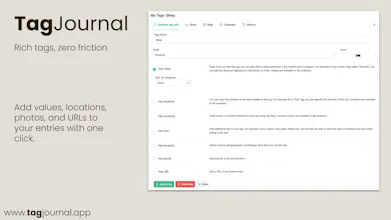


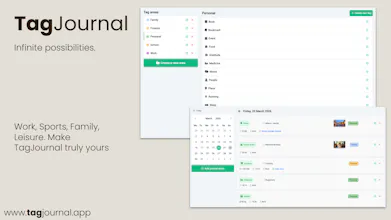

The rich-tag idea is strong because it avoids the usual journal-vs-database tradeoff. A lot of life-tracking apps make you choose between freeform notes that are hard to analyze and structured fields that feel too heavy to keep using.
The feature I’d be most careful with is the AI summary layer. For personal journals, summaries need to preserve “why this mattered,” not just compress events into a clean recap. I’d want controls like: summarize only selected tags, show which entries influenced the summary, and let me mark a summary as wrong so the system learns what not to flatten.
That would make the insights feel personal instead of generic.
Hi PH community!
I’m Nicola, the creator of TagJournal.
I’ve always struggled with finding the 'perfect' app to track my life. Most tools are either too specific (just for fitness or just for finance) or too complex. I wanted something that felt like a journal but acted like a database: fast, flexible, and visual.
TagJournal is a web and iOS application designed to help you effortlessly track what matters most.
For years I used a web app I had built for myself in my spare time (in .NET!) where I could add tags to my days to track basically anything and then get simple statistics out of it. At the same time, I was journaling using another app.
I always had many ideas for improving that application, but never enough time to work on it. AI helped accelerate that process, and in just a few months I finally built the app I had always wanted.
The idea is simple: using rich tags with flexible metadata.
The smallest possible entry you can add to a day might only contain date, time, and the tag name. But for each tag, the user can decide whether to enable these metadata fields:
Icon
Long text (editable later with a distraction-free editor), useful for journaling but also for many other types of content
Numeric value + unit of measure (which can also work as a 1–5 rating)
Currency
Duration
Photos
Location / Place (using Google autocomplete)
Person (I needed this to track information related to other family members too)
Tags are divided into color-coded categories.
This structure allows different kinds of objects/features:
Tag Watch: select a tag, a time period (current/previous week, current/previous month, current/previous year), and the field to monitor (duration, value, or currency, either total or average). The user can then keep that metric always visible on the “Today” page.
Goals: same idea—select tag, period, and field, then set a target. In “Today” you always see the completion percentage.
Charts / Trends: similar to Watch, but data is displayed as charts. These can also be added to the “Today” dashboard.
This way I track everything I need to monitor or review later:
Symptoms, medications, medical visits, physical activity, food and drink consumption, mood
Work activities, meetings, people I meet, focus sessions, releases
Information related to my children such as grades, absences, sports activities
Places, food, books, movies, TV shows, apps, things I learned
Portfolio performance, income, expenses, and specific spending categories
This is the core concept, but there are many other features too: map view for location-enabled tags, photo gallery, calendar, collections, etc.
Another thing I always wanted, and can finally use, is the Zapier integration to create entries from other platforms (for example, I track GitHub commits or calendar events). It’s also possible to create custom integrations by generating API keys directly inside the app.
Why I’m launching today: TagJournal is currently in a phase where validation is key. I’ve built the core features, rich tags, AI-powered summaries, and advanced statistics, but now I need your eyes on it. I want to know:
Does the 'tag everything' approach resonate with your workflow?
Which features (AI assistant, Goals, or Zapier integrations) are most valuable to you?
What’s missing to make this your daily driver?
I’ll be here all day to answer your questions and take notes on your feedback. Thank you for helping me shape the future of TagJournal!
Happy tagging!