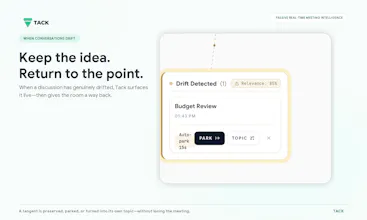
Most meeting assistants explain what happened afterward. Tack works while the conversation is happening - mapping emerging topics, catching sustained tangents, guiding the room back on track, and surfacing decisions and action items before everyone leaves.
No reviews yetBe the first to leave a review for TACK.IM
Maker
📌
Hey Product Hunt, I’m Hong, building Passive Real-Time AI Meeting Intelligence.
I started building Tack after I had more than 8 meetings a day, realizing that most meeting tools become useful only after the meeting is over.
A transcript can show where a conversation went off track. A summary can reveal that no real decision was made. But by then, the people needed to fix it have already left the room. And you have to wait for next week or meeting (whenever that is).
Tack is my attempt to make AI useful while the conversation is still happening.
It follows the discussion live, builds a map of emerging topics, notices when a genuine tangent is taking over, and gives the room a way to preserve that thought without losing the original objective. It also surfaces potential decisions and action items for confirmation before everyone moves on.
An important principle for me was that not every tangent is bad. Some of the best ideas begin as tangents. Tack waits for a sustained diversion, then helps you park it, not discard it, so the meeting can return to what it came to resolve.
The product originally began as a better way to visualize meeting outcomes. Over time, I realized the greater opportunity wasn’t producing a better record of a meeting. It was helping people create a better outcome in the first place.
Tack is targeting recurring meetings and short interviews.
I’d especially love feedback on:
1. Which kinds of meetings would benefit most from live guidance?
2. When does an intervention feel helpful rather than intrusive?
3. What do you not like about Tack?
Thanks for taking a look. I’m excited to hear what feels useful, what feels uncomfortable, and where you think Tack should go next.
Report
How does it actually nudge a room back on track without coming across as awkward or intrusive, especially with mixed groups where some people are more dominant than others?
Tack helps nudge a room back without speaking over anyone or calling a person out, when a discussion has meaningfully drifted, it plays a brief, gentle chime and shows a shared visual cue, then offers a neutral choice: continue or park the tangent and return to the topic.
The chime gets the room’s attention without assigning blame, while the visual explains why it appeared. Parking also acknowledges the point instead of shutting it down.
This is especially helpful in mixed groups because quieter participants don’t have to challenge a dominant voice themselves. The meeting owner still makes the final call; Tack simply gives the room a neutral, low-friction moment to reset.
Report
How does Tack actually nudge a room back on track without coming across as awkward or disruptive, especially in meetings with senior stakeholders who might bristle at an AI chiming in?
Report
Used it during a standup and it nudged us back when we drifted for ten minutes into a side debate. The real-time nudging actually feels helpful rather than intrusive.
Report
Caught a tangent in a standup before anyone else did and nudged us back on topic, which felt almost unfair. Useful for meetings that drift.
Report
It actually nudged us back on topic mid-discussion instead of just summarizing later, which caught me off guard. Felt less like a note-taker and more like a quiet moderator in the room.
Report
The real-time intervention angle is what got me, since most tools just summarize what already slipped by. Tack feels built for the messy reality of how meetings actually go, not a polished fantasy version.
How does it actually nudge a room back on track without coming across as awkward or intrusive, especially with mixed groups where some people are more dominant than others?
@keremmxlu Great question!
Tack helps nudge a room back without speaking over anyone or calling a person out, when a discussion has meaningfully drifted, it plays a brief, gentle chime and shows a shared visual cue, then offers a neutral choice: continue or park the tangent and return to the topic.
The chime gets the room’s attention without assigning blame, while the visual explains why it appeared. Parking also acknowledges the point instead of shutting it down.
This is especially helpful in mixed groups because quieter participants don’t have to challenge a dominant voice themselves. The meeting owner still makes the final call; Tack simply gives the room a neutral, low-friction moment to reset.
How does Tack actually nudge a room back on track without coming across as awkward or disruptive, especially in meetings with senior stakeholders who might bristle at an AI chiming in?
Used it during a standup and it nudged us back when we drifted for ten minutes into a side debate. The real-time nudging actually feels helpful rather than intrusive.
Caught a tangent in a standup before anyone else did and nudged us back on topic, which felt almost unfair. Useful for meetings that drift.
It actually nudged us back on topic mid-discussion instead of just summarizing later, which caught me off guard. Felt less like a note-taker and more like a quiet moderator in the room.
The real-time intervention angle is what got me, since most tools just summarize what already slipped by. Tack feels built for the messy reality of how meetings actually go, not a polished fantasy version.