
Tabstack gives AI agents and apps finished output from the live web in a single API call. Extract structured data to a schema you define, convert pages to Markdown, run cited multi-source research, and automate browser tasks. Every call returns exactly what you asked for. Built for developers shipping autonomous agents and those adding web interaction to an existing app or stack. Built by Mozilla, with ephemeral processing, no model training on your data, and robots.txt compliance by default.
This is the 6th launch from Tabstack by Mozilla. View more
Tabstack Browser Automation
Launched this week
Give /automate a task in plain English and it drives a real browser to do it: navigate a site, click through a multi-step flow, fill a form, reach a page that only renders after interaction. The result streams back in one API call.
It's an API you call, not a framework you install. Browser and LLM included, nothing to host, no concurrency ceiling. Accessibility-tree automation spends 60 to 80% fewer tokens than screenshot-based agents.
Built by Mozilla. Ephemeral, no training on your data.


Launch Team / Built With


How does this handle sites with heavy bot protection or JS-only content that needs real browser interaction, and is that tier priced differently than simple fetches?
Tabstack by Mozilla
@zgurbuzogl23098 JS-only content is the easy part: /automate runs a real browser and interacts with the page (click, scroll, fill, submit), so anything that only appears after render or interaction works.
On heavy bot protection, we respect robots.txt by default and don't do stealth or CAPTCHA-solving, so if a site is actively locking out automation, we're not the tool to beat it.
Pricing is usage-based, not a flat tier. A Markdown fetch is 10 credits (one action). /automate is 100 credits per action and runs as many actions as the task needs, so an interactive task costs more than a plain fetch, and a longer task costs more than a short one. You see the per-action rate before you run it.
Curious how it handles sites that block headless browsers or rely heavily on client-side rendering since you mentioned no browser infra on my end.
Tabstack by Mozilla
@perihan69108 Client-side rendering is handled: it runs on a real browser on our side, so JS-heavy and SPA content that only appears after render works, and yes, no browser infra for you to run. If a page is especially heavy, bumping effort to max gives it full rendering room.
Sites that actively block headless or automated access are a different story: we run real browsers and respect robots.txt by default, and we don't do stealth or CAPTCHA-solving. Ordinary bot checks are usually fine, but if a site is genuinely determined to keep automation out, we're not the tool to force it.
How does the pricing actually work for the research calls versus the simpler Markdown or extraction endpoints, since those seem like pretty different workloads?
Tabstack by Mozilla
@yavuz1682575 great question, thanks for asking! you can learn how @Tabstack by Mozilla billing works, what a credit buys, what each endpoint costs, and how overages are handled, in the docs here: https://docs.tabstack.ai/pricing/
TL,DR:
@Tabstack by Mozilla is credit-based.
Credits are spent per action.
An action is one unit of work the platform performs.
The cost of each action is set by its endpoint.
Full breakdown here and what it looks like in practice here: https://docs.tabstack.ai/pricing/#how-credits-work
hope it helps!
How does the ephemeral processing actually work in practice, like is there any retention window for debugging failed calls or is it truly gone the second the response lands?
Tabstack by Mozilla
@mirag1jy By default, gone the second the response lands. The payloads (URL, parameters, response data, extracted output) are discarded as soon as the call completes and never stored. What persists is request metadata: which endpoint you hit, success or failure, timestamp, credits. So you can see that a call failed, you just can't replay its contents.
If you need payload-level debugging, detailed data collection is opt-in per org. Turn it on and those payloads are retained for 90 days, then dropped. Interactive form values stay ephemeral either way, they expire in minutes and are never stored.
the stateless-per-call design makes sense for reliability but I'm curious how it handles flows that need to stay logged in across steps - like a site where you need a session cookie from step one to do anything in step two. do you pass auth state back in yourself each call, or is there something built in for that
Tabstack by Mozilla
@galdayan Good distinction. Within a single /automate call it's one live browser session, so a cookie set in step one is still there in step two. Multi-step flows that depend on earlier state work fine inside one task.
Across separate calls it's stateless: no built-in session store, and no param to pass auth state back in, each call starts clean. So the pattern that works is doing the whole logged-in flow in one task, not logging in on call one and trying to reuse it on call two. The hosted API isn't built to manage credentials or hold a login across jobs—not yet anyways.
How does the pricing scale if my agent is firing hundreds of these calls per hour, and is there a way to cap costs before things get out of hand?
Tabstack by Mozilla
@kezibanlgegjc6 great question re:pricing, thanks for asking.
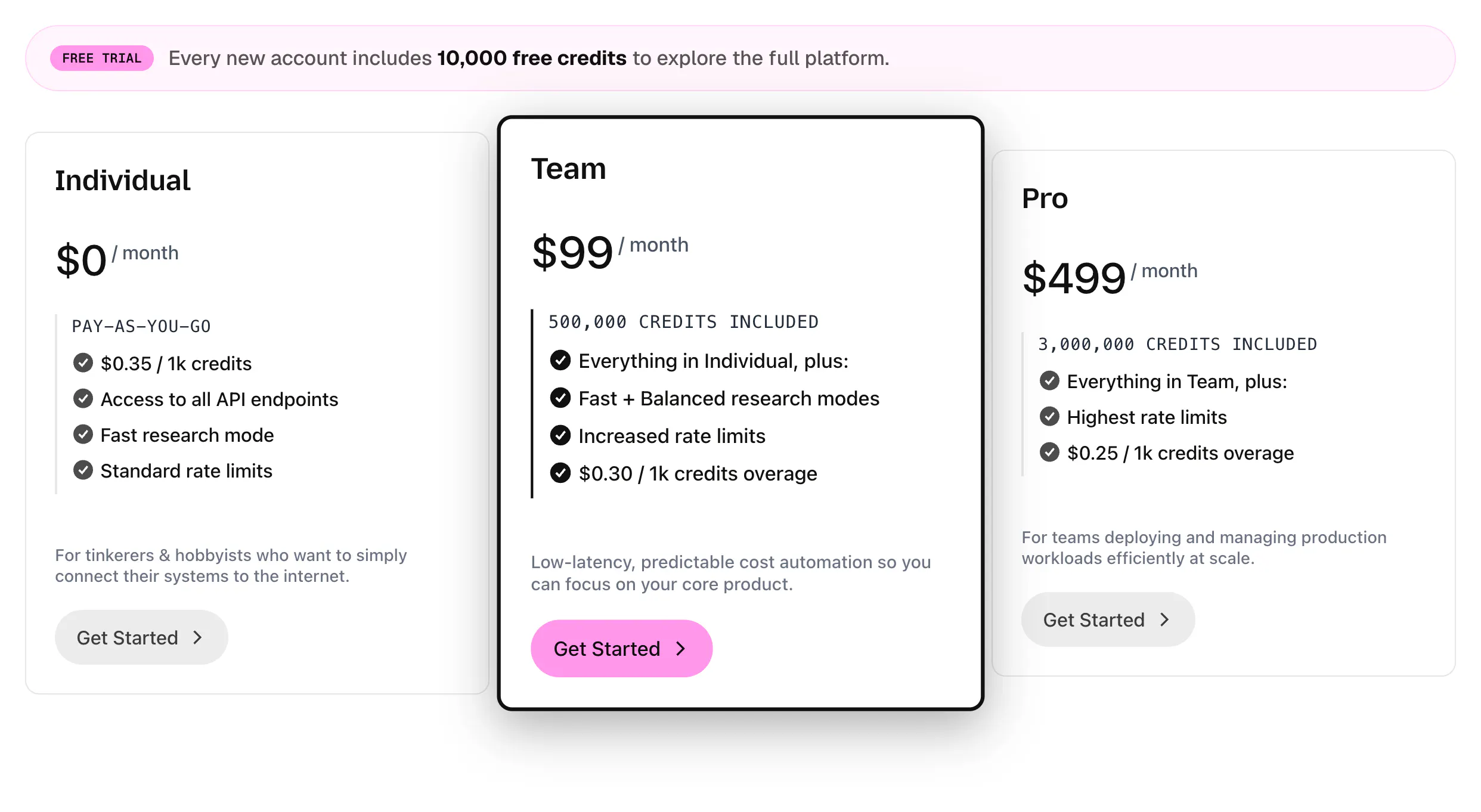
@Tabstack by Mozilla's pricing is clear and flexible. It starts with a free 10k credit trial tier to explore the full platform, then it offers a pay-as-you-go individual plan, or predictable monthly subscriptions. In short, you can build without interruption and scale at your own pace.
To learn more about how Tabstack billing works, read the docs: https://docs.tabstack.ai/pricing/
hope it clarifies!
Schema-defined extraction is the bit I was missing, and it worked cleanly on a couple of messy product pages. The robots.txt compliance and no-training stance from Mozilla make it easy to ship without a long legal check.
Tabstack by Mozilla
@gzdegalerinpu0 your words just made my day! make sure to add your review here: https://www.producthunt.com/products/tabstack/reviews/new
Tabstack by Mozilla
@gzdegalerinpu0 Thank you, love hearing it worked on the messy ones, that's the real test. And you named exactly why the Mozilla stance matters to us: ephemeral by default, no training on your data, robots.txt respected, so it clears legal fast instead of turning into a project. Glad it's easy to ship, and appreciate you giving it a run.