
SuperLocalMemory
The governed memory brain for every AI agent.
38 followers
The governed memory brain for every AI agent.
38 followers
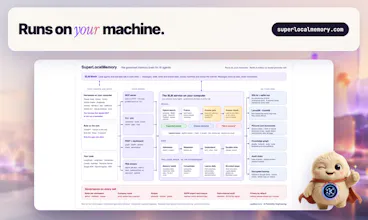
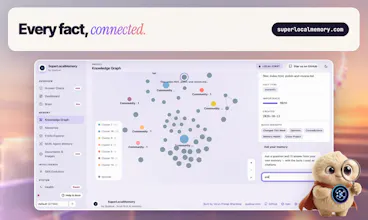
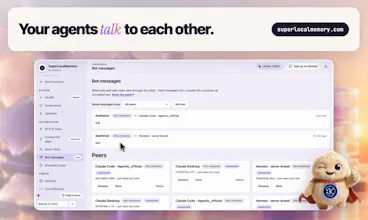
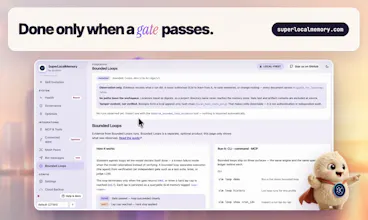
SuperLocalMemory is one local-first memory brain for every AI agent. Claude Code, Codex, Cursor, ChatGPT and any MCP or CLI agent share the same governed memory. Instead of guessing, recall tells you whether a memory answers the question, is only related, or is missing. It remembers pictures and PDFs, tracks when each fact was true and which agent wrote it, and enforces profiles, roles, an audit trail and verified erasure. The core runs on your machine. Open source, AGPL-3.0.
This is the 2nd launch from SuperLocalMemory. View more

SuperLocalMemory
Launching today
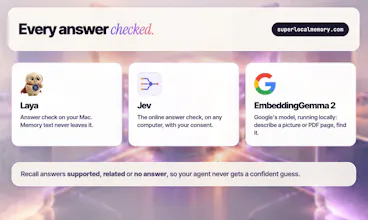
The relaunch of SuperLocalMemory, rebuilt from the ground up and backed by four arXiv papers. One local-first memory brain for Claude Code, Codex, Cursor, ChatGPT and any MCP or CLI agent. It never bluffs: recall says supported, related or no answer, checked by Laya on your Mac or Jev online. Find pictures and PDFs by describing them, with Google’s EmbeddingGemma 2. Governed, mesh-connected, AGPL-3.0. Built by Qualixar, the AI Reliability Engineering lab behind 10 open-source products.







Free
Launch Team / Built With


I have seen the code, read the papers, this software is truly underrated. Performs better than most highly starred (github) memory repository. It's not based on somw glorified heuristic or strategy. Memory is stored in facts, facts are ranked appropriately, recency and relevan e is respected, old memories are forgotten. Wishing this launch its deserved success.
The distinction between a related memory and one that actually answers the question is the part that stood out to me. Returning 'no answer' seems much more useful than passing a vaguely relevant fact to the next agent.
@oleksii_sekundant Thanks, that’s exactly the failure I kept hitting. One agent saves a half-related note, the next one treats it as fact, and the error compounds down the chain. So recall now hands back the closest memories separately, labelled as related, and only marks something as an answer when a stored memory actually supports it. With several agents sharing one memory, that label travels with the handoff.
I co-authored the SuperLocalMemory 4.0 paper with Varun, so take this with that disclosure in mind.
What I'd point technical readers to is how the paper handles its own results. It opens with a negative result: ten mechanisms were implemented, reachable on a live call path, and still ineffective at their final connection. "Implemented", "reachable" and "effective" turned out to be three separate questions, and the paper adds two mechanical checks to tell them apart.
It also tests the write path under failure: eleven fault-injection scenarios, each run 200 times, held 2,199 of 2,200 scoped properties. And it withdraws an overhead figure from the previous version because the two paths being compared weren't comparable. Measured properly, a governed write takes 11.0 ms, and most of that is the cost of durability, not governance.
Paper: https://arxiv.org/abs/2608.08253
Code: https://github.com/qualixar/superlocalmemory
Happy to answer questions on the evaluation or the reliability design.
I'm one of the co-authors on the SuperLocalMemory 4.0 paper, so read this with that in mind.
What I'd like people here to see is that this didn't appear overnight. Varun has worked on this problem for about eight months, in the open, and each step came with a preprint:
1. February: SuperLocalMemory. Local-first memory for multi-agent AI, with a defence against memory poisoning through isolation and Bayesian trust scoring, and no cloud or LLM calls.
https://arxiv.org/abs/2603.02240
2. March: V3, the mathematical foundations. A retrieval metric from information geometry, memory lifecycle modelled as Langevin dynamics instead of hand-tuned decay, and a formal way to detect contradictions between memories.
https://arxiv.org/abs/2603.14588
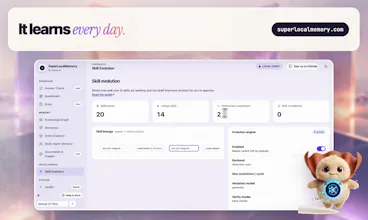
3. April: V3.3, "The Living Brain". The full cognitive memory taxonomy, adaptive forgetting, and a distance metric that prefers full-fidelity embeddings over quantized ones.
https://arxiv.org/abs/2604.04514
4. August: V4, the governed memory system I worked on. Role-based access, verified erasure, a hash-chained audit trail, and a write path tested under eleven fault-injection scenarios, each repeated 200 times. It also opens with a negative result: ten mechanisms that were built and reachable but didn't work at their final connection, plus the checks we added to catch that class of bug.
https://arxiv.org/abs/2608.08253
Each paper added something the product actually ships, and the code is all open: https://github.com/qualixar/superlocalmemory
Happy to answer questions about the V4 governance and evaluation work.