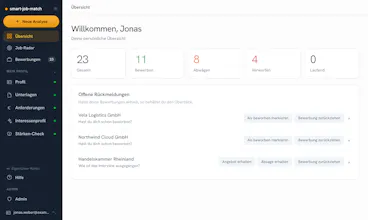
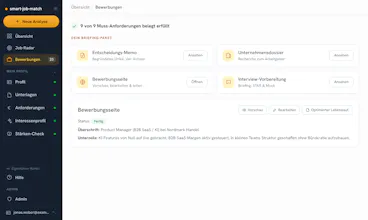
smart-job-match checks any job posting against your real profile and returns an evidence-based verdict: apply, consider, or skip, scored on profile match, company, role and your must-haves. On an Apply, you get the full pack: decision memo, tailored cover letter, optimized CV and a shareable page. Free radar scans 44,000+ DACH jobs daily. First analysis free, no subscription. German-language, DACH.
No reviews yetBe the first to leave a review for smart-job-match
Maker
📌
Hi PH 👋 I'm Pascal, the maker.
I built this while I was job hunting myself. I had a spreadsheet full of open roles and no honest way to tell which ones were worth the few hours a decent application actually takes. So I'd either fire off too many half-hearted ones or sink real effort into a role that was never going to fit. Both were a waste.
The question I couldn't answer was simple: is this one worth applying to? Most people answer it on gut feeling. And most applications don't go anywhere, usually not because the person can't do the job, but because the role and the profile were never a match to begin with. I wanted an answer I could actually stand behind, so I started scoring each posting against my profile on four things: how well it matches me, the company, the role itself, and my own dealbreakers. Out of that comes one call: apply, consider, or skip, with the reasoning written out so I know why.
It began as a scrappy script for one user, me. The more I leaned on it, the more obvious it got that the useful part was the decision and the evidence behind it, not another cover-letter generator. Loads of tools already write the letter. Almost none tell you whether you should bother. So I put the decision first and rebuilt the whole thing into something anyone can use, not just me, and made sure "why did it say skip?" always has an answer.
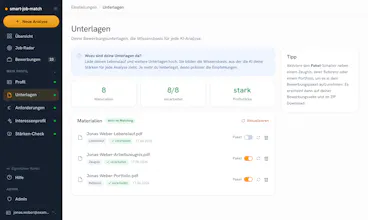
Now you paste a posting, get the verdict, and if it's a fit you also get the pack: a short decision memo, a cover letter, a CV tailored to the role, interview prep and a shareable page. Your documents stay private and never go to employers. Servers are in Germany.
🇩🇪 One honest thing: it's in German and built for the DACH market (Germany, Austria, Switzerland), so it's really only useful if that's where you're looking. First analysis is free, no subscription.
What I'd most like your read on is the scoring. Do the verdicts feel trustworthy, or would you second-guess them? Happy to answer anything.
Report
How does the scoring actually work for the company factor when there's barely any public info on smaller DACH employers, and does that drag the overall verdict down unfairly?
Report
Maker
@tahaawrj Fair thing to poke at, because that's the exact trap we built this to avoid.
The company read is only one of four things we weigh: product-market fit, how well the role matches your profile, company stability, and the logistics (location, remote, pay). No single axis decides the verdict on its own.
And when there's barely anything public on a company, we don't quietly count that against it. Thin data stays neutral. The memo just tells you straight: no reliable signals found, so the call leans on the other axes. A KILL only happens when we actually find something: layoffs, bad reviews, a real mismatch. Never because a company is too small to have a footprint. We also won't invent a signal that isn't backed by a source.
So that 20-person shop nobody's heard of? You'll usually get a CAUTION with an honest "here's what we couldn't confirm," not a KILL for being obscure. Evidence you can act on beats a black-box score every time.
Good question to raise. 👊
Report
How does the matching actually work under the hood - is it keyword-based or do you factor in things like seniority level and industry context from my profile?
The radar is the first pass. It surfaces roles worth a look, based on what you're actually after: the kind of role, your level, where you want to be. It matches on meaning, so a job that fits you shows up even when it's worded nothing like your profile.
The deeper read starts when you open a specific job. It takes the posting apart into individual requirements and checks each one against your real experience, and it shows you where every judgment comes from. If it can't back something up, it says so. That's a flagged gap, not one it quietly papers over.
To your actual question: yes, seniority and industry both count. Apply as a senior to a junior role and you'll see the mismatch, not a polite green tick. Industry is read by meaning too, so experience in one field can line up with an adjacent one without the same buzzwords on both sides.
And if you drop in an old cover letter, a reference, a project write-up, the deep read mines those for evidence as well. The match ends up reflecting what you've actually done, not just the form you filled in.
The trade-off we picked on purpose: keep the radar broad and fast, save the heavy lifting for the job you actually care about. Precise where it counts, honest about what it can and can't confirm.
Report
The must-have filter saved me from applying to a role that looked great but required onsite days I can't do. Letter and CV came out ready to send.
Report
Maker
@oktayxx8t Love hearing this, and honestly the "saved me from applying" part is the one that makes my day.
A good no is worth as much as a good yes. Most tools just push you toward more applications; catching the ones that look great but quietly don't fit (onsite days you can't do is a classic trap) is half of why this exists.
Ready-to-send is exactly the bar we hold the letter and CV to. If one ever lands needing more than a light polish, say so. That's the feedback we act on fastest.
Hey Pascal! Congrats to the launch! Looks amazing. I'm a big fan of unsolicited application (Initiativbewerbung). I think that could be a nice feature. So you find a company that fully matches but they don't have a public job offer – the tool helps you to show them how you can help with your profile. :) Just an idea...
Report
Maker
@chptk Hey Christoph, Thanks for your feedback! I really love your idea of showing companies how an unsolicited applicant could help them. It fits perfectly with the vision behind smart-job-match, so I'll definitely explore it in a future iteration.
How does the scoring actually work for the company factor when there's barely any public info on smaller DACH employers, and does that drag the overall verdict down unfairly?
@tahaawrj Fair thing to poke at, because that's the exact trap we built this to avoid.
The company read is only one of four things we weigh: product-market fit, how well the role matches your profile, company stability, and the logistics (location, remote, pay). No single axis decides the verdict on its own.
And when there's barely anything public on a company, we don't quietly count that against it. Thin data stays neutral. The memo just tells you straight: no reliable signals found, so the call leans on the other axes. A KILL only happens when we actually find something: layoffs, bad reviews, a real mismatch. Never because a company is too small to have a footprint. We also won't invent a signal that isn't backed by a source.
So that 20-person shop nobody's heard of? You'll usually get a CAUTION with an honest "here's what we couldn't confirm," not a KILL for being obscure. Evidence you can act on beats a black-box score every time.
Good question to raise. 👊
How does the matching actually work under the hood - is it keyword-based or do you factor in things like seniority level and industry context from my profile?
@celalatszq2r2 No, it's not keyword matching.
Think of it as two layers.
The radar is the first pass. It surfaces roles worth a look, based on what you're actually after: the kind of role, your level, where you want to be. It matches on meaning, so a job that fits you shows up even when it's worded nothing like your profile.
The deeper read starts when you open a specific job. It takes the posting apart into individual requirements and checks each one against your real experience, and it shows you where every judgment comes from. If it can't back something up, it says so. That's a flagged gap, not one it quietly papers over.
To your actual question: yes, seniority and industry both count. Apply as a senior to a junior role and you'll see the mismatch, not a polite green tick. Industry is read by meaning too, so experience in one field can line up with an adjacent one without the same buzzwords on both sides.
And if you drop in an old cover letter, a reference, a project write-up, the deep read mines those for evidence as well. The match ends up reflecting what you've actually done, not just the form you filled in.
The trade-off we picked on purpose: keep the radar broad and fast, save the heavy lifting for the job you actually care about. Precise where it counts, honest about what it can and can't confirm.
The must-have filter saved me from applying to a role that looked great but required onsite days I can't do. Letter and CV came out ready to send.
@oktayxx8t Love hearing this, and honestly the "saved me from applying" part is the one that makes my day.
A good no is worth as much as a good yes. Most tools just push you toward more applications; catching the ones that look great but quietly don't fit (onsite days you can't do is a classic trap) is half of why this exists.
Ready-to-send is exactly the bar we hold the letter and CV to. If one ever lands needing more than a light polish, say so. That's the feedback we act on fastest.
Thanks for taking a minute to write it up. 🙏
Formspector
Hey Pascal! Congrats to the launch! Looks amazing. I'm a big fan of unsolicited application (Initiativbewerbung). I think that could be a nice feature. So you find a company that fully matches but they don't have a public job offer – the tool helps you to show them how you can help with your profile. :) Just an idea...
@chptk Hey Christoph,
Thanks for your feedback! I really love your idea of showing companies how an unsolicited applicant could help them. It fits perfectly with the vision behind smart-job-match, so I'll definitely explore it in a future iteration.