
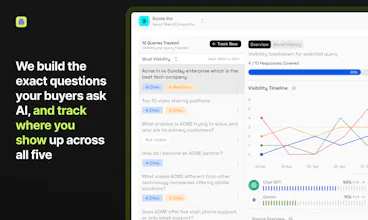
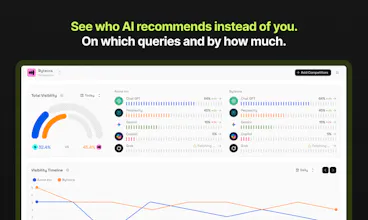
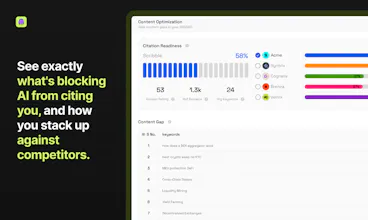
Your customers ask AI before they ask Google, and most brands have no idea whether they show up or lose to a competitor. Every other tool hands you a visibility score and stops there. Scribble does the whole loop: audit where you're invisible across every AI engine, create content that closes the gap, and amplify it through 50,000 creators who only get paid when AI cites them. A gap report won't win customers. Being the cited answer will.




Forum Threads


View all
This is a rlly cool idea! However the pricing model seems quite steep. I would be inclined to try this, but the lower tier subscriptions should have some level of creator distribution. More importantly, thoug, the lower tiers seem to just be more expensive versions of other GEO/AEO tools (but with MUCH less tracking / competitor analysis). I would keep a tier around the price range of your current lowest subscription, however the offerings you provide need to be more akin to what dozens of your competitors already offer (and for 50-80% cheaper).
The creator distribution aspect is genuinely different in the best way possible, but you NEED to offer distribution to lower tiers for users to really see the benefit of your platform. Would love to stay in touch!
@lucapiekarski Thank you for the feedback! Pricing has been tricky for us and we're still caliberating it. But rest assure, we want to bring creator distribution to everyone and will open it up gradually to lower tiers too.
How do you actually verify that a piece of content got picked up by the AI engines versus just guessing based on prompt testing?
@lkercmt2 Great question! Here's how we actually verify it: every time an AI engine (ChatGPT, Perplexity, Gemini, etc.) answers a question, it usually cites sources. We pull those cited source URLs directly from the AI's response and match them against our library of creator content — so if a TikTok or blog post pushed by one of our creators is a source behind an answer, we can show that exact link-up. It's not "does this prompt sound like it mentions us," it's "here's the actual source AI cited, and here's the creator piece it maps to."
Dropping screenshots below from our dashboard showing real citations for one of our clients mapped to the creator content behind them, so you can see it in action.
Happy to dig into any part of this further if useful!
Where do you find the list of AI creators and what are their geographic location. In addition i saw your profile its all web 3 projects, i assume they are web 3 creators?
@roy_kek Good eye. Yes, we built the network over two years in Web3, that's where our roots are and where most of our creators and clients come from today. Geographically, they're global. We're expanding into other categories now, and the mechanics transfer, engines cite genuine creator content the same way regardless of niche.
This is a really interesting product to get AI visibility. But does UGC mean only a videos or it's mostly a text-based citation from creators??
@jiteshghanchi We're trying to change that. If you use a product and write about it on Medium, it's as much UGC as an instagram post. However, we've seen citations from our network itself come from X, YouTube and even Instagram. For us, UGC means what it stands for - you're a user of a product and you create content about it.
What makes Scribble a better option for creators than traditional influencer marketplaces?
@robert_dimla Influencer marketplaces pay you for reach, followers, and impressions. Scribble pays you for quality, if your content is trusted AI engines. You don't need a minimum follower count. Your writing keeps working (and keeps you earning) long after the campaign ends. It rewards good writers and product users, not just big audiences.
The thing I'd layer on top of the daily hold is a paraphrase test. Repeat the exact prompt and a citation can survive just because the retrieval cache hasn't turned over, but reword the same intent three ways and only the durable sources keep citing you. When we tried this, verbatim-repeat stability and paraphrase stability behaved like two different metrics, and the second one tracked real answer quality a lot better than raw repeat counts.
Ran the audit on my own site and the gap report actually flagged specific prompts where competitors were getting cited instead of me, which is way more useful than a generic score. The creator amplification piece is a clever angle I haven't seen elsewhere.
@mirahazaraqb2 Thank you for actually running it! The specific prompts over generic score thing was exactly the design goal, a score tells you, you have a problem, the prompts tell you where to fight. Glad it helped!