
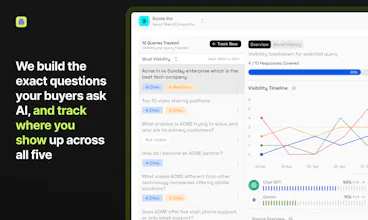
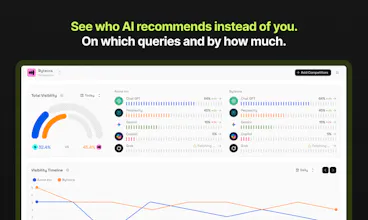
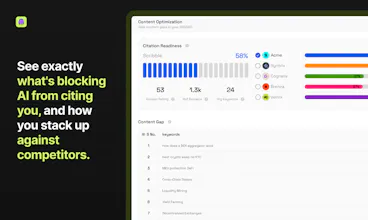
Your customers ask AI before they ask Google, and most brands have no idea whether they show up or lose to a competitor. Every other tool hands you a visibility score and stops there. Scribble does the whole loop: audit where you're invisible across every AI engine, create content that closes the gap, and amplify it through 50,000 creators who only get paid when AI cites them. A gap report won't win customers. Being the cited answer will.




Forum Threads


View all
For a brand that's already doing GEO content in-house, does Scribble work alongside that or is it more of a replace-your-current-workflow kind of tool?
@alexander_gray3 Alongside, definitely! If you're already doing GEO in-house(which is awesome), the audit shows you whether that content is actually getting cited (and where the gaps are), and the creator network adds the third-party layer you can't produce in-house. I'd love to chat with you further on this to understand better.
Congratulations on the launch!
i really like the idea of connecting AI visibility with creator distribution instead of just analytics. how do you identify which creator posts have the highest chance of being cited by LLMs? looking forward to seeing how this evolves.
@james_carter35 Thank you!
Two ways - creators are scored on citation history, so we know who's been picked up before, and briefs are built from the actual queries engines are being asked, so content is aimed at real questions, not generic topics. Then the surfaces matter, Medium, Paragraph, Reddit, places LLMs actually read. Beyond that, the engines decide, and honestly, they're a better filter than what we could build. :)
this feels like a unique combination of creator marketing and AI search optimization. I am curious how often does the visibility score refresh and can teams monitor improvements in near real time as new creator content goes live?
@olivia_bennett7 Thank you! :)
1)Citation tracking is daily, every query is fetched every 24 hours across all five engines, so you see whether that content shows up as a source within a day of the engines picking it up.
2)Creators submit their content link back on the platform as soon as they publish, so you see every piece the moment it's in.
Near real-time on the content side, daily on the citations.
Distribution is the insight everyone's been sleeping on. As you scale beyond SaaS/tech, what signals tell you when vertical domain knowledge becomes a blocker vs. just needing the right content angles?
@alejandro_fenn This is such a thoughtful question. AI answers are generally important for products that need research before purchase. Now, if this is a product or service that everyone uses, it boils down to content angles - think colleges, courses, ed-tech etc. If it's more niche - medical electronic devices, scientific software, custom hardware for factories - this requires niche knowledge.
Do different AI engines treat creator content differently? Like, could a post get cited on Perplexity but never show up on Gemini or Claude? If that happens, do you brief creators differently per engine, or is one piece expected to work across all five?
@iamaminmajid Yes, constantly, that's one of the biggest things we've seen. Same post, cited on Copilot and Gemini, invisible on GPT. We don't brief per engine though, one genuinely good piece tends to travel, and our best single result was one creator post cited by Copilot, Gemini and Perplexity at once.
Love the hustle behind this launch. qq how do you prevent creators from just keyword-stuffing articles to trick the LLM scrapers instead of writing actual high-quality content? congrts for launch @pythonhulk
@priya_kushwaha1 Thank you! Keyword stuffing is an SEO trick that doesn't really translate to GEO, llms are looking for genuine human opinions and simple, understandable content they can quote. A stuffed article is actually harder for a model to cite than a clean one.
I think the biggest value comes from connecting discovery with action. what happens if a brand already ranks well across several engines? Showing where effort brings the highest return could help users prioritize.
@joan_garcamo If you already rank well, the value flips to defending your position (engines recycle sources, strong positions decay without upkeep) and finding the specific queries you're still losing. The effort vs return prioritization idea is genuinely good though. Taking that one away.