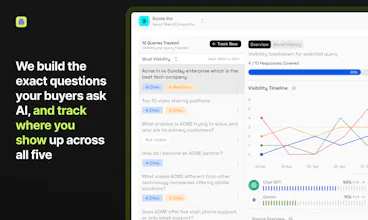
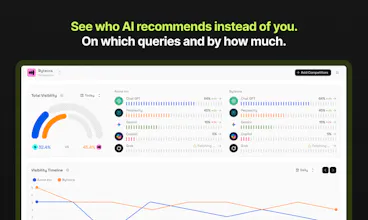
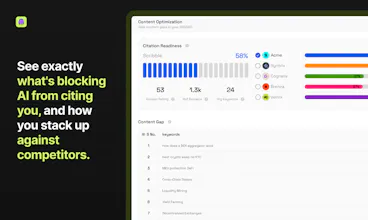
What it is: A Web3 creator marketing platform that monitors your brand's visibility across ChatGPT, Perplexity, Gemini, Grok, and Copilot — then deploys 50,000+ real creators to close the gaps with human-written content on Reddit, Medium, Substack, and X.
How it's different: Most GEO tools (Promptwatch, Otterly) show you where you're invisible and stop there. Scribble actually produces content to fix it. And unlike AI-written articles that LLMs downrank, Scribble's content comes from real independent voices — which is exactly what ChatGPT cites.
The data: RocketX went from zero to 9% AI Share of Voice in 15 days (162 creators, 358 pieces). Key finding — X/Twitter content drove zero citations; Reddit and long-form Medium/Substack drove nearly everything.
Pricing: 99/moformonitoring(2engines,50prompts),99/moformonitoring(2engines,50prompts),399/mo for insight, 1,500/moforactualcontentcampaigns.Thecatch—youneedthe1,500/moforactualcontentcampaigns.Thecatch—youneedthe1,500 plan to get the creator network.
Caveats: Founded 2026 — very new, almost zero independent user reviews on Reddit/G2/Trustpilot. All published case studies are Web3 projects; traditional brand applicability unverified. And $1,500/mo is steep for SMBs.
Verdict: If you're a Web3 brand with budget, worth testing on $99 Basic first. If you're a traditional industry, wait for more case studies.




How does the creator payout system actually work? Do the 50,000 creators pick which brands to cite, or do you assign them briefs, and what stops them from just gaming AI citations to chase the payout?
@znuranbarlr0wv Good question! So creators don't pick brands themselves; we find the queries where a brand is losing to competitors, turn those into bounties, and creators opt into the ones they want to write for. Usually around 100- 300 creators per campaign out of the 50k.
On payouts: creators aren't paid for publishing, or even for a single citation. Their piece has to show up as a source in the AI answer more than three times in a week before it pays. One-off appearances don't count.
On gaming, honest answer: we can't stop people from trying, and we don't have to. The LLM labs are the ones fighting astroturfing, and they're better at it than we'd ever be. We literally watch it fail every day, people copy-paste ChatGPT answers back out as content, word for word, and it never gets cited. What actually gets picked up, consistently, is genuine opinion from real people who've actually used the thing.
That's the whole reason our model works, we're not gaming the engines; we're feeding them the one thing they're actively looking for, which is authentic human content.
Happy to go deeper on any of it!
Interesting concept! One question that came to mind - how do you ensure the quality and authenticity of the content? If an author has never actually used the product, they're essentially writing promotional material about something they have no real experience with. Isn't there a risk that AI ends up recommending brands based on just technically well-written texts?
@julia_shtogren Really fair question! And honestly, it does happen now, and then, someone writes a technically clean piece about something they've never touched but that content doesn't last.
The engines recycle their sources constantly, and pieces that haven't been lived, just fall out on refresh. What sticks is content with real experience in it, because that's literally what the models are hunting for when they cite UGC over brand pages in the first place.
It's also why bounties are opt-in, not assigned. The ones who don't get cited maybe once, and since payment only kicks in after a piece holds as a source three times in a row, un-lived content basically doesn't pay.
So yeah, the risk you're describing is real, but the engines and our inbuilt economics both punish it.
ran it on my own site and the gap report actually flagged two prompts where competitors were getting cited instead of me, which was a bit of a gut punch but useful. the creator amplification angle is interesting too, hadn't seen that tied into AI visibility before.
@halimepolatcan Ha, the gut punch is the point 😅 better to know than to guess! And yes, tying creators into visibility is the whole bet, the gap report tells you where you're losing, the creators are how you actually take the spot back. Thanks for running it and sharing!
The full loop approach actually clicked for me, I ran the audit on a small client site and the content suggestions lined up with the gaps it flagged instead of feeling generic. Really curious how the creator amplifier piece works in practice.
@erafettinsabee This is so good to hear, thank you for actually running it! 🙏
We turn the gaps the audit flagged into bounties, creators from the network opt in and write for those exact queries, and the product tracks which piece gets cited, by which model. Then creators get paid when their piece holds as a source.
Let me know if you want ot chat about running a camapign with us.
Love the shift from just measuring AI visibility to actually helping brands become the cited answer.👏🏻
The creator network is an interesting approach too. Curious, how do you measure whether a piece of content is genuinely influencing AI citations over time rather than just improving traditional SEO metrics?
@worksforme Love this question. We don't infer from SEO metrics at all, we query the models directly. For every tracked query, we fetch the live AI answers across all five engines and log which sources each one actually used, over time. So "influence" isn't proxied through rankings or traffic, it's observed: this post was a source in this answer, on this date, and held (or fell out) on refresh. Google rankings can improve without a single AI citation moving, and vice versa, which is exactly why we track them separately.
@kaavya_prasad That's a really smart distinction. I like that you're tracking actual citations in live AI responses instead of using SEO as a proxy. It makes a lot more sense given how differently LLMs retrieve information. Thanks for explaining....it'll be interesting to see how those citation patterns evolve as the models continue to change. 👏
@worksforme 100%! The models will keep changing, but trusting external content isn't going anywhere, how it's weighted will and that's something we'll keep iterating on.
How does the payout structure actually work for the creators in the network, like is it a flat fee per citation or some kind of performance bonus based on ranking?
@elifnurufuk It's citation-based, not a flat publishing fee. A piece has to show up as a source in the AI answer more than three times in a week before it pays, one-off appearances don't count. So it's closer to performance-based: creators earn when their content actually holds as a cited source. Fuller breakdown is in my earlier reply if you want the details. :)
How does the creator amplification piece actually work in practice, do the creators see the brand brief first or just the content you draft for them?
@sultanbn41 They see the brief, not drafted content! We identify the queries where a brand is losing, turn those into briefs with the context and gaps, and creators write their own pieces in their own voice. We never hand them pre-written content, that's exactly the stuff engines ignore. The authenticity is the whole point.
You can check out client briefs on - https://scribble.network/creators