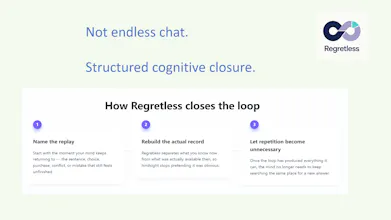
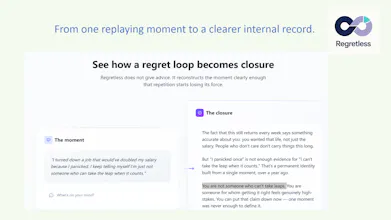
Regretless is a structured AI reflection tool for people stuck in regret, self-blame, rumination, and overthinking. Instead of endless chat, it helps users work through the specific moment their mind keeps replaying and reach cognitive closure.
Hey Product Hunt,
I built Regretless because I kept noticing a very specific problem:
Sometimes the mind does not need more advice. It keeps replaying one moment because the event still feels mentally unfinished.
Most AI tools are built for open-ended conversation. But regret often does not need endless conversation. It needs structure.
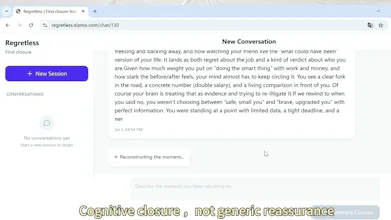
Regretless is an AI-guided reflection tool for regret loops, self-blame, and rumination. It helps you work through the specific moment your mind keeps replaying — not by giving generic reassurance, but by guiding the loop toward cognitive closure.
It is intentionally narrow:
- not therapy
- not diagnosis
- not coaching
- not toxic positivity
- not endless chat
It is built for moments like:
- “I keep thinking about what I said in that meeting.”
- “I spent money on something I regret.”
- “I hurt someone I care about, and I keep replaying it.”
- “I turned down an opportunity, and now I keep wondering who I would have been if I had taken it.”
- “I chose one path, but I keep thinking my life would be better if I had chosen differently.”
The core idea is simple:
The mind often keeps searching the same moment for a new answer.
Regretless helps make that search feel complete.
I would love to hear how the concept lands with you — especially if you have ever felt stuck replaying one specific moment long after it was over.
Report
How does it actually get someone to closure when they could just keep typing new prompts into ChatGPT for free, what's the real differentiator?
Report
Maker
@cemre46338 That’s a great question, and it’s the core of why I built Regretless.
The real differentiator isn’t just the "quality" of the AI response—it’s the structural intent of the session. Here is how Regretless differs from a standard ChatGPT thread:
1. Completion vs. Exploration: ChatGPT is designed for open-ended conversation. It’s built to keep you engaged, asking questions, and exploring more. But for someone in a regret loop, "more conversation" is often the problem. Regretless is built for cognitive closure—it’s a one-way path designed to finish the computation so the mind can stop searching the same moment for a new answer.
2. Structural Constraint: When you use a general LLM, you are the director. You have to know how to prompt it to stop it from just giving generic "toxic positivity" or reassurance. Regretless uses a specific 5-move framework (Somatic Resonance -> Validation -> Archaeology -> Closure -> Co-arrival) that a user doesn't have to manage. It forces the AI to deconstruct the "identity claim" behind the regret, which is something a general chat often misses.
3. The "Courtroom" Effect: Rumination is like a private trial that never ends. A standard chatbot often acts like a defense attorney (telling you it’s okay) or a witness. Regretless acts as a system that helps you recognize that the trial itself is built on faulty evidence (hindsight bias). It’s designed to return agency to you, not to just "chat it out."
In short: ChatGPT is a tool for thinking more. Regretless is a tool for being done with a specific thought.
I’d love for you to try a session with a specific replaying moment and see if you feel that shift in pressure—it’s a very different sensation than a standard chat!
Report
No reviews yetBe the first to leave a review for Regretless
How does it actually get someone to closure when they could just keep typing new prompts into ChatGPT for free, what's the real differentiator?
@cemre46338 That’s a great question, and it’s the core of why I built Regretless.
The real differentiator isn’t just the "quality" of the AI response—it’s the structural intent of the session. Here is how Regretless differs from a standard ChatGPT thread:
1. Completion vs. Exploration: ChatGPT is designed for open-ended conversation. It’s built to keep you engaged, asking questions, and exploring more. But for someone in a regret loop, "more conversation" is often the problem. Regretless is built for cognitive closure—it’s a one-way path designed to finish the computation so the mind can stop searching the same moment for a new answer.
2. Structural Constraint: When you use a general LLM, you are the director. You have to know how to prompt it to stop it from just giving generic "toxic positivity" or reassurance. Regretless uses a specific 5-move framework (Somatic Resonance -> Validation -> Archaeology -> Closure -> Co-arrival) that a user doesn't have to manage. It forces the AI to deconstruct the "identity claim" behind the regret, which is something a general chat often misses.
3. The "Courtroom" Effect: Rumination is like a private trial that never ends. A standard chatbot often acts like a defense attorney (telling you it’s okay) or a witness. Regretless acts as a system that helps you recognize that the trial itself is built on faulty evidence (hindsight bias). It’s designed to return agency to you, not to just "chat it out."
In short: ChatGPT is a tool for thinking more. Regretless is a tool for being done with a specific thought.
I’d love for you to try a session with a specific replaying moment and see if you feel that shift in pressure—it’s a very different sensation than a standard chat!