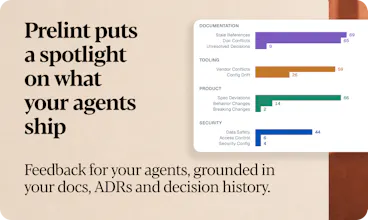
AI writes your code at 10× speed. Prelint makes sure it's the right code - it reviews every PR against your ADRs, docs and past decisions, and catches product drift before it ships. On teams using several AI reviewers, ~40% of the issues fixed before merge are caught by Prelint.
AI agents ship code that passes every test - and quietly makes product decisions that break your product. @Prelint is the decision layer for AI-written software.
Tools like CodeRabbit check if your code is correct; Prelint checks if it does the right thing.
Live on Product Hunt today: worth a look and vote: https://www.producthunt.com/prod...
Framer AI AgentsDesign and publish professional sites with AI
Promoted
Congratulations on your launch! quick minute question: couldn't someone give instructions to the AI coding agent to check specification document or product design document before shipping code?
Thanks, Richard! They could and should and it does a great job at detecting the first 20% issues.
Our core strength is that in the background of a simple "reviewer" we store a decision ledger that understands not only "what is written in the docs" (this you can compare using a Claude skill) but helps companies organize colliding specifications and decisions, understand how they supercede and override each other and which require human attention. We also understand the authority of the person making the decision (and whether it's a human or an AI).
As a starting point we are quite good at squashing and deduplicating decisions out of the box to address messy documentation, but we also have CLI tools that allow users to iterate on the ground truth that Prelint stores, understand which docs clearly contradict each other and just need addressing.
The problem is also that most teams now create design docs on the fly - so the issue is often not "does the code follow the docs?" but "does anyone know what the AI is actually building?" - and this is a problem that both small and big teams have. In larger orgs it's often a bigger mess because there's less transparency and product and business people get completely lost.
Report
The "decision ledger, not a code reviewer" framing is the part I'd have paid for a year ago.
One gap I'd want to understand. Every ingestion source you've described is an artefact of a team — Slack, meetings, tickets, ADRs. I run a one-person company and I have none of those. Nine months of architectural decisions exist only in AI chat transcripts and in commit messages I wrote to myself. There's no PR either; changes go straight to main.
So: is the CLI a first-class path for the no-PR case, or a fallback for the GitHub flow? And is there any way to seed the ledger from conversation history rather than from repo artefacts? The decisions I most want caught are the ones I made at 11pm in a chat window and had forgotten I'd made by the following week.
Step 1: It's plug and play - connect your GitHub repo, it understands your code, docs, change history and starts building an ontology of your business. From the start we see it being very helpful at surfacing implicit decisions your agents make (like: small changes to business logic that have an impact downstream) or violating desing patterns your team decided on. For example, you don't have to tell it you're HIPAA or SOC compliant, it's smart at understanding your team's ruleset.
Step 2: As your agents and team work with Prelint, with every interaction it absorbs microdecisions and "product breadcrumbs". It understands if a given decision is made by a human or AI and the authority of the decision maker, understands how the decision collides or supercedes others and allows agents to access this data through CLI.
Step 3: In the future, we see interfaces for non-technical people as extremely important - very often your product, business, sales teams are affected by these microdecisions and they don't event have access to GitHub or ways to course-correct. In 3 months we want to have interfaces for eg your product team or CEO where they can record soundbites that complement or expand the tracked decisions, too.
Report
Few weeks in with Prelint and it's been a genuinely good experience.
Best part for me is that it notices when a change goes against what the docs already say, which means you deal with it early instead of in a painful review later. Solid tool.
Thanks, appreciate the support! Do let us know about the features you'd like to see going forward, I try to pay very close attention to how people use the tool.
Report
QA engineer here, been using Prelint for a while. A lot of our PRs are AI-assisted now code compiles, tests pass, looks right, but whether it still matches what the team actually decided used to land entirely on me.
Prelint does that pass before I get there. It catches spec drift early, and the notes it leaves on the PR are genuinely useful input for my testing, I go in knowing which areas need attention instead of reading a diff cold.
Thanks for your support Michał, feel free to reach out whenever there's a feature you feel is missing!
Report
I've watched AI-generated PRs balloon in volume while nobody's actually re-reading the original design docs. Tying review criteria back to ADRs feels like the missing piece most teams skip.
Thanks, Grayson! That's if there are any original design docs at all! We have to prepare for a world where there's a lot of micro product decisions being made in Claude sessions, in conversations and on Slack. Very very little people sit down now and do a top-down design doc that they ask agents to implement. So we're building for a world where we need to catch these decisions where they happen and serve+structure them back.
Report
My team's biggest AI-coding headache isn't bugs, it's silent scope creep, code that works but drifts from what we actually decided months ago. Tools like this feel overdue.
Thanks William! Yes. Also, the problem is often that AIs try to add something that genuinely adds value - a feature, design pattern but it just gets baked into the code without a human ever knowing about it - and it creates a spaghetti of the right thing built at the wrong time.
Do try Prelint for your projects and let me know what your team thinks :)
Congratulations on your launch! quick minute question: couldn't someone give instructions to the AI coding agent to check specification document or product design document before shipping code?
Prelint
Thanks, Richard! They could and should and it does a great job at detecting the first 20% issues.
Our core strength is that in the background of a simple "reviewer" we store a decision ledger that understands not only "what is written in the docs" (this you can compare using a Claude skill) but helps companies organize colliding specifications and decisions, understand how they supercede and override each other and which require human attention. We also understand the authority of the person making the decision (and whether it's a human or an AI).
As a starting point we are quite good at squashing and deduplicating decisions out of the box to address messy documentation, but we also have CLI tools that allow users to iterate on the ground truth that Prelint stores, understand which docs clearly contradict each other and just need addressing.
The problem is also that most teams now create design docs on the fly - so the issue is often not "does the code follow the docs?" but "does anyone know what the AI is actually building?" - and this is a problem that both small and big teams have. In larger orgs it's often a bigger mess because there's less transparency and product and business people get completely lost.
The "decision ledger, not a code reviewer" framing is the part I'd have paid for a year ago.
One gap I'd want to understand. Every ingestion source you've described is an artefact of a team — Slack, meetings, tickets, ADRs. I run a one-person company and I have none of those. Nine months of architectural decisions exist only in AI chat transcripts and in commit messages I wrote to myself. There's no PR either; changes go straight to main.
So: is the CLI a first-class path for the no-PR case, or a fallback for the GitHub flow? And is there any way to seed the ledger from conversation history rather than from repo artefacts? The decisions I most want caught are the ones I made at 11pm in a chat window and had forgotten I'd made by the following week.
How does it work?
Prelint
Good question!
Step 1: It's plug and play - connect your GitHub repo, it understands your code, docs, change history and starts building an ontology of your business. From the start we see it being very helpful at surfacing implicit decisions your agents make (like: small changes to business logic that have an impact downstream) or violating desing patterns your team decided on. For example, you don't have to tell it you're HIPAA or SOC compliant, it's smart at understanding your team's ruleset.
Step 2: As your agents and team work with Prelint, with every interaction it absorbs microdecisions and "product breadcrumbs". It understands if a given decision is made by a human or AI and the authority of the decision maker, understands how the decision collides or supercedes others and allows agents to access this data through CLI.
Step 3: In the future, we see interfaces for non-technical people as extremely important - very often your product, business, sales teams are affected by these microdecisions and they don't event have access to GitHub or ways to course-correct. In 3 months we want to have interfaces for eg your product team or CEO where they can record soundbites that complement or expand the tracked decisions, too.
Few weeks in with Prelint and it's been a genuinely good experience.
Best part for me is that it notices when a change goes against what the docs already say, which means you deal with it early instead of in a painful review later. Solid tool.
Nice to finally see you on PH, good luck!
Prelint
Thanks, appreciate the support! Do let us know about the features you'd like to see going forward, I try to pay very close attention to how people use the tool.
QA engineer here, been using Prelint for a while. A lot of our PRs are AI-assisted now code compiles, tests pass, looks right, but whether it still matches what the team actually decided used to land entirely on me.
Prelint does that pass before I get there. It catches spec drift early, and the notes it leaves on the PR are genuinely useful input for my testing, I go in knowing which areas need attention instead of reading a diff cold.
Good luck with the launch!
Prelint
Thanks for your support Michał, feel free to reach out whenever there's a feature you feel is missing!
I've watched AI-generated PRs balloon in volume while nobody's actually re-reading the original design docs. Tying review criteria back to ADRs feels like the missing piece most teams skip.
Prelint
Thanks, Grayson! That's if there are any original design docs at all! We have to prepare for a world where there's a lot of micro product decisions being made in Claude sessions, in conversations and on Slack. Very very little people sit down now and do a top-down design doc that they ask agents to implement. So we're building for a world where we need to catch these decisions where they happen and serve+structure them back.
My team's biggest AI-coding headache isn't bugs, it's silent scope creep, code that works but drifts from what we actually decided months ago. Tools like this feel overdue.
Prelint
Thanks William! Yes. Also, the problem is often that AIs try to add something that genuinely adds value - a feature, design pattern but it just gets baked into the code without a human ever knowing about it - and it creates a spaghetti of the right thing built at the wrong time.
Do try Prelint for your projects and let me know what your team thinks :)
DMs always open if you ever need support