We did it! Prelint hit #1 on Product Hunt this week - thank you for every upvote, comment and DM Now let me return the favour:
I honestly didn't imagine a launch where we'd have a customer registering every couple minutes - or that I'd spend part of it exchanging comments with one of the world's most popular YouTubers. Wild week.
I replied to every comment on our launch - solo builders, CTOs, investors all interested in the same problem from different angles. Here is how it started in February:
Prelint exists because of one code change. An agent ignored our event-driven architecture and implemented a feature completely bypassing it. The code was technically correct, passed all tests. And nobody made that decision - it was just quietly baked into our product.
That's product drift. It's almost never one big bad call - it's micro-decisions nobody notices for 6 weeks. A change in permissions, a "simplified" billing edge case, a dependency nobody approved. Usually it's good code, wrong product.
So here's my launch offer - not a discount - it's my time.
If you're rolling out coding agents and agentic workflows at your company right now, comment or e-mail me at wojtek(at)prelint.com. I'll share the exact agentic workflows and tooling we use internally to manage 50 production changes a day as a small team and I'll honestly tell you which parts you can solve in-house before you need a tool like ours. These conversations were the best part of the launch and I want more of them :)
Also - if you want to see what your agents have been deciding on your behalf, connect a repo at prelint.com Code PH100 gets you 100$ in free review credits this month - it's full speed AI, but with lane assist.




Congrats on shipping this! Product drift is such a sneaky problem, the code works fine but the product quietly became something else. Does Prelint only catch drift in new pull requests, or can it also scan an existing codebase for decisions that already slipped through?
Prelint
Thanks for the question, Dogan!
We do scan your existing repo and your agents do see contradictions, collisions and product breadcrumbs through the CLI.
1752vc Pitch Deck Analyzer
Congrats on the launch! "Product drift" is a great name for a problem I didn't have a word for. The code compiles, tests pass, and it still quietly isn't the thing you asked for. Catching that at lint time is the right layer. Does it work across any codebase, or are you starting with specific languages?
Prelint
Thanks, Ben! Prelint works quite well with most modern popular languages, we've seen teams getting great results also with some hardware projects, we also have some happy customers reporting very good results with infrastructure in code.
I can imagine Fortran would be tricky though
Prelint
Thanks, Hamza! Usually a technical choice that looks risky from the outside is something that is worth acknowledging by a human. There are cases where something done by your Claude agent can be actively helpful but lead to a disaster if a human is not aware of it.
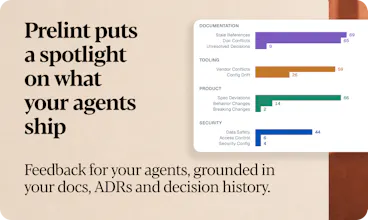
There's of course the danger of being "too noisy" - probably the #1 reason people dislike some code reviewers or feedback tools - this is mostly a configuration issue, we feel we're quite good at putting spotlight on the right things.
MonoCloud for Startups
Finally a reviewer that reads the ADRs. Checking PRs against past decisions instead of just correctness is where the leverage sits, most AI reviewers catch broken code, almost none catch code that contradicts a decision the team already made. The messier problem on my teams was always docs that drifted from reality, so a tool that treats them as the source of truth creates pressure to keep them current. That alone changes how teams write docs.
Prelint
@roguetink Your teams can now use the Prelint CLI to understand how your docs drift and collide and have your agents work on them.
FlowTask
yes true The stat about catching 40% of pre-merge issues on teams already running multiple AI reviewers is the part I'd want to see broken down further. What kinds of issues specifically? Style violations are cheap to catch. Actual drift from architectural intent is a completely different, much harder category and I'd bet that's where the real value is.
Prelint
We practically don't catch "style violations" - we're centered around architecture drift, breaking design patterns, and very often the agents just plain going in a product direction that makes sense in their limited context but not in the context of the company the humans are trying to build.
PRISM by Block Convey
Prelint
It does.
The honest answer is, it's a two step process:
1/ Connect your GitHub repo. You will get a lot of value just from our decision review that works great even just with access to your code - it puts a spotlight on all implicit decisions the agents make on your behalf, on every pull request.
2/ Data sources (JIRA, ADRs, meeting notes, slack, micro-decisions through CLI and Claude sessions) - these all compound and over time make your workflow more accurate. Without it, (1) will still work great, but if you ask the CLI "give me all decisions on billing" it won't have the same depth with less source material.
1752vc Pitch Deck Analyzer
The interesting bet here isn't catching bugs. It's catching code that works but quietly contradicts a decision the team made six months ago, and nobody has a linter for that. How much ADR discipline does a team need before Prelint has enough to check against?
Prelint
Zero. If you don't have ADRs Prelint is a great tool because you can use it as the ground truth, or if you need to export or access your decision records you can use Prelint's CLI.