
PodcastorAI
Your AI twin hosts your video podcast
709 followers
Your AI twin hosts your video podcast
709 followers
Create studio-quality video podcasts from scripts, links, PDFs, or ideas — with AI hosts, natural voices, and your digital twin. Podcastor handles production and puts you on screen, turning hours of recording and editing into a finished video podcast in around 15 minutes. Create solo or two-host episodes and get a publish-ready video without cameras or a production team. Already have an audio episode? Upload it and transform it into a video podcast with your voice and AI avatar.


Free Options
Launch Team / Built With


Customer.ioAutomate Messaging Everywhere — Startups Get 12 Months Free
Promoted


Turning an existing recording into a video podcast without recording everything again is such a practical use case.
@auula_ Thank you! That’s exactly the practical problem we wanted to solve: creators shouldn’t have to re-record an entire episode just to make it work as video. With Podcastor AI, they can turn the content they’ve already created into a video podcast while preserving their voice and presence.
The option to create a solo or two-host podcast is a nice touch. A lot of tools seem built for only one format.
@xiao_zhang9 Thank you! We didn’t want creators to be locked into a single format. Some ideas work best as a focused solo episode, while others become much more engaging through conversation, questions, or debate between two hosts. Podcastor is designed to support both, so the format can follow the content rather than the other way around.
@xiao_zhang9 Thanks Xiao 🙌 Exactly — real podcasts aren't one-size-fits-all, so we wanted both the solo monologue and the two-host back-and-forth to feel natural. The host handoffs in two-host mode are the part we're most proud of. Would love to hear which format you'd reach for 👀
I love the idea of turning an existing content library into video instead of always creating from scratch.
@buzzy_jade Thank you! That’s exactly the idea: creators already have so much valuable content sitting in their libraries. We want to help them give it a second life in video, without having to start from scratch every time.
Hi everyone, I’m Shay, a core developer at @PodcastorAI .
When the project was first launched and we decided to build a product that could help podcast creators produce videos quickly and dramatically simplify their workflows, I was genuinely excited. We wanted to save creators from repetitive work so they could spend more time creating great content and focusing on what truly matters. Once the goal was clear, the entire team quickly got to work, with everyone contributing their strengths and collaborating closely. Our product and operations teams also gave the development team tremendous support. I feel very fortunate to work alongside such talented people and turn an idea into a product that people can genuinely use.
When we started the project, GPT-5.6 Sol had not yet been released. With the help of GPT-5.5, we quickly built the MVP and continued refining the experience based on user feedback. AI did more than help us write code faster. It allowed us to validate ideas sooner, identify problems earlier, and spend more time on the details that truly shape the user experience.
When GPT-5.6 Sol was released, our team switched to the new model right away. Combined with Codex, it made the entire development process much smoother. GPT-5.6 Sol understands requirements and code context with impressive accuracy. Even when working on complex tasks involving multiple modules and long call chains, it can quickly identify where changes actually need to be made. The plans produced by Codex’s Plan mode are usually thorough and rarely require major revisions before we can move forward. For us, this is about much more than simply writing code faster. Communication, analysis, implementation, and verification have all become more efficient and reliable, giving the team greater confidence while maintaining a rapid pace of iteration.
We have also introduced GPT-5.6 Sol into our production monitoring workflow. Our agents regularly scan failed tasks and error logs in production. Whenever an issue is detected, they automatically investigate it by combining information from production logs, database records, and the codebase. Once the cause has been identified, they generate a fix and submit the code to our repository for the team to review. This process has saved us a significant amount of time previously spent on repetitive troubleshooting and fixes. It also helps us detect production risks earlier, allowing the team to focus more of its energy on building the product.
We hope @PodcastorAI can bring podcast creators the same kind of productivity boost that GPT-5.6 Sol and Codex have brought to our team. Our goal is to help creators multiply their output and free up more time for creating, thinking, and doing work that truly matters.
We warmly welcome everyone who already creates podcast videos, as well as anyone interested in getting started, to try @PodcastorAI . We hope to become a reliable and effortless part of your creative journey and help you create even greater value!
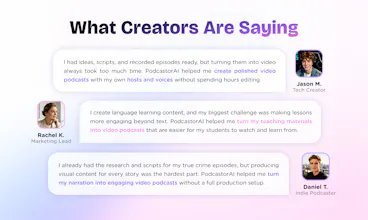
For true crime episodes, the research and writing are already intense. I do not want video production to become another full-time job.
@ea_z Absolutely. For research-heavy formats like true crime, creators should be able to focus their energy on accuracy, storytelling, and responsible reporting, not spend another full-time job producing the video. That’s exactly the production burden we want Podcastor AI to take off their plate.
Congrats on your launch! How long does it usually take to render a one-hour video podcast with lip sync?
@charlenechen_123 Thank you! We currently support episodes up to 30 minutes, so we don’t have a reliable render-time benchmark for a full one-hour podcast yet. Longer generation is already on our roadmap and should be available next month. Once it’s released, we’ll share accurate timing based on real production runs rather than guess today.
I am curious how PodcastorAI handles difficult names, acronyms, and specialized pronunciation.
@linglistack Yes, users can add phonetic guidance to correct the pronunciation of difficult names, acronyms, and specialized terms. If something still doesn’t sound right, they can update the pronunciation and regenerate that specific scene without redoing the entire episode.