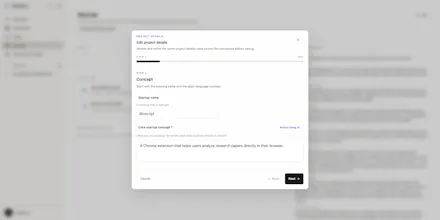
OPTRA for Startups is a predictive intelligence workspace for founders. Instead of guessing whether your idea will work, OPTRA helps you validate it, map your go-to-market strategy, research your market, and get investor-ready—all from one dashboard. OPTRA is built for founders who want data-backed conviction before they build, pitch, or spend a dollar on marketing.
No reviews yetBe the first to leave a review for OPTRA for Startups
Maker
📌
Hi Product Hunt Community! This is Justin from the OPTRA Labs team.
Over the past year, we've talked to a lot of founders (and been founders ourselves) who spent months building something, only to realize the market wasn't quite there for it. It's a pain point we constantly run into, again and again, in our own experience, and something we’ve found to have been shared by many others.
That's why we built OPTRA for Startups, to help founders save time and build products that have a strong product market fit. Instead of stitching together spreadsheets, generic AI chats, and a dozen browser tabs to figure out "is this actually a good idea," OPTRA serves as a single predictive intelligence platform to:
🔍 Validate your idea → pressure-test your concept against real market signals before you build
🚀 Build your go-to-market strategy → turn a vague plan into a concrete, sequenced, and actionable strategy
📈 Research your market → understand your competitive landscape and how to position yourself to fill in any relevant gaps
💼 Prepare for investors → walk into fundraising conversations with interview practice and data behind you, not just a good story
We started this because we watched (and lived) the same pattern over and over: talented founders spending months building something the market didn’t quite ask for, then scrambling to retrofit a narrative for investors after the fact. OPTRA flips that, so that validation and strategy come first, and subsequently the building and pitching are grounded in something real.
We're a small team, we're early, and we’d love to hear about what you think is missing, confusing, or what would make this a no-brainer to test your next idea.
Try it out and tell us what you think!
As a founder, I can definitely relate to wanting more conviction before spending months building something. The dangerous part is that validation tools can sometimes make a weak idea feel scientific, so I like the pressure-testing angle much more than simply promising to predict success.
The real value for me would be seeing which assumptions are supported, which are still guesses, and what evidence would actually change the recommendation. Curious how OPTRA communicates uncertainty when the market signals are incomplete or contradictory, instead of giving founders one confident-looking answer?
Report
Maker
@andrasczeizel Really appreciate this perspective. We completely agree that no tool should claim it can predict whether a startup will succeed. Our goal is to help founders understand why an idea looks promising or risky by identifying key assumptions, showing what evidence supports them, and highlighting where uncertainty still exists.
If market signals are incomplete or conflicting, we'd rather surface that uncertainty and recommend the next validation steps than give a false sense of confidence.
We see OPTRA as a decision support platform, not a decision maker. Founders should always make the final call, and our job is to help them make it with better information.
Report
Lots of founders here on product hunt, myself included. So definitely the right place to post the tool. How does the tool research the market to provide a data-backed conviction?
OPTRA for Startups combines multiple layers of analysis, including market trends, competitor landscapes, customer pain points, and existing market signals, to evaluate an idea. We then use that information to identify key assumptions behind the founder's idea and assess where there is strong evidence versus where more validation is needed.
For us, the most valuable output isn't just a score, but understanding why an idea may or may not work and what founders should test next. The market is always uncertain, especially at the early stage, so OPTRA is designed to help founders make more informed decisions before committing significant time and resources.
Report
Maker
What’s been the biggest challenge you’ve faced when validating a startup idea before building it?
We built OPTRA to help founders validate ideas, research markets, plan their go-to-market strategy, and become investor-ready in one place. We’d love to hear your thoughts or answer any questions.
Report
Maker
So excited for this!
Early-stage founders are constantly making decisions with incomplete information. Who is the customer? Is the pain point real? How should I price? What should I build first? Most of us piece together answers from dozens of different tools and conversations.
We launched OPTRA for Startups because we wanted to give founders a better pathway to build. A single place where founders can validate ideas, challenge their own assumptions, understand the market, develop a go-to-market strategy, and prepare for fundraising before investing months of effort into building.
If there's anything that feels missing or could make this a more valuable tool for founders, we'd really appreciate the feedback!
YourSitee
As a founder, I can definitely relate to wanting more conviction before spending months building something. The dangerous part is that validation tools can sometimes make a weak idea feel scientific, so I like the pressure-testing angle much more than simply promising to predict success.
The real value for me would be seeing which assumptions are supported, which are still guesses, and what evidence would actually change the recommendation. Curious how OPTRA communicates uncertainty when the market signals are incomplete or contradictory, instead of giving founders one confident-looking answer?
@andrasczeizel Really appreciate this perspective. We completely agree that no tool should claim it can predict whether a startup will succeed. Our goal is to help founders understand why an idea looks promising or risky by identifying key assumptions, showing what evidence supports them, and highlighting where uncertainty still exists.
If market signals are incomplete or conflicting, we'd rather surface that uncertainty and recommend the next validation steps than give a false sense of confidence.
We see OPTRA as a decision support platform, not a decision maker. Founders should always make the final call, and our job is to help them make it with better information.
Lots of founders here on product hunt, myself included. So definitely the right place to post the tool. How does the tool research the market to provide a data-backed conviction?
@mjohnson42 Great question!
OPTRA for Startups combines multiple layers of analysis, including market trends, competitor landscapes, customer pain points, and existing market signals, to evaluate an idea. We then use that information to identify key assumptions behind the founder's idea and assess where there is strong evidence versus where more validation is needed.
For us, the most valuable output isn't just a score, but understanding why an idea may or may not work and what founders should test next. The market is always uncertain, especially at the early stage, so OPTRA is designed to help founders make more informed decisions before committing significant time and resources.
What’s been the biggest challenge you’ve faced when validating a startup idea before building it?
We built OPTRA to help founders validate ideas, research markets, plan their go-to-market strategy, and become investor-ready in one place. We’d love to hear your thoughts or answer any questions.
So excited for this!
Early-stage founders are constantly making decisions with incomplete information. Who is the customer? Is the pain point real? How should I price? What should I build first? Most of us piece together answers from dozens of different tools and conversations.
We launched OPTRA for Startups because we wanted to give founders a better pathway to build. A single place where founders can validate ideas, challenge their own assumptions, understand the market, develop a go-to-market strategy, and prepare for fundraising before investing months of effort into building.
If there's anything that feels missing or could make this a more valuable tool for founders, we'd really appreciate the feedback!