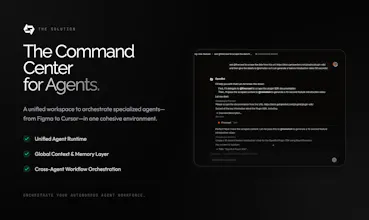
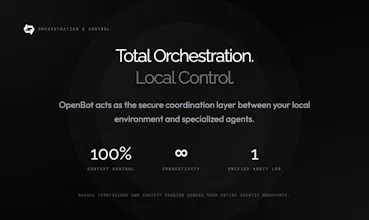
OpenBot is an open-source, local-first runtime that lets you drop diverse agents into a single workspace and orchestrate them using a clean tag-and-channel system. Just tag their capabilities and let OpenBot dynamically route tasks, sync collaborative workflows, and manage persistent threads right in your local file system. Fully modular, completely self-contained, and built for developers and makers who want absolute structural control over their agent fleets.
No reviews yetBe the first to leave a review for OpenBot
Maker
📌
Hey Product Hunt! 👋
I built OpenBot because I kept hitting a massive fragmentation problem when trying to build actual products with multiple AI tools.
Before this, my workflow for building a web app looked like this:
- Use Firecrawl to scrape and research a topic.
- Manually copy-paste that data into Stitch to design the website UI.
- Download the .zip file from Stitch, extract it, and feed it into Claude to generate the React code.
It was a frustrating, manual loop of context-switching and moving files around.
I didn't want one giant mega-agent trying to do everything poorly—I wanted specialized tools to work together smoothly. So I built OpenBot to act as a local workspace that bridges that gap.
Now, you can tag any agent from Claude to Figma (or Stitch) and drop them into a single multi-agent workspace. OpenBot runs locally on your machine, handles the dynamic task routing, and shares the execution context between the agents automatically. We used it to launch our own site with multiple agents handling different parts of the stack, and it completely cut out the friction of passing context back and forth.
Why we didn't just build another MCP client:
Shoving dozens of unrelated tools into a single client breaks down quickly. One agent shouldn't have to handle a massive, messy toolbox across totally different domains. We believe companies should build and manage their own specialized agents—each with its own distinct identity, specific tone, and curated tools. OpenBot isn't a massive toolbox; it's the local workspace where these distinct, company-built agents talk to each other cleanly.
Would love to get your feedback, answer any technical questions, or hear what kinds of agents you're looking to hook up!
Report
🔌 Plugged in
love this guys congrats @giorgi_daraselia 👏web app stack example is perfect. qq how long did it take you to configure OpenBot to handle that specific Firecrawl -> Stitch -> Claude pipeline from scratch?
Report
Maker
@vikramp7470 Thanks a lot! ❤️ That specific pipeline took us around 10–15 minutes to configure from scratch. Most of the time was spent defining the workflow itself rather than connecting the tools. Once everything is set up, it's easy to reuse, modify, or extend with additional agents and tools.
What is the first specific use case you want new users to try and immediately understand the value of OpenBot? What makes OpenBot different than Manus?
The first use case we'd love new users to try is building a simple multi-agent workflow. For example: a research agent gathers information, another agent summarizes it, and a coding or browser agent takes action. It only takes a few minutes to set up, and that's usually the moment people realize the value of coordinating multiple AI agents instead of relying on a single one.
Compared to Manus, our focus is different. OpenBot is designed as an open, extensible multi-agent operating system. You can create custom agents with natural language, connect your own tools and APIs, coordinate multiple agents in one workflow, and even self-host or extend the platform if you want. We're building an ecosystem where users have full flexibility and ownership, rather than a single closed AI assistant.
Report
Maker
@byalexai thanks for your feedback! Much appreciated! I think George already mentioned the use case and I would add that soon we will be launching a cloud based subscription model which will be direct competition with Manus but multi-agent 😁
Btw, Does OpenBot support long-running agents and persistent memory across sessions?
Report
Maker
@barath_kanna_bk Thanks for your interest! Yes, it supports both features. And the good thing is that its completely open-source and highly customizable.
@busmark_w_nika We've been using Claude, Codex, PI, Firecrawl, Remotion, Stitch internally. Would love to see further statistics when people start building workflows/projects using multiple agents
Report
Maker
I'm one of the builders behind OpenBot. We're incredibly excited to launch today after months of work.
OpenBot helps you create specialized AI agents with natural language and coordinate them on tasks like teammates.
Report
Maker
We built OpenBot to solve a real problem we faced with multi-agent workflows: constant context switching between different tools. Our goal was to create a local-first orchestration layer where specialized agents can collaborate seamlessly instead of relying on one giant AI to do everything. Excited to keep building and see where this journey goes!
love this guys congrats @giorgi_daraselia 👏web app stack example is perfect. qq how long did it take you to configure OpenBot to handle that specific Firecrawl -> Stitch -> Claude pipeline from scratch?
@vikramp7470 Thanks a lot! ❤️ That specific pipeline took us around 10–15 minutes to configure from scratch. Most of the time was spent defining the workflow itself rather than connecting the tools. Once everything is set up, it's easy to reuse, modify, or extend with additional agents and tools.
Scarlett.
Congrats on the launch @ddaras @giorgi_daraselia !
What is the first specific use case you want new users to try and immediately understand the value of OpenBot? What makes OpenBot different than Manus?
@byalexai Thanks a lot! 🙌
The first use case we'd love new users to try is building a simple multi-agent workflow. For example: a research agent gathers information, another agent summarizes it, and a coding or browser agent takes action. It only takes a few minutes to set up, and that's usually the moment people realize the value of coordinating multiple AI agents instead of relying on a single one.
Compared to Manus, our focus is different. OpenBot is designed as an open, extensible multi-agent operating system. You can create custom agents with natural language, connect your own tools and APIs, coordinate multiple agents in one workflow, and even self-host or extend the platform if you want. We're building an ecosystem where users have full flexibility and ownership, rather than a single closed AI assistant.
@byalexai thanks for your feedback! Much appreciated! I think George already mentioned the use case and I would add that soon we will be launching a cloud based subscription model which will be direct competition with Manus but multi-agent 😁
Oxlo.ai
Congrats on the launch Guys!!
Btw, Does OpenBot support long-running agents and persistent memory across sessions?
@barath_kanna_bk Thanks for your interest! Yes, it supports both features. And the good thing is that its completely open-source and highly customizable.
minimalist phone: reduce your screentime
Which agent is mostly used?
@busmark_w_nika We've been using Claude, Codex, PI, Firecrawl, Remotion, Stitch internally. Would love to see further statistics when people start building workflows/projects using multiple agents
I'm one of the builders behind OpenBot. We're incredibly excited to launch today after months of work.
OpenBot helps you create specialized AI agents with natural language and coordinate them on tasks like teammates.