
Manuscripts.app
For academics who have outgrown the spreadsheet tracker
66 followers
For academics who have outgrown the spreadsheet tracker
66 followers
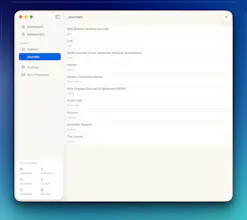
Manuscripts is a Mac app for academics who've outgrown the spreadsheet. Draft, submit, revise, and repeat. Most tools pretend to be project managers or reference managers. Manuscripts does one thing: it tracks where your papers are in the submission journey—which journal, which round, which reviewers' comments triggered which revisions. One-time purchase. No subscription. No cloud. Your data lives on your Mac. Built for how academic work actually feels: slow, iterative, and often unglamorous.



The "outgrown the spreadsheet tracker" insight is universal — academics, founders, and project-finance modelers all hit the same wall: a workbook starts as a tracker and gradually becomes a brittle source of truth that no one trusts. The fix is usually a tool that owns the workflow shape (state machine: drafted, submitted, revised, accepted) instead of a free-form grid. I see the same in finance — we ship valuation and project-finance templates on Eloquens (https://www.eloquens.com/channel/samir-asadov-cfa) precisely because the template encodes the state machine, not just the cells. Question: do you let users define their own status taxonomy or is the journey fixed (drafted → submitted → revised → final)? Different journals have different conditional-revision steps that don't map cleanly to a linear flow.
This is a very specific and very real writing workflow pain. The hard part with academic manuscripts is not only tracking “which draft is current,” it’s remembering why a revision happened and which reviewer/editor constraint it was meant to satisfy.
I like that you’re treating the submission journey as its own object instead of trying to force it into generic project management. Do you find academics mostly struggle with version/control chaos, response-to-reviewer tracking, or just the emotional load of keeping the whole process straight?
What happens after acceptance? Does the workflow just end or is there a post-acceptance phase? Congrats on the launch!
this solves a very real publishing headache. The hard part is often not writing the manuscript, but surviving revisions, formatting rules, reviewer responses, checklists, and resubmission details. how does Manuscripts tracks reviewer concerns across multiple rounds, can it connect each comment to the response letter, manuscript change, and final submission checklist?