
Loomal
Monetize any MCP server in 5 minutes with no % skim.
355 followers
Monetize any MCP server in 5 minutes with no % skim.
355 followers
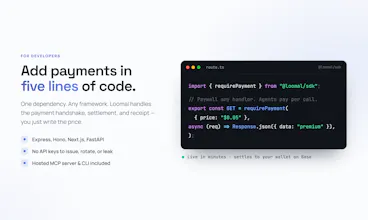
Loomal lets you charge for what you sell online — API calls, tools, digital products, or your whole store. One line of code (or a Shopify/WooCommerce plugin) adds an agent-ready paywall: AI agents pay you in USDC, settled in about 2 seconds, and you keep 100% of your revenue — no percentage cut, ever. Free to start, no card; flat monthly plans as you grow. Every paid listing appears on the Loomal Index, where agents discover and pay. Launch offer: first 500 sellers get 1,000 transactions free.
This is the 2nd launch from Loomal. View more
Loomal
Launching today
Loomal lets you charge for what you sell online — API calls, tools, digital products, or your whole store. One line of code (or a Shopify/WooCommerce plugin) adds an agent-ready paywall: AI agents pay you in USDC, settled in about 2 seconds, and you keep 100% of your revenue — no percentage cut, ever. Free to start, no card; flat monthly plans as you grow. Every paid listing appears on the Loomal Index, where agents discover and pay. Launch offer: first 500 sellers get 1,000 transactions free.




Free Options
Launch Team / Built With


Humalike
Congrats on the launch! What if people optimize to trick agents to buy something? We as humans have decent taste on what's "off" and what's scam, I feel like agents might struggle more than us no?
Loomal
@mcarmonas Agents can be tricked, just differently than humans 😄
Funny thing is, most scams that work on us don't work on agents. Countdown timers, fake urgency, flashy pages — agents don't feel FOMO. They just compare data.
What does work on agents is bad data — fake claims, inflated listings. Our take:
Sellers on the Index are verified, not anonymous
Payments are tiny and per-call — worst case an agent loses cents, not savings
Every transaction is on-chain, so agents can check a seller's real track record before paying
Not fully solved — it's a cat-and-mouse game. But "agent wastes $0.05 on a bad call" beats "human wires savings to a fake broker" 😅
the failed-call refund gap Rajesh mentioned below is one thing, but the scarier version is a hijacked or misconfigured agent making a bunch of legitimate-looking purchases nobody authorized - since USDC settlement is instant and final, is there any dispute window on the seller side, or is "the agent's wallet, the agent's problem" the actual model for now?
Loomal
@galdayan yes, USDC settlement is final — there's no chargeback rail like cards. We're not going to pretend otherwise.
Our model is prevention over dispute, because the dispute layer doesn't exist yet on-chain:
Spend mandates. Every agent wallet operates under a policy — per-transaction caps, daily limits, allowed categories. A hijacked agent can't drain a wallet; it hits the ceiling fast.
Small blast radius by design. Payments are per-call micropayments, not lump sums. "A bunch of unauthorized purchases" on Loomal looks like dollars, not thousands.
Instant revoke. The human can kill a mandate the moment something looks off — the agent's spending power dies immediately, no bank call needed.
So the real answer to "the agent's wallet, the agent's problem?" — it's "the mandate's problem." The human sets the boundaries of what they're willing to lose, upfront, instead of disputing after the fact.
Longer term we think a dispute/escrow layer emerges for bigger-ticket agent purchases. For sub-dollar API calls, the economics of mandates + caps work better than chargebacks ever did — card disputes cost merchants $15+ to process a $0.10 problem.
@oxrajesh the mandate framing clicks - moving the risk decision to setup time instead of dispute time is a much cleaner model than trying to bolt a chargeback system onto micropayments. small blast radius by design is probably the more honest sales pitch too, most fraud prevention is really just capping the downside rather than actually preventing anything
Nas.com
I am wondering how fraud prevention works once thousands of autonomous agents start making purchases simultaneously?
Loomal
What happens when an agent pays for a tool call that fails? Refunds?
Loomal
@himanshi_kum563 Honest answer — no automatic refunds yet. Settlement is instant and final, which is great until a call fails. We're building a credits system that auto-credits failed calls back to the agent's balance — it's in the pipeline, not live yet
That's interesting. Do agents handle failed USDC transactions automatically, or does the seller need to retry?
Loomal
@dhiraj_patel5 The agent handles the retry, not the seller. Loomal returns the failure reason, and the agent can retry automatically for transient issues as long as the spend mandate is still valid. For issues like insufficient balance or an expired mandate, the buyer agent has to resolve it before retrying. The seller should never need to manually re-initiate the charge or risk creating a duplicate payment.
GrowMeOrganic
How difficult was it to make MCP servers agent-ready without forcing developers to redesign their existing APIs?
Loomal
@iamanantgupta The hardest part was making the payment layer sit cleanly around existing MCP tools without changing how they work. Loomal handles the x402 payment handshake, verifies the agent’s authorization, settles the USDC payment, and returns a signed receipt.
That means developers can wrap the MCP server or endpoint they already have, set a price per call, and avoid redesigning their underlying API.
Congrats. The one-line integration is probably what caught my attention first. Adoption usually comes down to reducing setup friction.
Loomal
@himani_sah1 Thank you! That’s exactly what we’re aiming for—making adoption feel effortless. The one-line integration removes the usual setup overhead so teams can start seeing value almost immediately. Really appreciate your support!